
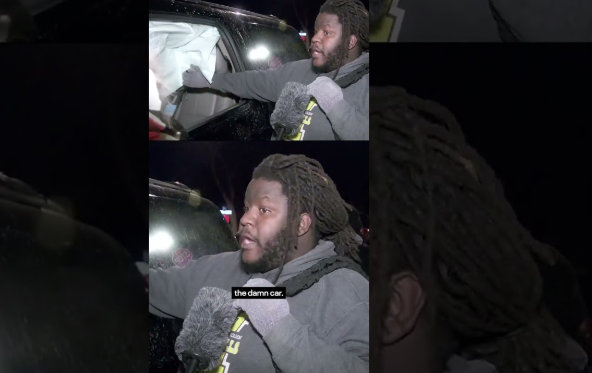

What began as a normal evening for one North Minneapolis family quickly turned into a terrifying experience that sent six children to the hospital. Destiny and Sean Jackson were driving home with their kids after attending their son’s basketball game and making a short stop at a nearby grocery store. Their route was familiar. It was the same way they often took to get back home. But on Wednesday night, the streets were not normal at all.
Jackson family’s normal trip home turns into a night of fear
As Destiny and Sean Jackson drove home with their six children, aged six months to 11 years, they noticed crowds and flashing lights in the distance. The family drove through parts of Minneapolis where protests were happening. They did not realize how close they were. The crowds trapped them before they could react. tried to take another street, but crowds and stopped cars blocked every route.
Their car became trapped between protesters and law enforcement. Suddenly, a flash bang went off near their vehicle, and tear gas filled the air. The blast was so strong that the car’s airbags deployed. Smoke and gas rushed inside, making everyone cough and struggle to breathe.
ICE agent Jonathan Ross faces doxxing attempt by woman after shooting incident in Minnesota
Destiny screamed at her oldest son to get out, but he said he could not breathe. The six-month-old baby was still in the car seat. Strangers helped pull Destiny into a nearby home, but she ran back to her baby, who appeared lifeless with foam around his mouth and tears in his eyes. She began giving him mouth-to-mouth breathing, desperate to save him.
Emergency responders took all six children to the hospital. The chemical irritants had caused breathing problems. The children are now physically okay. The family’s car and belongings were badly damaged. They now face emotional and financial challenges.
What happened during the protests and the use of tear gas
The incident happened during a night of unrest in Minneapolis, where protests and clashes with law enforcement were unfolding after recent tensions involving federal immigration agents. Federal officers, including ICE agents, used crowd‑control tools such as tear gas and flash bangs as part of efforts to manage the situation.
The Jackson family says they were not part of the protest and were simply trying to drive home when their route put them in the middle of the crowd. As tensions rose, law enforcement moved to break up the protests and began deploying chemical irritants. The parents report that a flash bang and tear gas were used near and around their vehicle, causing gas to fill the area around the car.
President Trump defends ICE agent in Renee Nicole shooting and stresses respect for law enforcement
Witnesses described a chaotic scene of loud noises, smoke, and people trying to move away. Caught with no clear way out, the children inside the vehicle began coughing and having trouble breathing.
Emergency services responded and took all six children to the hospital after chemical exposure caused breathing problems. Officials said the tear gas deployment contributed to the children’s distress, and doctors treated and monitored them before releasing them.
While the family says the children are now physically stable, the experience was frightening, and the effects of that night remain with them.
The human cost and the questions being raised
The story of the Jackson family has touched many because it shows how quickly ordinary people can become trapped in dangerous situations. Destiny and Sean Jackson were not part of the protest; they were simply trying to take their children home safely.
Now, they are dealing with both the emotional and practical aftermath. Their car, their main form of transportation, was damaged, and many personal belongings, including school items, remain inside. Replacing or repairing it will be costly.
The emotional toll is harder to measure. Destiny recalls the terror of seeing her baby struggle to breathe, fearing she might lose him. For the older children, the explosions, choking smoke, and chaos are experiences they may not easily forget.
Federal agent shoots man in Minneapolis as anger spreads after last week’s fatal ICE shooting
The incident also raises questions about how crowd-control methods are used and how innocent bystanders can be harmed. Many are asking how a family with young children ended up in such danger and whether it could have been prevented.
Community members are stepping up to help the family recover from the physical, emotional, and financial impact. Destiny and Sean say they are grateful their children are safe, but the night has left a lasting mark.
For the Jacksons, streets that are usually part of daily life became the scene of a frightening ordeal, a reminder that real families can be affected when chaos erupts.