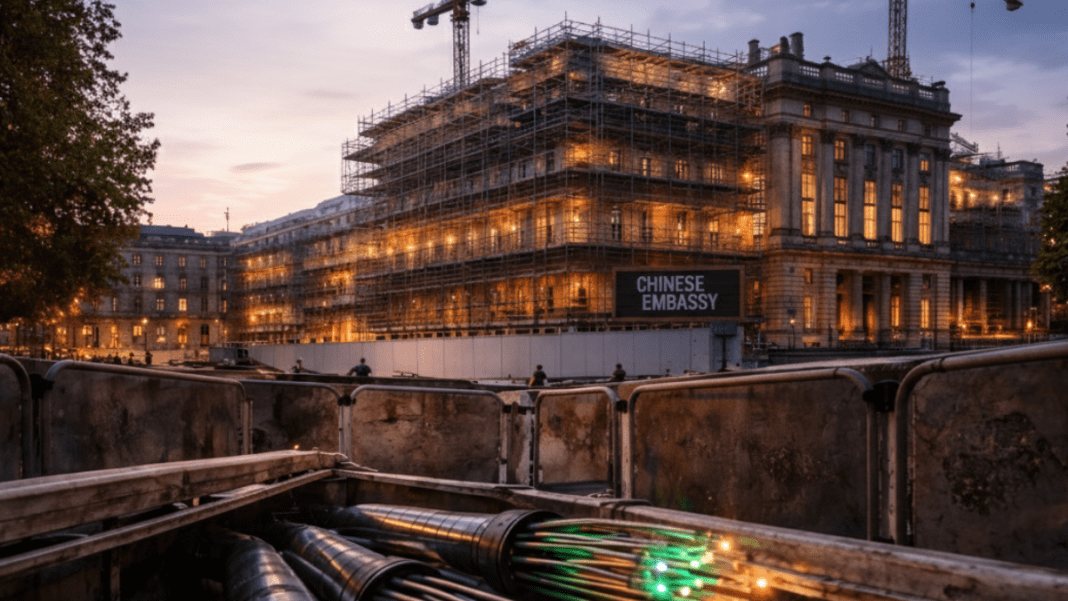
Underground rooms and fiber-optic lines spark UK intelligence concerns over China’s London embassy

More from Author

Newly revealed construction documents have intensified security concerns in the United Kingdom over a planned Chinese embassy in central London. The plans show a concealed underground room placed unusually close to major fiber-optic cables. These cables carry internet and financial data across the country. The proximity has raised fears about risks to critical national infrastructure.

Against this backdrop, the Chinese government plans to build the embassy at the historic Royal Mint site. The project would make it the largest Chinese diplomatic mission in Europe. The proposal has drawn added attention as Prime Minister Keir Starmer prepares to approve the plans. His decision comes ahead of a trip to China to meet President Xi Jinping. This timing has added political sensitivity to what would normally be a routine planning decision.

Embassy design raises red flags over cable proximity

The unredacted blueprints reveal that one underground room would sit just over three feet from key fiber-optic cables. These lines form part of the United Kingdom’s digital framework. They carry heavy internet traffic, business communications, and financial transactions used daily by households and companies.

UK weighs tougher rules on Chinese lobbying — China fires back with threat of diplomatic and economic pushback

However, the British government has said the cables do not carry classified state information. Even so, security specialists argue the cables remain highly sensitive because of their location. For this reason, they warn that the extremely close access shown in the plans could allow monitoring, thereby making the short distance a serious concern.

At the same time, the concealed room appears to include multiple hot-air extraction systems. In general, experts say these systems are used to cool heat-producing equipment. Because of this, the design detail has prompted suggestions that the space may be intended to house powerful computer systems rather than standard office facilities.

Large underground complex deepens security fears

Beyond this, the plans show that the hidden room forms part of a much larger underground structure. According to the documents, more than 200 concealed rooms are planned beneath the embassy. In addition, the layout includes backup generators, sprinkler systems, extensive wiring, and shower facilities.

Taken together, this infrastructure suggests the basement could function independently for long periods. While embassies typically include secure areas and emergency systems, critics argue that the overall scale of this underground network is unusual. As a result, they say it raises questions about the intended purpose of the space.

China warns Netherlands to act responsibly after embassy denies cyberattack allegations

Consequently, the ability to operate below ground with independent power and ventilation has fueled speculation that the complex could support continuous technical or monitoring activity. Given that London serves as a global financial and communications hub, analysts say any large-scale secure facility located near key data routes naturally attracts scrutiny.

Meanwhile, reports indicate that Britain has faced pressure to reassure the United States and other intelligence partners. Specifically, those partners have sought confirmation that the nearby cables do not carry sensitive government traffic. Although officials have reportedly provided assurances, nevertheless, concerns remain over the broader risks linked to commercial and private data flows.

Political debate intensifies as approval for Embassy nears

The embassy proposal has become a point of contention in domestic politics. Alicia Kearns, the shadow national security minister, has strongly opposed the project in its current form. In a statement shared on X, she warned that approving the site could give China a strategic foothold close to the core of Britain’s financial and digital systems.

Supporters of the embassy argue that diplomatic missions require secure facilities and that there is no public evidence of illegal activity. They maintain that engagement with China remains an important part of foreign policy and that authorities retain oversight of construction standards.

Concerns grow over paid anti-China content appearing as public opinion in Japan

Critics, however, say the combination of secrecy, underground scale, and proximity to critical infrastructure sets this project apart. They argue that even the perception of risk could undermine trust in how national systems are protected.

As the approval decision approaches, the proposed embassy at the Royal Mint site continues to attract intense scrutiny, reflecting wider concerns over national security, digital infrastructure, and the limits of diplomatic trust.

- Advertisement -

Trending on Deftechtimes