
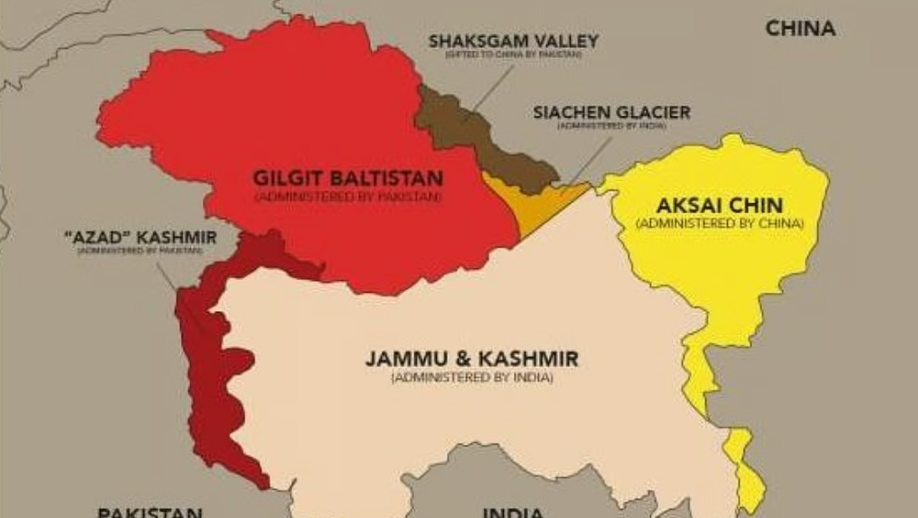

China has once again sparked tensions in South Asia by asserting that India’s Shaksgam Valley belongs to it. The area, currently under Chinese control after being handed over by Pakistan in 1963, is part of the larger Kashmir region that India has long claimed. This recent statement comes amid growing concerns over infrastructure development in the region under the China-Pakistan Economic Corridor (CPEC).
China Defends Its Control Over Shaksgam Valley
At a recent press briefing, Chinese officials stated that Shaksgam Valley is part of China and cited the 1963 boundary agreement with Pakistan as justification. According to China, this agreement allowed Pakistan to transfer the territory to Beijing.
Officials also claimed that infrastructure projects in the area are fully justified since it is Chinese land. They emphasized that initiatives like the China-Pakistan Economic Corridor promote local development and improve the livelihoods of people in the region.
Pentagon sounds alarm as China elevates Arunachal Pradesh to ‘core interest’ status alongside Taiwan
China’s spokesperson reiterated that the 1963 agreement formally delimits the boundary between China and Pakistan. The spokesperson emphasized that the two sovereign countries signed the agreement, giving them the right to carry out any development in the area. This statement comes weeks after China reaffirmed its claim over Arunachal Pradesh, another territory claimed by India.
India Rejects China’s Claims and Calls Agreement Illegal
India has strongly rejected China’s assertion, stating that the 1963 agreement between Pakistan and China is illegal. Indian officials have maintained that Shaksgam Valley, along with the rest of Pakistan-occupied Jammu and Kashmir, is part of India and has been under illegal occupation. India has also made it clear that it does not recognize the China-Pakistan Economic Corridor passing through this territory.
Indian authorities have emphasized that the boundary agreement between China and Pakistan explicitly stated that it would take its final shape only after resolving the broader Kashmir dispute with India.
India-China relations see cautious reset as US tariffs tensions escalate
Article 6 of the 1963 agreement noted that once India and Pakistan reach a settlement on Kashmir, the sovereign authority involved would reopen negotiations with China to formalize the boundary. This means, according to India, Pakistan had no right to hand over Shaksgam Valley to China without India’s consent.
Indian military officials have reiterated that any activity by China in the region is considered illegal under Indian law. They stressed that India does not accept Chinese infrastructure projects or economic initiatives in Shaksgam Valley, which remains Indian territory under occupation.
Historical Context of Shaksgam Valley
Shaksgam Valley has a complex history. The region was initially part of the princely state of Jammu and Kashmir, which was invaded by Pakistan in 1947. During this invasion, Pakistan took control of parts of the region, including Shaksgam Valley. In 1963, Pakistan signed a boundary agreement with China, officially transferring control of the valley to Beijing.
Despite Pakistan’s transfer of the valley, India has consistently maintained that the region is illegally occupied. The Indian government has also clarified that any projects or activities conducted by China in Shaksgam Valley are invalid and do not change India’s claim. The 1963 agreement itself recognized that the countries provisionally agreed on the boundary deal and made it depend on the future resolution of the Kashmir issue, a condition that India insists they have not fulfilled.
Brahmaputra Dispute: 5 Major Risks of India’s and China’s Dam Rivalry
Shaksgam Valley is strategically significant, lying near the Karakoram range and bordering multiple countries. It has also become part of China’s larger infrastructure and economic plans with Pakistan, particularly under the CPEC initiative, which aims to connect western China to Pakistan’s Gwadar port. India, however, continues to reject these projects, describing them as illegal developments on its territory.
In recent months, the spotlight on Shaksgam Valley has intensified as both China and India have maintained firm stances on the territory. China insists it is fully justified in building infrastructure and conducting economic projects in the area, while India calls the agreement that enabled China’s control illegal and invalid.