
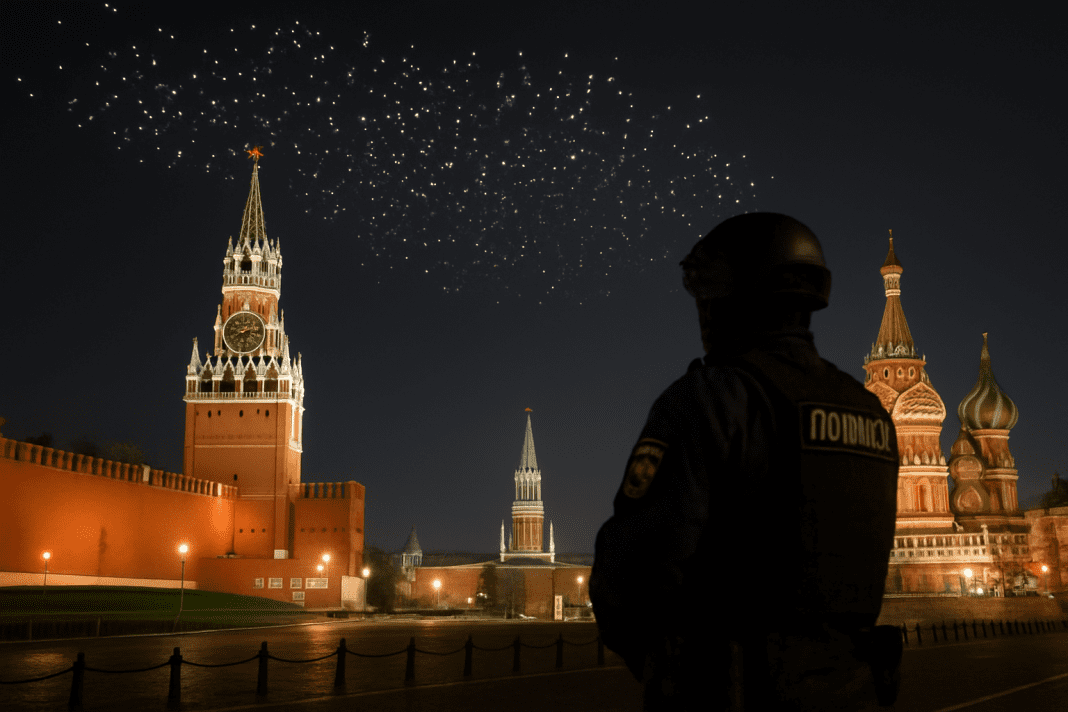

In one of the most audacious long-range operations of the war so far, Ukraine launched a massive drone barrage toward Moscow overnight on December 9–10, forcing Russia’s capital into hours of disruption, triggering widespread air-raid alerts, and grounding flights at all major airports. While Russian officials claimed that all incoming drones were intercepted, the scale of the attack has raised fresh questions about the vulnerability of Moscow’s defenses and the evolution of Ukraine’s asymmetric warfare strategy.
A Night of Repeated Explosions and Warnings
Moscow Mayor Sergey Sobyanin began issuing public alerts late on Dec. 9, announcing successive waves of unmanned aerial vehicles (UAVs) heading toward the capital. According to his statements, Russian air-defense systems intercepted at least 31 drones before they reached central Moscow.
Although no casualties or structural damage were immediately reported, residents in several suburbs said they heard multiple explosions, consistent with mid-air intercepts. Channels on Russia’s Telegram ecosystem, including the well-known Shot, posted footage of flashing lights in the sky and emergency vehicles racing through neighborhoods.
Emergency teams were deployed across southwest and southeast Moscow to collect debris, with several districts cordoning off streets as a precaution. Russia’s Federal Air Transport Agency (Rosaviatsiya) temporarily halted operations at Vnukovo, Sheremetyevo, Domodedovo, and Zhukovsky airports, a rare simultaneous suspension that underscores the seriousness of the perceived threat.
Ukraine’s Silence—and a Strategy That’s Getting Sharper
As is typical for such operations, Kyiv did not immediately claim responsibility for the swarm. However, Ukrainian military doctrine has increasingly emphasized long-range, low-cost drone strikes designed to disrupt Russia’s logistics, degrade military infrastructure, and stretch air-defense assets thin.
Over the past year, Ukraine has demonstrated the capability to hit refineries deep inside Russia, including sites in Tatarstan, as well as weapons manufacturing plants hundreds of kilometers from Ukrainian territory. The previous large-scale attack on Moscow occurred on October 27, when over 30 drones reportedly targeted the capital as part of a coordinated strike.
By targeting Moscow—Russia’s political nerve center—Ukraine aims to send a dual message: Russian territory is no longer untouchable, and the Kremlin cannot guarantee security even in its most heavily defended airspace.
A Russian Capital on Edge
Though Russian officials insist there was no damage, the psychological effect of repeated nighttime alarms in Moscow is unmistakable. Drone attacks, even when intercepted, break the narrative of wartime normalcy that the Kremlin has attempted to cultivate.
Residents took to social media platforms to describe the eerie escalation:
-
“This was the closest we’ve heard explosions since the war began,” wrote one Moscow resident.
-
Others described the city’s usually bright nighttime skyline punctuated by flashing intercepts and fast-moving defense systems.
The temporary closure of all four major airports added to public anxiety. Aviation observers note that shutting down such high-traffic hubs, even briefly, carries significant economic and logistical consequences—impacting both domestic travel and Russia’s international connections.
Ukraine slams Kremlin’s map: ‘Pokrovsk is not fallen’ — fierce battles rage street-by-street
A Battle for the Future of Air Defense
Military analysts say that drone swarms are rapidly becoming one of the defining features of modern warfare. Unlike ballistic or cruise missiles, drones can be launched cheaply and in large numbers, overwhelming even the most advanced defense systems by forcing them to expend disproportionately expensive interceptors.
For Russia, the challenge is compounded by the sheer size of the territory it must defend. Protecting the capital alone requires a multi-layered system of radars, anti-aircraft missiles, jammers, and rapid-response units. Even if all drones are shot down, the cost of stopping them—and the strain on the system—is immense.
“These attacks reveal not just range, but adaptability,” said one European defense expert. “Ukraine is testing Russia’s defenses in waves, mapping vulnerabilities, and forcing constant recalibration.”
Moscow vs. the Drone Age
The latest incident marks yet another chapter in the growing list of drone-related escalations hitting Moscow. What was once unthinkable—attacks reaching the capital—has now become a recurring event.
While Russia will likely emphasize that all drones were destroyed, the larger reality remains: the skies over Moscow are no longer guaranteed safe, and Ukraine is increasingly willing to project military pressure far beyond the front lines.
As both sides race toward more advanced drone technology, the war is entering a new phase—one where the battle is not only on the ground or at sea but miles above the cities that symbolize national power.