
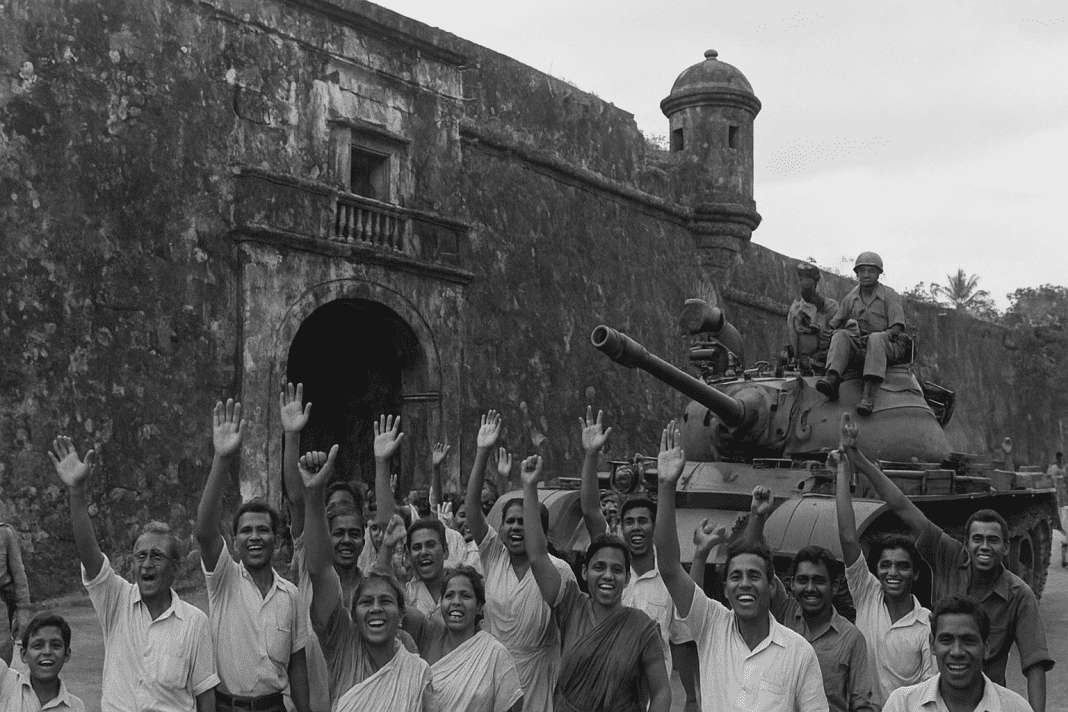

It has been over sixty years since India reclaimed Goa from Portuguese rule, yet the story of what truly happened behind the scenes remains largely unknown. While most people remember the military operation, few are aware of the crucial role international politics played, especially the support India received from the Soviet Union at the United Nations. This support proved decisive in safeguarding India’s action and shaping the course of history.
Goa Under Portuguese Rule and India’s Struggle
Goa had been under Portuguese control for more than four centuries. Portuguese explorers first arrived in India in the early 1500s, and by 1510, Portugal had established a stronghold in Goa. Over the years, the region became a center of trade, culture, and administration. Portuguese settlers intermarried with local communities, creating a unique Eurasian population, and Goa flourished as an important outpost of Portugal in Asia.
After India gained independence in 1947, it was widely expected that remaining European colonial powers would leave the subcontinent quickly. Britain did so almost immediately, and France eventually handed over its smaller territories. Portugal, however, refused to give up Goa, Daman, and Diu, claiming that the local population, especially Catholics, would face danger. This reasoning ignored the fact that Hindus formed the majority of the population and that millions of Catholics lived peacefully elsewhere in India.
Throughout the 1950s, tensions between India and Portugal steadily increased. Indian volunteers carried out peaceful protests and satyagrahas, entering Goa to demand liberation, but Portuguese forces responded with violence. Several protesters were killed, and incidents of brutality fueled resentment. India tried economic measures, including blockades, to pressure Portugal, but these had limited impact. Portugal, confident in support from Western allies, believed India would back down.
By December 1961, India’s patience had run out. The government launched a military operation to liberate Goa, Daman, and Diu. Resistance from Portuguese forces was minimal. Within two days, the Governor-General of Goa surrendered, ending over 450 years of colonial rule. While the operation itself was short, its repercussions on the international stage were significant.
Western Backlash and United Nations Pressure
News of India’s military action caused an immediate stir in Western countries. Many governments criticized India for using force, claiming it went against the country’s commitment to non-violence. Nations including the United States, the United Kingdom, France, Canada, Australia, and others pushed for a United Nations resolution demanding that India withdraw its troops and restore Portuguese control.
The situation at the UN became tense. If the resolution passed, India could have faced international isolation, which might have forced it to undo its military success in Goa. For a newly independent nation still finding its place on the world stage, this was a moment of high stakes. The pressure from Western powers threatened to overshadow India’s successful operation, creating a potential diplomatic crisis.
Soviet Support and the Turning Point in Goa
At this critical moment, the Soviet Union intervened. Using its veto power at the United Nations, the USSR blocked the resolution that would have forced India to reverse its victory. The Soviet representative publicly criticized Western countries for applying “double standards” in international affairs and highlighted historical colonial injustices. Moscow also emphasized that Goa naturally belonged to India due to its history, culture, and geography.
This support gave India the confidence to maintain its actions without fear of international retaliation. The UN could not impose any binding resolution against India, allowing the country to consolidate control over Goa. The diplomatic pressure gradually eased, and India’s military success was solidified.
India moves to restrict Bay of Bengal air and sea traffic under NOTAM amid possible missile trial
Portugal formally recognized Goa as part of India only years later, in the mid-1970s, after the fall of its dictatorship. By then, India had firmly established its sovereignty over the territory. The Soviet Union’s timely support at the UN remained a decisive but often overlooked moment in India’s post-independence history.
The liberation of Goa was more than a military operation. It was also a story of international politics, strategic alliances, and timely intervention that ensured India’s victory remained secure. While the operation itself is widely remembered, the role played by Moscow in the United Nations is a largely forgotten chapter that helped shape India’s destiny.