


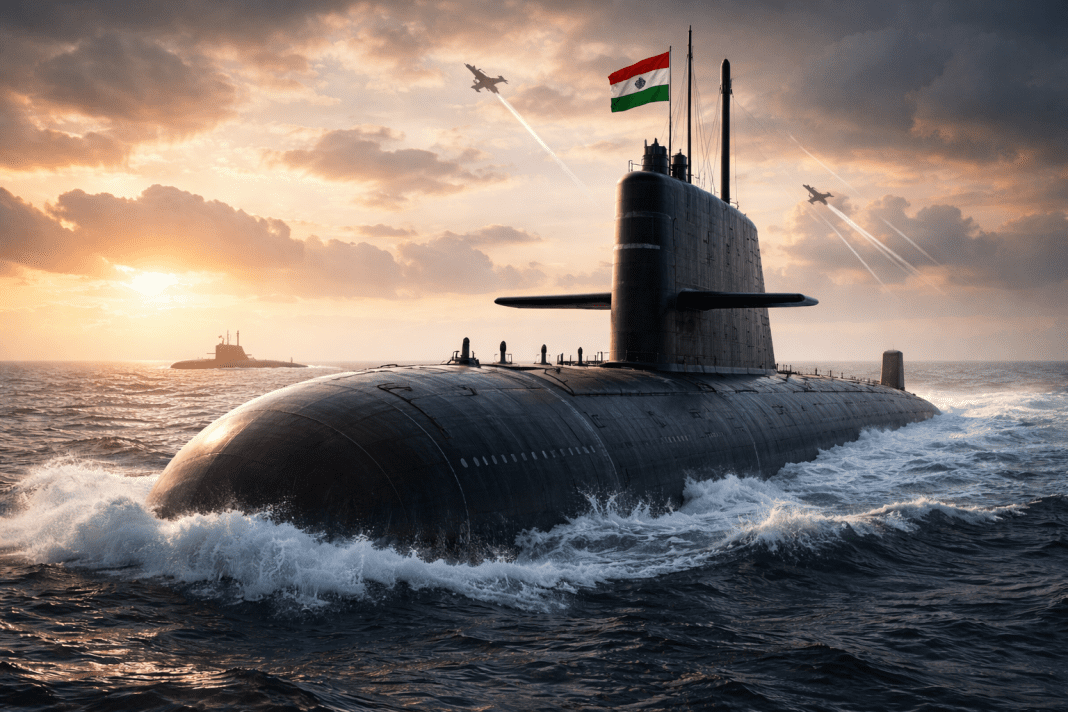


India has quietly inducted INS Aridhaman, its third nuclear-powered ballistic missile submarine, marking a key step in strengthening its nuclear deterrence. Part of a growing fleet of advanced submarines, it enhances India’s ability to respond effectively to potential nuclear threats while maintaining strategic stability.
Strengthening India’s Nuclear Deterrence at Sea with INS Aridhaman
The commissioning of INS Aridhaman strengthens India’s position as a nuclear-capable nation with a strong sea-based deterrent. It joins INS Arihant and INS Arighaat as part of India’s underwater defence system. These submarines support a strategy called Continuous At Sea Deterrence (CASD), where at least one nuclear-armed submarine stays hidden in the ocean at all times, ensuring the country can respond even after a surprise attack.
India follows a no-first-use nuclear policy, meaning it will only use nuclear weapons in retaliation. This makes a reliable second-strike capability essential. Submarines like INS Aridhaman provide this advantage by remaining undetected underwater for long periods.
India to add five more S-400 missile systems and strike drones in major defence boost
Their stealth is their greatest strength. Unlike land-based systems or aircraft, they are extremely difficult to track or target. This makes them one of the most secure and dependable parts of India’s nuclear defence, helping maintain strategic balance and national security.
Understanding How SSBN Submarines Work
INS Aridhaman belongs to a special class of submarines known as SSBNs, or Ship Submersible Ballistic Nuclear submarines. These are not ordinary submarines. They are designed specifically to carry and launch ballistic missiles equipped with nuclear warheads.
One of the key features of an SSBN is its nuclear-powered engine. Unlike diesel-electric submarines, which need to surface regularly for air, nuclear submarines can stay underwater for long periods. This is because their nuclear reactor provides a continuous source of energy.
This ability to remain submerged for extended durations increases their stealth and operational reach. In simple terms, they can travel long distances without being detected and stay hidden for weeks or even months. The only limitations are the crew’s endurance and the amount of food onboard.
India weighs Israeli ‘Golden Horizon’ missile with 2,000 km range for deep-strike capability
SSBNs are not meant for direct combat like other naval vessels. Their main purpose is to act as a hidden deterrent. They stay silent and invisible, carrying powerful missiles that can be launched if the country faces a serious threat.
Building such submarines is extremely complex. It involves advanced engineering, especially in designing a safe and efficient nuclear reactor that can operate under high pressure deep underwater. The successful development of INS Aridhaman shows India’s growing expertise in this challenging field.
Expanding India’s Underwater Strategic Capabilities
The addition of INS Aridhaman marks steady progress in India’s indigenous submarine program, which has been developed over several decades with a strong focus on secrecy, precision, and advanced engineering. As the third nuclear-powered ballistic missile submarine in the fleet, it strengthens India’s underwater defence capabilities and reinforces its growing strategic presence at sea.
Defence experts point out that to maintain an effective Continuous At Sea Deterrence posture, a country ideally needs at least four operational submarines. This is necessary because submarines regularly undergo maintenance and may sometimes be unavailable due to technical or operational issues. A larger fleet ensures that at least one submarine remains deployed at all times, maintaining a constant deterrent presence.
India allows Iranian Navy ship IRIS Lavan to dock in Kochi amid rising Middle East tensions
Past instances of submarine unavailability have highlighted the importance of expanding the fleet. INS Aridhaman helps reduce this gap and improves overall operational readiness. At the same time, India has invested in dedicated infrastructure, including a specialised base on the eastern coast to securely house and maintain nuclear submarines.
This development reflects a broader shift in India’s defence preparedness, focusing on building a credible and survivable nuclear deterrent. It also underlines the importance of self-reliance in defence technology, reducing dependence on foreign systems while enhancing long-term national security.