
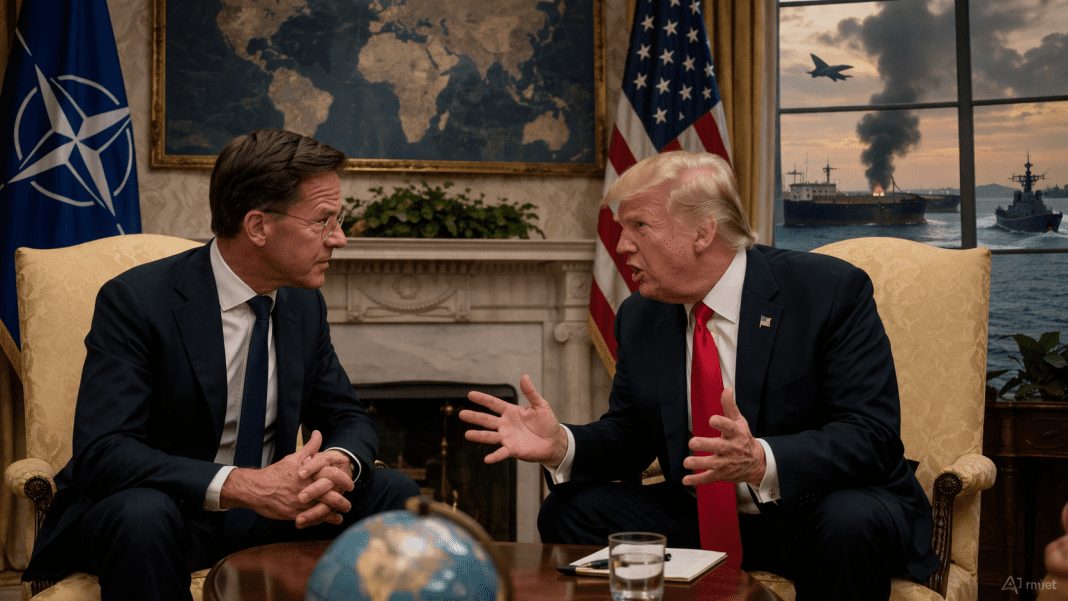

A private White House meeting drew global attention. It was between US President Donald Trump and NATO Secretary-General Mark Rutte. Reports described tense exchanges during the talks. The discussion reportedly focused on the Iran conflict. It also touched on divisions within NATO. Officials later played down the reported disagreements.
Background to the Closed-Door White House Meeting with Mark Rutte
A private meeting between US President Donald Trump and NATO Secretary-General Mark Rutte at the White House has drawn global attention after reports described it as a tense and emotional exchange. Officials held the talks behind closed doors in Washington, D.C., during Rutte’s scheduled visit as part of ongoing diplomatic engagement with NATO.
They planned the meeting to focus on international security, coordination among NATO members, and the ongoing conflict involving Iran. However, officials said the discussion quickly became more intense, as Trump criticised NATO allies for what he sees as weak support for US-led military actions in the Middle East.
Trump slams NATO as paper tiger while re upping Greenland and Pituffik base annexation demands
The situation unfolded during a fragile 14-day ceasefire linked to the Iran-Israel conflict and wider regional instability. It also connects to US operations referred to as “Operation Epic Fury,” with Trump expressing frustration at countries like Spain and France for not fully backing Washington during the crisis.
Inside the ‘Venting Session’ and Key Disputes
Reports from European officials and people familiar with the meeting described the closed-door talks between US President Donald Trump and NATO Secretary-General Mark Rutte as a “venting session.” They said Trump openly expressed frustration during the White House discussion and used strong language while criticising NATO allies for not fully supporting US actions linked to the conflict involving Iran.
Officials said Trump repeatedly complained about what he sees as Europe’s reluctance to cooperate with Washington. A key point of tension was the level of NATO involvement in the crisis and how member countries were responding to US expectations during the ongoing military and diplomatic pressure in the region.
Germany rejects Trump’s call for NATO to secure the Strait of Hormuz
A major focus of disagreement was the Strait of Hormuz, a vital global shipping route through which nearly 20% of the world’s oil passes. The waterway has become a flashpoint as Iran has been accused of restricting access in response to the conflict, raising concerns about global energy security and trade disruptions.
Sources said Trump pushed allies to take faster and stronger steps to help reopen the Strait of Hormuz and showed frustration with countries not supporting US demands. While some described the discussion as highly heated, other officials clarified that no formal decisions were made and no NATO policies were changed during the meeting.
NATO Response, Iran Tensions, and Strait of Hormuz Crisis
After the meeting between US President Donald Trump and NATO Secretary-General Mark Rutte, the White House offered a different account of events. A spokesperson said Trump made “no demands” on NATO and did not request any specific actions during the conversation. The statement also stressed that the President did not issue instructions to the alliance.
The White House further said Trump believes NATO allies benefit more from the Strait of Hormuz than the United States. It added that the discussion did not involve formal requests or pressure on member states, despite earlier reports suggesting tensions during the talks in Washington, D.C.
Donald Trump is questioning the future of NATO after a lack of support in Iran
NATO also responded publicly. Spokesperson Allison Hart described the meeting as a “very frank conversation,” meaning both sides spoke openly. She rejected claims that the talks went badly and called them “constructive.” Mark Rutte later said he sensed Trump’s disappointment, noting concerns about limited allied support during the ongoing crisis.
The wider geopolitical situation remains tense due to the Iran-related conflict and instability around the Strait of Hormuz, a key global oil route. Countries including Spain and Italy have taken different positions on US operations, while a UK-led group of 41 nations backed sanctions but avoided military involvement. These divisions highlight ongoing differences within NATO over how to respond to the crisis.