


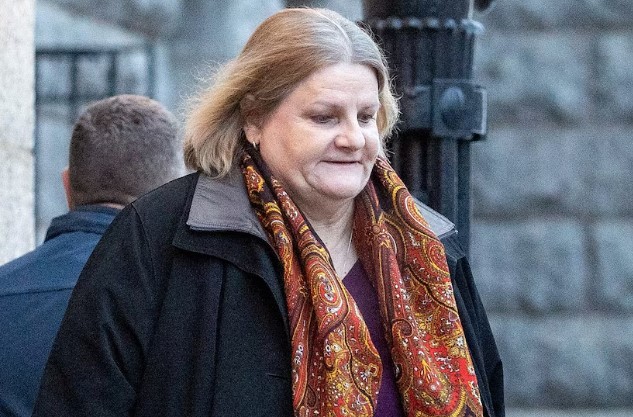


A federal jury has convicted Wisconsin Milwaukee County Judge Hannah Dugan of a felony for obstructing federal immigration authorities, a rare case involving a sitting judge and ICE enforcement. While she was acquitted of a lesser misdemeanor charge, the conviction could lead to prison time and bars her from continuing as a judge, drawing national attention amid the Trump administration’s tough stance on officials who challenge its policies.
Wisconsin jury finds judge guilty of obstructing federal agents
Judge Hannah Dugan, 66, has served on the Milwaukee County bench since her election in 2016. Prosecutors said she deliberately interfered with FBI and U.S. Immigration and Customs Enforcement agents who were trying to arrest an undocumented immigrant at the county courthouse.
After deliberations, the jury agreed that Dugan obstructed an official proceeding, a felony that carries a possible prison sentence of up to five years. Jurors, however, acquitted her of a misdemeanor charge, indicating they did not fully accept all of the prosecution’s claims.
ICE data shows how Chicago raids led to arrests and transfers of 1,600 people nationwide
Under Wisconsin’s constitution, a felony conviction bars a person from holding public office, meaning Dugan can no longer serve as a judge. In April, the Wisconsin Supreme Court had already suspended her from the bench while the charges were pending.
During closing arguments, Assistant U.S. Attorney Kelly Brown Watzka said Dugan acted out of frustration and chose to take matters into her own hands instead of following the law. Prosecutors argued her actions were intentional and aimed at delaying or preventing a lawful arrest.
Dugan’s defense rejected that view. Her lawyer, Jason Luczak, told jurors that uncertainty marked the case and said the judge was trying to navigate unclear rules about immigration arrests in courthouses. Despite those arguments, the jury concluded her actions crossed a legal boundary.
What happened inside a Wisconsin courthouse that led to the charges
The incident at the center of the case occurred in April at the Milwaukee County courthouse, when FBI and ICE agents arrived to arrest Eduardo Flores Ruiz, a Mexican national whom authorities say the United States deported in 2013 and who later returned illegally.
Flores Ruiz was appearing in Judge Hannah Dugan’s courtroom on misdemeanor battery charges. Federal agents waited in the hallway outside the courtroom, planning to arrest him after the hearing. Prosecutors said that when Dugan learned of the agents’ presence, she confronted them and sent them to the office of the county’s chief judge, temporarily clearing the area outside her courtroom.
While the agents were away, Dugan postponed the hearing and personally escorted Flores Ruiz and his attorney out through a back door. The exit led to a short private hallway that connected to a public corridor.
USCIS reveals 275 cases of suspected immigration fraud in Minnesota operation
Trial testimony showed that Flores Ruiz emerged into the public hallway only a short distance from where agents had been waiting. An agent spotted him, followed him, and alerted others. Federal officers then chased and arrested Flores Ruiz outside the courthouse. He was later deported in November.
Prosecutors also played an audio recording in which Dugan discussed using the back door and said, “I’ll do it. I’ll get the heat.” They argued this showed she understood the risks of her actions but chose to proceed anyway.
Political reaction and broader debate
The prosecution and conviction of Judge Hannah Dugan have sparked intense political debate across the country, as judges rarely face charges for actions tied to their courtroom duties. Supporters of Dugan, including critics of the Trump administration, described the case as political and retaliatory, arguing that officials brought it to intimidate judges and others who question federal immigration enforcement.
Supporters of the administration disagreed, saying the case showed that judges are not above the law. They accused Dugan of placing personal beliefs ahead of her legal responsibilities and described her actions as part of broader resistance within government institutions to enforcing immigration laws.
The Trump administration emphasized the case from the start. FBI Director Kash Patel publicly announced Dugan’s arrest on social media and later shared a photo of her in handcuffs. Attorney General Pam Bondi also promoted the case in television interviews, accusing Dugan of protecting a criminal defendant over victims of crime.
The verdict comes as the administration has faced difficulties in other high-profile cases against critics, including former FBI Director James B. Comey and New York Attorney General Letitia James, whose cases were dismissed by courts but later challenged by the Justice Department.
Ilhan Omar warns Somali Americans are being singled out after ICE stop involving her son
Testimony during the trial highlighted uncertainty within the judiciary. Milwaukee County Judge Laura Gramling Perez said there was no clear policy on immigration arrests in courthouses. Former Milwaukee Mayor Tom Barrett testified in Dugan’s defense, praising her honesty.
Unlike a similar case in Massachusetts during Trump’s first term, which ended with dropped charges, the Wisconsin verdict stands, making Dugan’s conviction a rare legal outcome.