


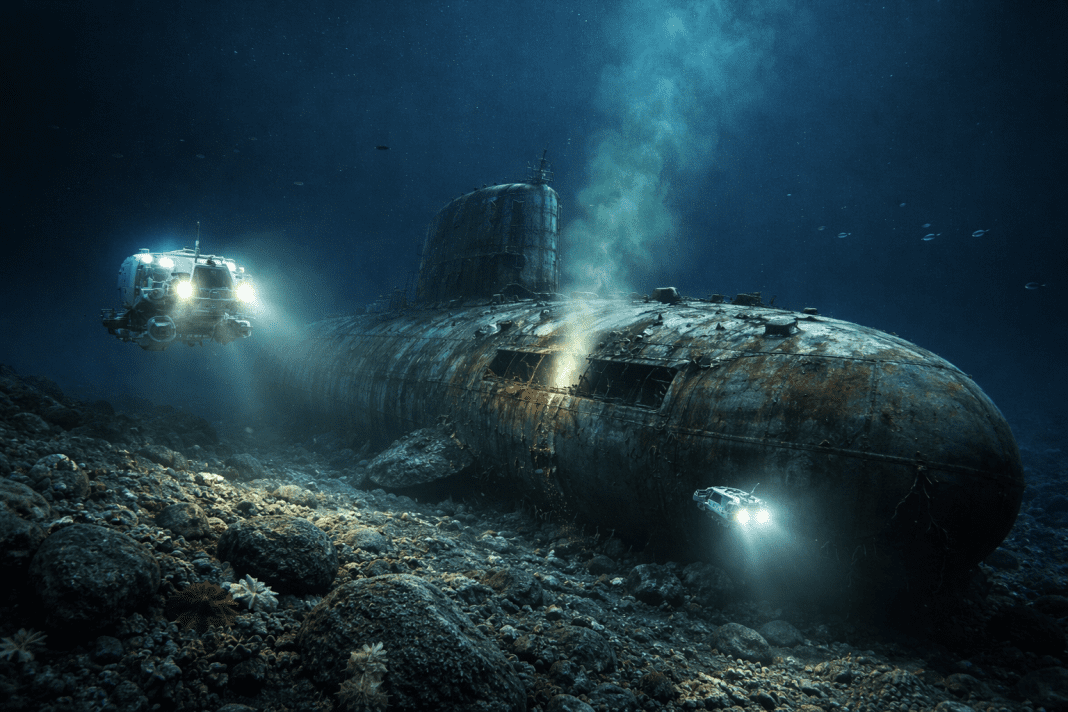


A Cold War-era submarine rests deep in the Norwegian Sea. It has drawn attention due to reports of radioactive leakage. The Soviet submarine K-278 Komsomolets sank in 1989. Scientists are closely monitoring the site. They say the situation remains controlled and limited in impact.
What Lies Beneath the Norwegian Sea
Deep beneath the icy waters of the Norwegian Sea, a Cold War-era nuclear submarine rests silently on the seabed. The vessel, Soviet submarine K-278 Komsomolets, sank in 1989 after a fire broke out onboard. Today, it lies at a depth of about 1,700 metres, or nearly 5,500 feet below the ocean surface.
At first, the idea of a leaking nuclear submarine may sound alarming and dangerous. However, scientists who have studied the site over many years say the situation is more controlled than it appears. The wreck has been examined several times using remotely operated underwater robots, which help researchers observe the submarine closely without disturbing the surrounding environment.
British nuclear submarine HMS Anson moves into strike range of Iran amid widening Middle East war
Recent studies confirm that small amounts of radioactive material are leaking from parts of the submarine, mainly from a ventilation duct. Samples taken near the source show higher levels of Caesium-137 compared to normal seawater. However, these findings are not new and match results from earlier investigations, showing a consistent pattern over time.
Why Radiation Levels Are Not Alarming
While the presence of radioactive leakage might sound dangerous, the actual risk is far lower than many would expect. Scientists have found that the radiation is highly localised, meaning it is mostly limited to the immediate area around the leak. Measurements show that even a short distance away from the source, radiation levels drop sharply, and within a few feet, the water returns to near-normal conditions. This sharp decline plays a key role in reducing the overall impact.
Another important factor is the sheer size of the Norwegian Sea. The vast volume of water helps dilute any radioactive material that escapes. This natural dilution reduces the concentration of harmful substances very quickly, preventing them from building up in one place.
Undersea power shift as China overtakes US in nuclear submarine launches
Long-term monitoring has also shown that radiation levels in the wider surrounding area have not increased. This indicates that the leakage is not spreading across large distances or affecting broader marine ecosystems. Experts have also noted that the levels detected, even at the source, fall within ranges that can be managed and studied safely.
The situation is not new, and similar findings have been recorded during earlier visits to the site, making current observations consistent with past data. Because of these factors, scientists do not consider the situation to be an immediate environmental threat and instead view it as a controlled and well-understood phenomenon.
Continuous Monitoring and Safety Measures
The submarine itself was built with multiple layers of safety. Nuclear reactors inside such vessels are designed to be sealed and protected by strong containment systems. Even after decades underwater, these barriers still play a role in limiting the spread of radioactive material. The outer hull of the submarine acts as an additional shield, and although parts of the structure have degraded over time, much of the radioactive content remains contained within the wreck.
Scientists continue to monitor the site carefully. Regular inspections help track any changes in radiation levels or structural conditions. This ongoing surveillance ensures that even small shifts in the situation are quickly detected, allowing researchers to respond quickly if needed.
Britain nuclear submarine base sees breach surge as UK MoD reviews security at HMNB Clyde
Advanced technology, including underwater robots and specialised sensors, allows researchers to gather accurate data without risking human safety. These tools have become essential in studying deep-sea environments like this one. So far, decades of observation have not shown any major environmental damage linked to the submarine.
Marine life in the surrounding areas continues to exist without noticeable disruption from the leakage. Authorities and researchers treat the site as an important long-term study area, offering valuable insights into how radioactive materials behave in deep-sea conditions. Despite the presence of radioactive leakage, the situation remains stable, with limited spread and continuous monitoring in place.