


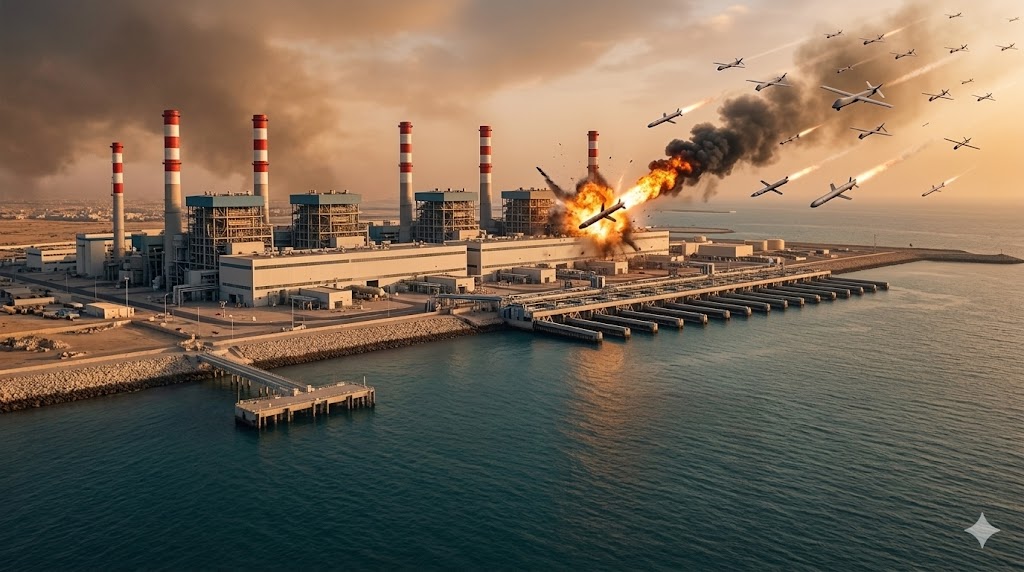


The Iranian drone strike on Bahrain’s water desalination plant this Sunday marks more than just another episode in the nine-day conflict engulfing the Gulf region. It represents a fundamental transformation in how modern warfare targets the most vulnerable pillars of human survival—and raises urgent questions about the future of civilian infrastructure in an era of precision weaponry.
The Invisible Battlefield: Why Water Matters
When we discuss military targets, we typically envision airbases, weapons depots, or command centers. But the attacks on desalination plants in both Bahrain and Iran reveal a darker calculus: in the Gulf’s hyper-arid environment, controlling water isn’t just strategic—it’s existential.
Bahrain generates the majority of its drinking water from desalination plants. Iran’s Qeshm Island facility supplied 30 villages before the U.S. strike. These aren’t merely infrastructure—they’re lifelines. A single successful attack doesn’t just damage machinery; it threatens the daily survival of thousands of civilians who have no alternative water sources.
This creates a chilling new dynamic: water infrastructure has become both shield and sword, a justification for retaliation and a target itself. Iran’s Foreign Minister Abbas Araghchi explicitly framed Bahrain’s plant as retribution for the American strike on Qeshm, establishing what amounts to a doctrine of “eye for an eye” applied to civilian utilities.
U.S. Navy conducts rare submarine torpedo strike against Iranian warship in international waters
The Precedent Problem: Who Started It?
Iran claims the United States “set this precedent” by striking first. The U.S. and its allies would undoubtedly contest this narrative. But regardless of who initiated this particular tactic, a dangerous threshold has been crossed.
Once desalination plants become legitimate targets in the minds of military planners, a Pandora’s box opens. The Gulf states collectively operate approximately 400 such facilities, producing 40% of the world’s desalinated water. If these installations are now considered fair game, the entire region’s civilian population becomes inherently vulnerable in any future conflict.
This shift matters because it creates a template. Today it’s desalination plants in the Gulf. Tomorrow, could it be water treatment facilities in other conflict zones? Electrical grids? Agricultural systems? The normalization of targeting life-sustaining infrastructure sets a precedent that extends far beyond this particular war.
The Geography of Vulnerability
The Gulf states face a unique geographic curse: they’re among the most water-scarce regions on Earth, yet they host some of the world’s most valuable energy infrastructure and strategic military installations. This creates an impossible triangle of dependencies.
Kuwait, Bahrain, UAE, Qatar, and Saudi Arabia all host American military facilities. All depend heavily on desalination for drinking water. All sit within easy striking distance of Iranian drones and missiles. When President Masoud Pezeshkian warned that Iran would be “forced to respond” if their territory is used to attack Iran, he wasn’t making an idle threat—he was describing the geometric reality of the Gulf’s military geography.
These countries now face an excruciating dilemma: maintain strategic partnerships that provide security guarantees, or risk becoming collateral damage when those partnerships draw retaliatory strikes. The falling missile debris that injured three people in Muharraq, the fuel tank fires at Kuwait’s airport, the damaged university building—these are the physical manifestations of that impossible choice.
The Apology That Wasn’t
Perhaps most revealing was the diplomatic whiplash surrounding President Pezeshkian’s statements. On Saturday, he apologized to neighboring countries for attacks on their territory. By Sunday, state TV reported his remarks had been “misinterpreted,” and the strikes continued unabated.
This reversal illuminates the political pressures within Iran itself. Pezeshkian’s initial apology suggested recognition that attacking Gulf neighbors risks isolating Iran diplomatically and economically at precisely the moment it needs regional relationships most. The swift walk-back indicates hardline elements—likely within the Islamic Revolutionary Guard Corps—won’t accept any appearance of weakness or restraint.
This internal Iranian dynamic may be the most dangerous factor of all. If civilian casualties and infrastructure damage in Gulf states continue while Iran simultaneously claims it doesn’t want conflict with its neighbors, it suggests policy incoherence at best, or competing power centers with different objectives at worst.
What Comes Next?
Nine days into this conflict, patterns are emerging that should concern far more than just the immediate combatants:
First, the civilianization of warfare continues. When water plants, airports, and universities become impact zones, the distinction between military and civilian targets blurs to meaninglessness.
Second, the escalation ladder has more rungs than anyone wants to climb. Each retaliatory strike establishes a new baseline of acceptable targeting, ratcheting upward the potential for catastrophic miscalculation.
Third, the Gulf’s geographic and resource constraints create a pressure cooker environment where small-scale attacks carry outsize humanitarian consequences. Three injuries and one damaged plant in a water-rich region would be concerning; in Bahrain, it’s potentially catastrophic.
The international community’s response will determine whether targeting desalination plants becomes normalized or remains an outlier. If this tactic goes unanswered or unpunished, future conflicts in water-scarce regions from North Africa to Central Asia may witness similar attacks.
The question isn’t just about stopping this particular war—it’s about preventing the weaponization of water from becoming the 21st century’s most destructive innovation in warfare. Because in a world where climate change is already straining water resources, deliberately destroying the infrastructure that keeps people alive crosses a line that, once normalized, may be impossible to redraw.