


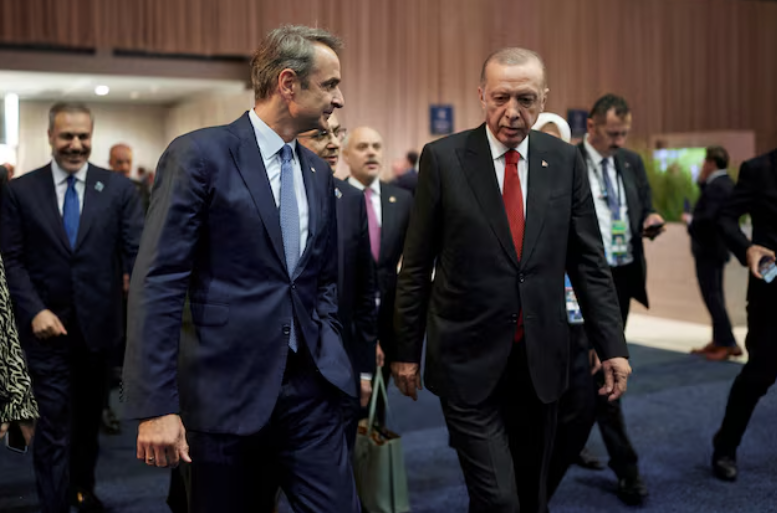


Tensions between Turkey and Greece remain high as the two neighbors prepare for talks to ease long-standing disputes. A looming war threat continues to cast a shadow. The conflict affects not just the Aegean Sea but also Europe’s defence and political cooperation. At the heart of the dispute is disagreement over sea boundaries and security. Both sides are balancing dialogue against distrust and domestic political costs.
Greece and Turkey: A Fragile Meeting Under the Weight of Old Disputes
The leaders of Turkey and Greece are meeting in Ankara to ease long-standing tensions. The talks will focus mainly on practical issues like migration and daily cooperation, while sensitive topics such as borders and defence are being set aside for now.
However, a major unresolved issue looms over the discussions: Turkey has declared it would consider war if Greece expands its territorial waters in the Aegean Sea. Greece currently claims six nautical miles and says it has the right under international law to extend this to 12. Turkey objects strongly, arguing that such an expansion would restrict its access to open seas and threaten its naval security. It has formally labeled the move a “casus belli,” or cause for war.
Greece integrates Centauros with Barak MX to curb low cost drone threats and reduce missile costs
This threat is more than a regional problem. It blocks Turkey’s deeper cooperation with the European Union, particularly in defence projects. Greece has made it clear that as long as the threat exists, it will oppose Turkey’s participation in EU defence initiatives.
Europe, defence cooperation, and the limits of compromise
The disagreement between Turkey and Greece is affecting Europe’s broader defence and security plans. The European Union has been working on new programmes to strengthen joint security, and Turkey, as a key regional military power, wants to participate.
Greece has blocked Turkey’s involvement, citing the ongoing war threat. Athens argues that cooperating with a country that openly threatens an EU member would violate trust, sovereignty, and international law. European officials have stressed that respecting EU member states and international rules is essential for progress.
Russia’s S-400 turns into Turkey’s headache—airpower crisis mounts as F-35 ban persists
Some voices in Turkey suggest the Aegean dispute could be resolved with political will from both sides. Senior officials have hinted that compromise is possible, signaling a willingness to engage in dialogue.
Any agreement, however, carries political risks. Public opinion in both countries is highly sensitive to issues of sovereignty and national pride. Leaders must consider how a compromise would be perceived at home, where accusations of weakness or betrayal could carry serious consequences.
Regional pressure and growing diplomatic complexity
Tensions between Turkey and Greece are closely tied to wider developments in the Eastern Mediterranean and the Middle East. Issues such as energy resources, security cooperation, and regional alliances all influence the relationship and add pressure to already fragile ties.
Greece and Cyprus have recently deepened cooperation with Israel through renewed trilateral talks. These discussions focus on energy, security, and regional stability. Although they are not aimed at excluding any country, Ankara is watching closely, as Turkey sees itself as a key regional actor that should not be left out of major decisions.
Turkey has also shown interest in taking part in international initiatives linked to the Gaza conflict. This has added complexity, with Greece and Cyprus weighing the benefits of engagement against their commitments to international rules and partnerships.
Greece warns of intensifying East–West cyber conflict as espionage attempts quietly spike
Within Greece, opinions differ on how to handle Turkey. Some believe continued engagement is vital to keep Turkey aligned with Europe, while others argue cooperation should only move forward if international law is respected and the war threat is removed.
In Turkey, internal debates also shape policy. Some voices support dialogue, while others prioritize security in the Aegean. As talks continue in Ankara, communication remains open, but the unresolved war threat still shapes regional cooperation and trust.