


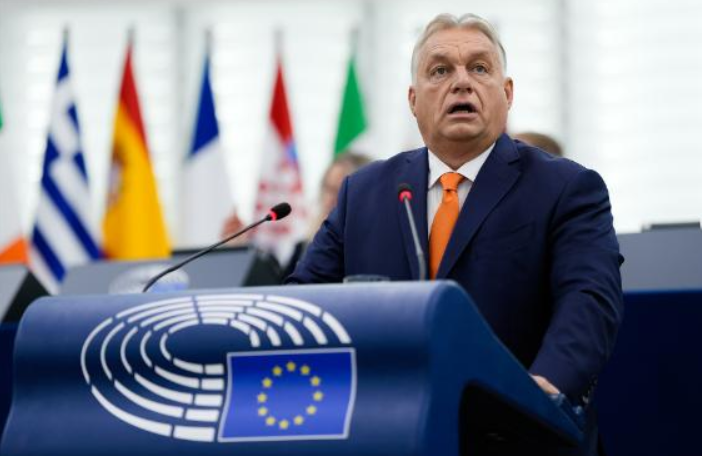


Europe is facing a major political clash as Hungarian Prime Minister Viktor Orbán has openly refused to provide further support to Ukraine, sharply criticizing President Volodymyr Zelensky. The announcement comes amid rising tensions within the European Union and growing public scrutiny of how European countries are responding to the ongoing war in Ukraine.
Orbán’s comments mark one of the clearest public rejections of Ukraine’s appeals for aid by a European leader in recent months. Speaking directly to Zelensky via social media, Orbán described the Ukrainian president as being in a desperate position and accused him of failing to end the war despite receiving substantial international assistance, particularly from the United States. He made it clear that Hungary will not provide financial or military help, saying that “not a single penny” will be sent to fund what he called an “endless war.”
Orbán Rejects Ukraine Amid Hungary Election Pressures
The timing of Orbán’s remarks is crucial. Hungary is approaching a pivotal parliamentary election in April, and the prime minister’s party, Fidesz, is trailing in several opinion polls. With voters increasingly concerned about rising inflation, energy prices, and economic instability, Orbán has framed his stance on Ukraine as a choice between war and peace.
Japan pledges $6 billion to Ukraine for humanitarian aid and energy support in 2026
Orbán argued that continued European funding for Ukraine is not only prolonging the conflict but also draining Hungary’s resources. His comments suggest that he is prioritizing domestic political considerations over European solidarity, using the war in Ukraine as a central talking point for his campaign.
The Hungarian leader has long promoted negotiation and ceasefire talks as alternatives to sustained military support for Ukraine. By refusing aid, Orbán positions himself as the defender of Hungarian sovereignty, emphasizing that Brussels, Kyiv, and other European powers should not expect Hungary to continue funding the conflict.
Tensions Erupt After Zelensky’s Davos Speech
The confrontation escalated after Zelensky’s appearance at the World Economic Forum in Davos. In a speech that quickly went viral, Zelensky criticized Europe for being fragmented and lacking courage in the face of international pressures from both the United States and Russia. He directly targeted leaders like Orbán, saying that those who rely on European funds while undermining European interests “deserve a smack upside the head.”
Orbán’s response was swift and forceful. Rejecting Ukraine’s requests outright, he insisted that Hungary would not finance the ongoing conflict and accused Zelensky of mismanaging the war despite extensive support. The Hungarian prime minister also highlighted the issue of Russian oil, noting that Europe’s sanctions have not fully stopped the flow and that Russian companies continue to profit from the war.
He emphasized that Europe must strengthen its own military forces instead of relying solely on NATO, warning that the alliance’s effectiveness remains uncertain in the event of a direct Russian attack on European soil. Orbán questioned whether NATO would intervene if Russia were to target countries like Lithuania or Poland, underscoring his argument that Europe cannot depend solely on the United States for its defense.
Sharp Words and Rising Fault Lines in Europe
The clash between Orbán and Zelensky highlights a growing divide within the European Union over support for Ukraine. With Orbán’s election looming, the Hungarian leader is leveraging public concern over economic and security issues to justify his refusal to provide aid.
Orbán has made it clear that his stance is non-negotiable. He criticized Zelensky for failing to secure a ceasefire and for relying too heavily on European funding. At the same time, he warned that Europe must act decisively to prevent Russian aggression, including stronger sanctions and more effective military cooperation.
Brussels stunned as Slovakia openly opposes EU military aid strategy for Ukraine
The dispute also reflects broader questions about Europe’s role in global security. Orbán’s criticism extends beyond Ukraine, touching on the need for European countries to develop independent military capabilities and to take stronger action against threats like Russian oil shipments and military activities near European borders.
As Europe grapples with these internal tensions, the public spat between Orbán and Zelensky serves as a stark reminder of the political and economic challenges facing the EU while the war in Ukraine continues.