


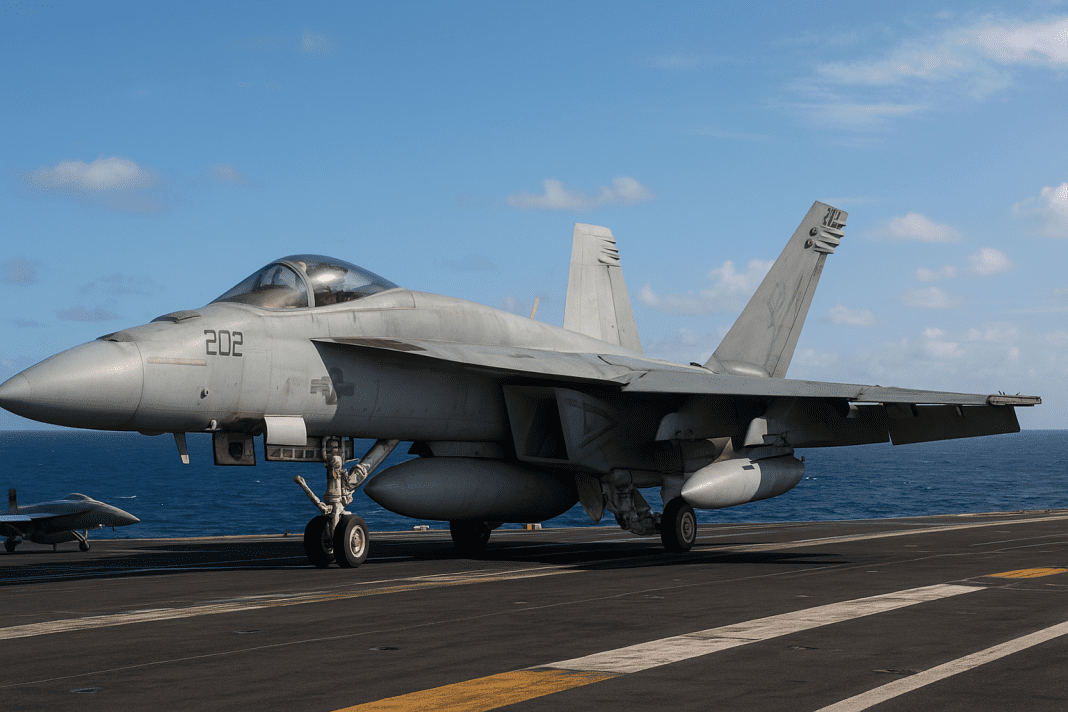


The situation around the Caribbean Sea has escalated sharply as the United States has deployed F-18 fighter jets just outside Venezuela. This F-18 deployment is part of a larger military buildup, with jets preparing for possible strike missions alongside advanced stealth aircraft already in the region.
Rising Tension Over F-18 Deployment in the Caribbean
The escalation followed a tense phone call between US and Venezuelan officials. Soon after, the United States warned all airlines and pilots to avoid Venezuelan airspace, raising concerns that the F-18 deployment could signal a more aggressive military stance. The warning was unusual in its tone and scope, causing airlines and shipping operators to reroute flights and maritime traffic for safety.
The US Navy released images showing rows of F-18 jets on a massive aircraft carrier that recently arrived near Venezuelan waters. This super carrier is among the most advanced in the world and uses electromagnetic catapult systems to launch aircraft. While technical limitations currently restrict the carrier to deploying only F-18s, US officials say that nearby land bases in Puerto Rico or other locations can launch stealth F-35 jets within minutes if they order an immediate operation.
Observers note that the F-18 deployment shows one of the largest US displays of force in the Caribbean in decades. Analysts say the display of firepower clearly signals US readiness and capability. At the same time, the buildup leaves many questions about what could happen next and how Venezuela might respond.
US Firepower Expands Across Air and Sea with F-18 Deployment
The United States is not relying solely on fighter jets. Heavy strategic bombers, including B-52 and B-1B models, have been flying missions across the Caribbean and eastern Pacific since mid-October. These aircraft often fly with transponders turned off for stealth training or show-of-force maneuvers.
Alongside these bombers, the F-18 deployment continues to be a central focus of US operations. Military officials report that the jets are running simulated strike drills on potential targets in Venezuela. These exercises rehearse scenarios that could be used in real combat situations. By combining F-18 deployment with other assets, the US ensures multiple layers of military readiness, increasing the speed and efficiency of any possible operation.
China warns US over Venezuela standoff: ‘Sovereignty must not be trampled’
The US has also increased the bounty on certain Venezuelan leaders and designated some of their activities as terrorism-related. Following the phone call with Venezuelan officials, the closure of Venezuelan airspace further highlighted the seriousness of the ongoing F-18 deployment.
Photos released by the US military show an impressive concentration of ships, aircraft, and personnel in the region. The F-18 deployment remains central to these preparations, demonstrating both strategic mobility and a rapid-response capability. The combination of carrier-based jets, land-launched stealth fighters, and strategic bombers underscores the scale and seriousness of the US military posture.
Venezuela Responds With Military Mobilization
Venezuela responded swiftly to the F-18 deployment by activating its air-defense systems. In addition, long-range missile batteries and radar networks were placed on high alert. Fighter jets were deployed, and the nation launched military readiness drills across the country.
Meanwhile, Venezuelan officials sharply criticized the US military move, describing it as an illegal act aimed at undermining the country’s sovereignty. They argue that US actions are part of a broader effort to enforce political change and gain control over Venezuela’s natural resources, which include the largest oil reserves in the world and significant gas deposits.
Consequently, the F-18 deployment, combined with the presence of strategic bombers and other US military assets, has turned the Caribbean into a significant military flashpoint. Both nations now have forces on high alert, and international observers are closely watching as tensions reach levels not seen in years.
With this in mind, and with F-18 jets staged for immediate action, carriers ready to launch additional aircraft, and strategic bombers conducting regular drills, the US F-18 deployment emphasizes the seriousness of the standoff. As a result, the Caribbean Sea has become one of the most closely watched regions in the world, as the deployment of these jets signals an unprecedented show of force.
Analysts note that this F-18 deployment, alongside other military activities, could have far-reaching implications for regional security and travel. While the situation remains tense, the presence of these jets underscores the scale and readiness of US military operations in the Caribbean.