


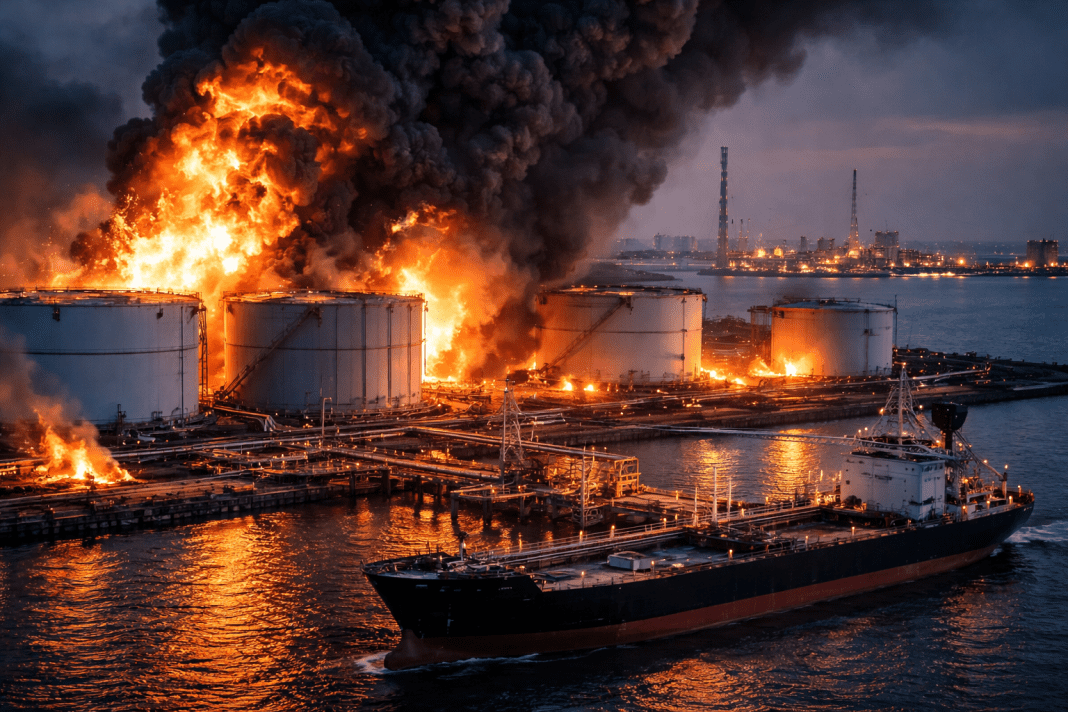


The rapidly intensifying US–Israel–Iran conflict entered a dangerous new phase on March 19, 2026, as United States Defense Secretary Pete Hegseth defended Washington’s sweeping military campaign against Iran, even as Donald Trump issued stark warnings of devastating retaliation and Scott Bessent indicated potential easing of oil sanctions. With missile strikes hitting Ras Laffan Industrial City in Qatar, explosions reported near Azadi Tower in Tehran, and rising threats around the Strait of Hormuz, the war is reshaping global energy flows, military strategy, and geopolitical alignments at an unprecedented pace.
US claims overwhelming military dominance over Iran
At a high-stakes press conference, Pete Hegseth forcefully rejected criticism that the war risked spiraling into a prolonged quagmire, asserting that the campaign was delivering rapid and decisive results.
According to Hegseth, US forces have struck more than 7,000 targets across Iran, focusing on dismantling its military infrastructure, missile systems, and defense industrial base. He described the campaign as one of “overwhelming force applied with precision,” emphasizing that Iran’s operational capabilities have been severely degraded.
He claimed that Iranian air defenses have been “flattened,” while missile and drone production capacity has been drastically reduced—reportedly cutting attack volumes by nearly 90% since the conflict began.
Perhaps most striking was Hegseth’s assertion that Iran’s naval power has effectively been neutralized. “Their surface fleet is no longer a factor,” he said, adding that all 11 Iranian submarines are gone, and over 120 naval vessels have been damaged or destroyed.
This dramatic claim, if verified, would represent one of the most significant naval degradations in modern warfare, fundamentally altering the balance of power in the Persian Gulf.
Kharg Island strike shifts strategic control
A key turning point in the conflict appears to be the US strike on Kharg Island—Iran’s primary oil export hub. Hegseth suggested that this operation has given Washington unprecedented leverage over Tehran’s economic future.
Kharg Island handles the bulk of Iran’s crude exports, making it a critical node in the global energy supply chain. By targeting infrastructure linked to the island, the US has effectively placed pressure on Iran’s ability to sustain its war effort financially.
Hegseth framed this as a strategic advantage, stating that the strikes give the US “control over Iran’s fate,” a remark that underscores the broader objective of forcing Tehran into submission without necessarily committing to a prolonged ground war.
Trump escalates rhetoric with South Pars warning
While the Pentagon projected confidence, Donald Trump adopted a far more aggressive tone, issuing a stark warning regarding the South Pars Gas Field—a critical shared energy resource between Iran and Qatar.
Trump warned that any further Iranian attacks on Qatari LNG infrastructure could trigger a massive US response, including the potential destruction of the South Pars field “at a level of force never seen before.”
The warning came after Iranian missile strikes hit LNG facilities in Ras Laffan Industrial City twice within 12 hours, causing extensive damage and fires at key facilities, including gas-to-liquids operations.
This escalation raises the stakes dramatically, as targeting South Pars could have catastrophic consequences for global energy markets, given its status as the largest natural gas field in the world.
Oil markets in focus as US signals possible relief
In a surprising development, Scott Bessent suggested that Washington may ease restrictions on Iranian oil already at sea—estimated at around 140 million barrels.
The move appears to be a calculated effort to stabilize global oil markets, which are under severe strain due to disruptions in the Persian Gulf and attacks on critical infrastructure.
Bessent emphasized that the US has deliberately avoided targeting Iran’s energy infrastructure directly, allowing oil exports to continue flowing. However, he also hinted that Washington retains significant leverage over global supply.
This dual-track strategy—military escalation combined with selective economic relief—highlights the complexity of US policy, balancing pressure on Iran with the need to prevent a global energy crisis.
Gulf region under sustained attack
The broader Middle East remains on edge as the conflict spills across borders. Iranian missile strikes have targeted key infrastructure in multiple countries, triggering defensive responses and emergency measures.
In Saudi Arabia, a ballistic missile aimed at the port of Yanbu was intercepted, while a drone crashed at the SAMREF refinery, raising concerns about the vulnerability of critical oil infrastructure.
Meanwhile, the UAE reported intercepting seven ballistic missiles and 15 drones, underscoring the scale and intensity of the threat.
Qatar, one of the world’s leading LNG exporters, has been particularly hard hit. The repeated attacks on Ras Laffan Industrial City have disrupted operations and sent shockwaves through global gas markets.
Despite the strikes, Qatari authorities confirmed that air quality levels remain normal, and emergency teams have successfully contained fires at affected facilities.
Strait of Hormuz tensions threaten global trade
The Strait of Hormuz—through which a significant portion of the world’s oil supply passes—has emerged as a critical flashpoint.
US Central Command confirmed that American forces are actively targeting Iranian naval assets that pose a threat to international shipping in and around the strait.
Any prolonged disruption in this narrow waterway could have severe implications for global trade, energy prices, and economic stability.
Iran’s ability to harass shipping lanes, even with reduced naval capacity, remains a key concern for policymakers and markets alike.
US considers troop deployment amid escalation
As the war enters its third week, reports suggest that the Trump administration is considering deploying thousands of additional troops to the Middle East.
The move would build on the recent deployment of a Marine Expeditionary Unit consisting of around 2,500 personnel, providing the US with greater operational flexibility as it weighs its next steps.
While Hegseth insisted that the conflict is not becoming a “forever war,” the potential for expanded troop presence indicates that Washington is preparing for multiple scenarios, including further escalation.
India reassures citizens amid fuel concerns
Amid rising global uncertainty, India moved quickly to reassure its citizens about fuel availability.
The Ministry of Petroleum and Natural Gas confirmed that refineries are operating at high capacity and that adequate stocks of petrol and diesel are available across the country.
Officials urged the public to avoid panic buying, emphasizing that supply chains remain stable despite geopolitical tensions.
The government is also encouraging commercial LPG users to shift to piped natural gas (PNG), aiming to optimize resource allocation and prevent shortages.
Civilian advisories and regional alerts intensify
Governments across the region have issued a series of advisories aimed at protecting civilians.
In Qatar, authorities released precautionary guidelines for Eid prayers, urging citizens to prioritize safety and limit large gatherings.
The US Embassy in Saudi Arabia issued a security alert advising American citizens to consider leaving the country via commercial flights, while noting that airports remain operational despite ongoing missile and drone threats.
The Indian Embassy in Saudi Arabia also urged its community to remain calm and follow official guidelines, reflecting widespread concern over the conflict’s potential impact on civilians.
A war reshaping global geopolitics
The US–Israel–Iran conflict is no longer a localized confrontation—it is rapidly evolving into a broader geopolitical crisis with global implications.
From the destruction of Iran’s military infrastructure to the targeting of critical energy hubs in Qatar and the growing risk to shipping lanes in the Strait of Hormuz, the war is reshaping the strategic landscape of the Middle East.
The interplay between military operations, economic policy, and diplomatic signaling—evident in statements from Pete Hegseth, Donald Trump, and Scott Bessent—underscores the complexity of the crisis.
As the situation continues to evolve, the world is watching closely, aware that the next phase of this conflict could have far-reaching consequences for global security, energy markets, and international relations.
For now, one thing is clear: the trajectory of this war will define the geopolitical order of the coming decade.