


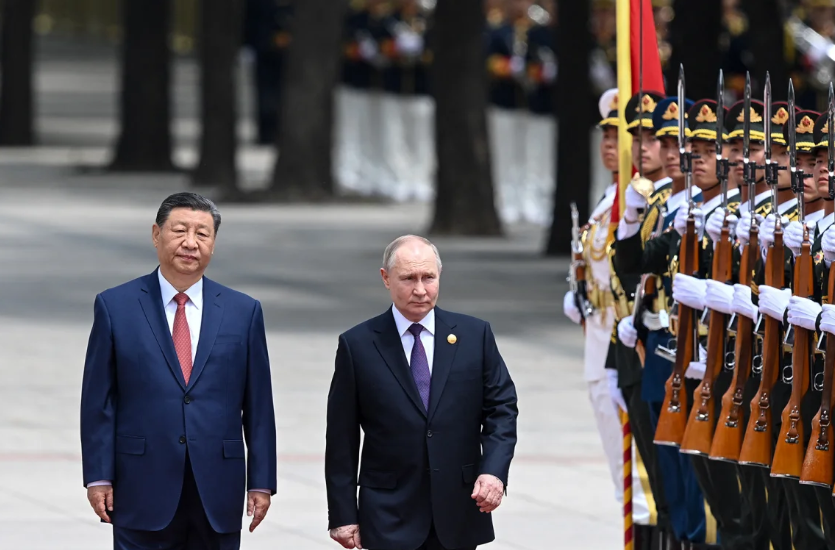


At the Munich Security Conference, senior U.S. diplomat Matthew Whitaker said China has the power to rapidly end the Russia-Ukraine war if it chooses to intervene, arguing that Beijing’s deep economic and political alignment with Russia — including large-scale crude purchases and dual-use technology flows — is materially sustaining President Vladimir Putin’s war effort. Whitaker’s remarks place renewed scrutiny on President Xi Jinping’s government ahead of high-level diplomatic engagements and intensify debate across Western capitals about leveraging China’s trade exposure to alter the trajectory of the Ukraine conflict.
China’s influence on Russia’s war effort
During a US foreign policy panel, Matthew Whitaker said China has enough influence to stop Russia’s war in Ukraine if it chooses to act. He argued that Beijing could directly contact Vladimir Putin and quickly change the course of the conflict. Whitaker said China could also halt the sale of dual-use technologies to Russia, including components that can be used in drones and other military equipment.
Analysts warn rising Ukraine war costs fuel debate to end fighting before balance shifts
He highlighted energy trade as another key source of leverage, saying China could increase pressure by stopping its purchases of Russian oil and gas, which provide vital funding for Russia’s economy and war effort. Whitaker added that the conflict is being “completely enabled by China,” a remark made during a panel moderated by Bloomberg journalist Francine Lacqua.
Trade data support his argument. In January, about 1.65 million barrels of Russian crude per day were delivered to Chinese ports, the highest level since March 2024. Since the invasion of Ukraine in 2022, China and Russia have deepened their partnership, with Moscow relying on Beijing for key components while China has emerged as Russia’s largest oil buyer.
Beijing’s stance and growing trade ties
Despite the scale of its trade with Russia, China has repeatedly said it wants to play a “constructive” role in resolving the conflict. Chinese officials have often stated that Beijing supports peace talks and opposes actions that could make the war worse.
China has not publicly admitted to providing direct military support to Russia. However, Western officials argue that the flow of dual-use goods and continued large-scale energy purchases are helping Moscow keep its war effort going.
The economic link between the two countries has grown deeper over time. As many Western nations reduced or stopped buying Russian energy after the invasion, China stepped in as a major buyer. This shift helped Russia find new markets for its oil and gas, softening the impact of sanctions.
Russia’s Iskander missile production rises threefold, fueled by growing industrial ties with China
At the same time, China’s position has allowed it to present itself as a potential mediator. Beijing has released statements calling for dialogue and political solutions, while also maintaining close diplomatic contact with Moscow.
This balancing act has drawn criticism from the US and its allies, who say China cannot claim neutrality while continuing to support Russia economically. Whitaker’s comments in Munich reflected this view, placing responsibility on Beijing to use its influence if it truly wants the war to end.
Diplomacy in Munich and talks with Ukraine
Alongside Matthew Whitaker’s remarks, China and Ukraine also held diplomatic talks at the Munich Security Conference. Chinese Foreign Minister Wang Yi met Ukrainian Foreign Minister Andrii Sybiha, with discussions focused on the ongoing war and the impact of Russian attacks on Ukraine’s energy infrastructure. Wang said China was willing to provide new humanitarian assistance to Ukraine, including support for civilians affected by the fighting.
Sybiha described the meeting as “substantive and pragmatic” and said he had invited Wang to visit Ukraine, adding that China could play an important role in bringing about a just peace. He also said Ukraine appreciates China’s stated support for its territorial integrity and sovereignty.
Ukraine war transforms Europe’s security as NATO and Russia slide into prolonged power confrontation
In a separate official summary, China’s foreign ministry said dialogues around the Ukraine crisis were progressing but did not mention any invitation to Kyiv. Wang repeated Beijing’s position that it supports stability, dialogue, and humanitarian aid while monitoring diplomatic efforts.
The talks underlined China’s complex role in the conflict. While it remains Russia’s key economic partner, Beijing continues to engage with Ukraine and present itself as a supporter of peace, a dual position highlighted by Whitaker’s comments in Munich.