


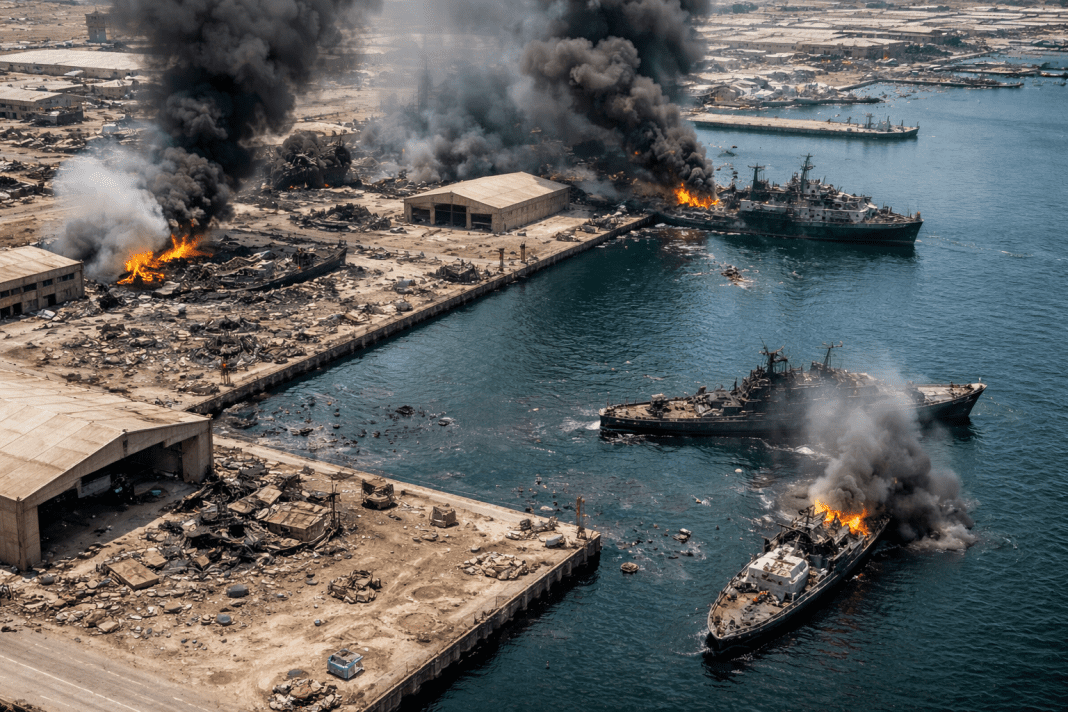


Iran continues to face the aftermath of large-scale military strikes carried out by the United States and Israel, with new satellite imagery revealing significant destruction at the Konarak naval base in southern Iran. The facility lies along the Gulf of Oman, a strategically important waterway that connects the Middle East to major global shipping routes.
Damage Reported at Konarak Naval Base After Joint Strikes
Recent satellite images appear to show significant damage inside Iran’s Konarak naval base, with several buildings displaying collapsed roofs, burn marks, and debris spread across large sections of the complex. Analysts reviewing the imagery say the strikes heavily affected parts of the harbor infrastructure, although Iranian authorities have not officially confirmed any operational losses.
Early battlefield assessments suggest the strikes sank three naval vessels positioned at or near the base. The ships were reportedly docked at the time, which left them exposed to precision attacks. Satellite photos showing smoke plumes and darkened water patches have strengthened claims that the strikes destroyed maritime assets.
After heavy losses, Iran’s missile power still shapes Middle East security balance
Konarak naval base is strategically important because it monitors maritime activity near the entrance to the Arabian Sea and helps project naval presence beyond the Persian Gulf. Despite visible damage, officials have not released details on casualties or equipment losses, and wartime communication limits have restricted independent verification.
Escalation Expands Across Land and Sea
The strikes on Konarak naval base are part of a wider military confrontation that has intensified across multiple regions. In recent days, missile launches, drone attacks, and air operations have been reported across the Gulf and nearby areas, signaling a rapid escalation in hostilities.
Iran responded soon after the strikes with retaliatory actions. Military statements said missile units operating from different locations targeted foreign military facilities and vessels linked to opposing forces. Reported targets included the Ali Al Salem air base in Kuwait and ships operating in the northern Indian Ocean.
Military forces activated air defense systems in several locations as explosions and interception attempts followed incoming projectiles. Authorities also issued maritime security warnings to commercial vessels traveling through nearby waters, highlighting growing risks to shipping activity.
The conflict’s naval dimension has drawn increased attention because the Gulf of Oman serves as a key global trade route, with large volumes of oil and cargo shipments passing through daily. Meanwhile, armed groups launched rockets from Lebanon toward Israeli territory, and Israeli forces carried out additional airstrikes in areas linked to Tehran-backed groups, increasing fears of wider regional instability.
Leadership Loss and Growing Military Pressure
The strikes in Tehran deeply affected the situation inside Iran by causing a major leadership loss. Satellite images showed widespread destruction at a secured compound in the capital that once housed senior leadership facilities, reducing the area to rubble and heavily damaging nearby buildings. Reports also stated that the attack killed several family members present at the site, marking a significant moment in the long-running confrontation and sharply raising regional tensions.
In the days that followed, public messaging from opposing governments intensified, encouraging political change while warning that military operations could continue for weeks. These developments added uncertainty for civilians already facing air defense sirens, communication disruptions, and economic pressure linked to the conflict.
Breaking: Iran’s Supreme Leader Ayatullah Ali Khoneini is Dead
At the same time, Iranian forces continued missile and drone launches targeting military installations and maritime assets. Officials described the strikes as coordinated operations carried out by ground and naval missile units from multiple locations. Analysts noted that targeting both land bases and ships showed an expansion of the conflict beyond traditional battle zones, including operations in the Indian Ocean.
Inside Iran, heightened security measures, restricted information flow, power disruptions, and temporary closures followed repeated air raid warnings, while satellite imagery remained one of the few ways to assess the scale of damage.