
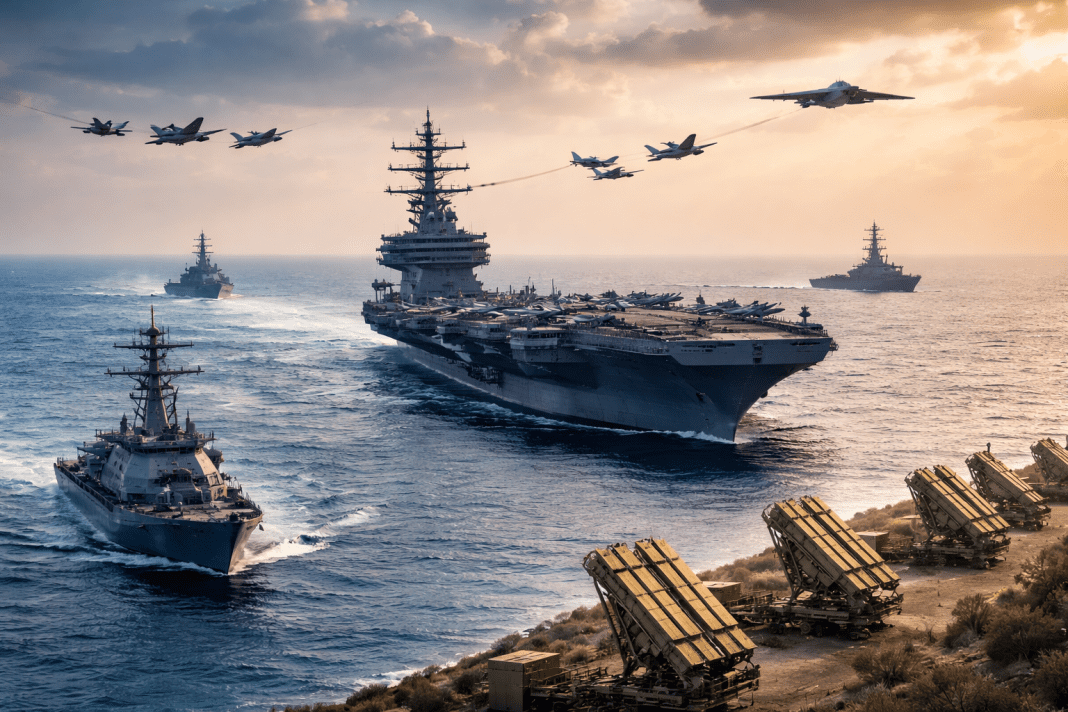

The United States has carried out its largest military buildup near Iran since the 2003 Iraq war. The deployment includes two aircraft carriers, over 50 fighter jets, advanced air-defence systems and long-range bombers placed on alert. Forces are positioned across key regional waters and bases, drawing global attention and raising concerns about rising tensions linked to the growing military buildup in the region.
Massive Military Buildup Explained
At the centre of the military buildup are two aircraft carrier strike groups, among the most powerful military formations in the world. Each includes a nuclear-powered aircraft carrier supported by guided-missile destroyers equipped with advanced radar, cruise missiles and layered defence systems. The scale of this military buildup represents a rare concentration of naval power outside major conflicts.
One carrier was already operating in the region with stealth fighters and multirole jets capable of air defence, surveillance and precision strikes, supported by aerial refuelling for long missions. A second advanced carrier has now joined operations, carrying more than 75 aircraft and significantly expanding air power. Together, the two carriers enable continuous flight operations day and night.
U.S.–Iran talks resume in Oman as missile dispute threatens fragile nuclear diplomacy
The United States has also deployed over 50 fighter jets to bases in Jordan, the UAE and Saudi Arabia. Supported by refuelling tankers and airborne warning aircraft, the deployment is reinforced by long-range bombers on alert and Patriot and THAAD air-defence systems protecting key bases.
Strategic Locations Across Key Oil Routes
The military buildup stretches across several critical waterways and nearby regions. Forces are positioned throughout the Persian Gulf, the Strait of Hormuz, the Gulf of Oman and parts of the Arabian Sea. These areas are vital to global trade and energy supply.
A large share of the world’s oil exports passes through the Strait of Hormuz. Stability in this region is therefore important for international energy markets. Even small disruptions in this narrow waterway can affect fuel prices worldwide. This is why the current military buildup has drawn strong international attention.
Aircraft carriers operating in nearby waters allow missions across large parts of the Middle East without fully relying on land bases. Fighter jets stationed at regional airfields provide rapid response capability. They also strengthen air patrol coverage as part of the wider military buildup.
China warns US against attacking Iran, says ‘military adventurism’ could plunge West Asia into chaos
Naval patrols and surveillance flights have increased in frequency. Military planners use these operations to monitor sea traffic, track missile activity and maintain awareness of developments across the region. Air-defence systems placed near bases serve as protective measures, detecting launches early and intercepting potential threats before impact.
Together, naval forces, aircraft and missile defence systems create a layered security structure supporting the ongoing military buildup, combining mobility, surveillance and protection.
Iran’s Response and Rising Regional Tensions
Iran has responded to the large-scale military buildup by showcasing its own military capabilities. State media has highlighted missile tests and naval exercises near the Strait of Hormuz, a key global shipping route. The drills involved warships and fast-attack vessels operating in strategic waters, demonstrating readiness to defend national territory and nearby sea lanes.
Military exercises included simulated scenarios designed to test coordination between naval units and missile forces. Iranian officials also warned against foreign aircraft carriers operating close to their coastline, describing the deployments connected to the military buildup as a security concern. Officials presented public displays of missile systems to signal defensive strength.
Iran races to harden missile arsenal with Russian help as fears of U.S. or Israel strike grow
Military actions from both sides have increased global attention on the region. Countries often use large deployments and exercises to demonstrate deterrence and preparedness without direct confrontation. International observers say governments and global markets are closely monitoring movements linked to the current military buildup.
The situation now reflects a rare concentration of military power across land, sea and air. The developments are unfolding in one of the world’s most sensitive geopolitical regions. US carrier groups, fighter jets, missile defence systems and bombers remain on alert. The military buildup continues across key waterways and regional bases. These movements are keeping global attention focused on developments across the Middle East.