


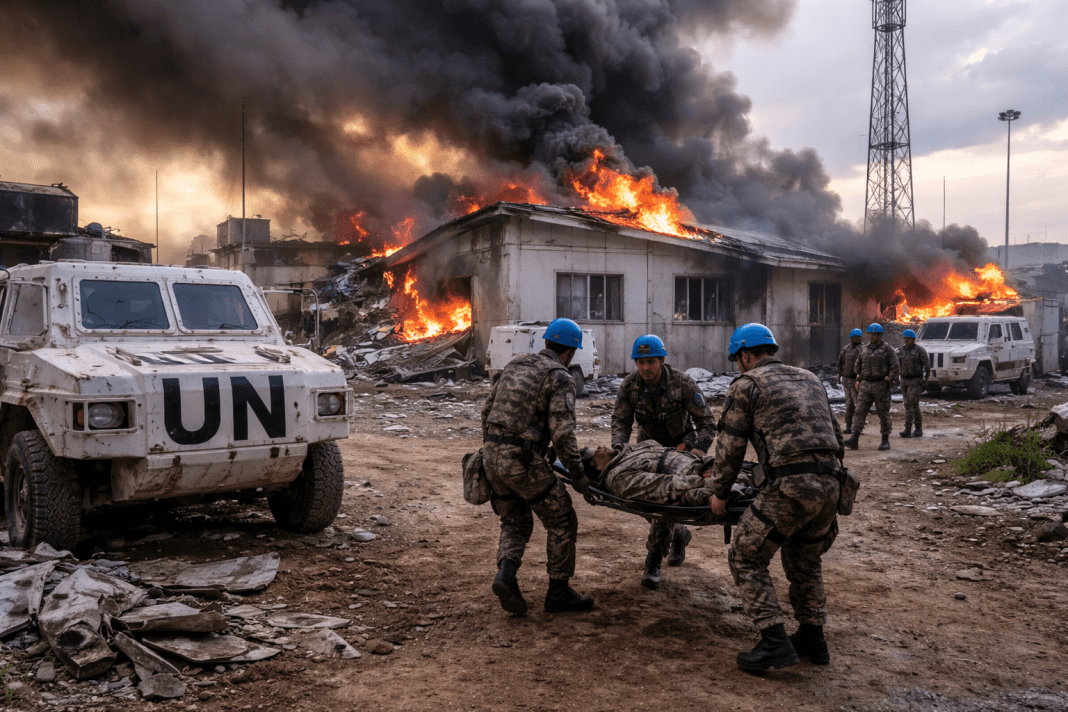


Tensions in southern Lebanon have risen sharply. Israeli shelling struck a United Nations peacekeeping base. This has raised serious concerns about the safety of international forces. The incident comes amid ongoing clashes along the Lebanon-Israel border. It has added to fears of further escalation in an already volatile region.
Alarm Rises After Shelling Hits UN Peacekeepers
Israeli artillery shelling struck the headquarters of an Indonesian unit serving with the United Nations Interim Force in Lebanon (UNIFIL) in southern Lebanon on Sunday. The incident took place in the village of Adshit al-Qusayr, a small area near the tense Lebanon-Israel border.
According to initial reports from local media, several UN peacekeepers were injured in the attack. The exact number of casualties has not yet been officially confirmed. Soon after the shelling, UN helicopters were seen flying toward the site, likely to assist with evacuation and medical support.
Israel strikes Zrariyeh bridge in Lebanon and launches new wave of airstrikes on Tehran
The Indonesian unit is part of the international peacekeeping mission that has been stationed in southern Lebanon for years. These peacekeepers are meant to monitor the situation, help maintain stability, and prevent further conflict in the region. An attack on such a base is considered serious because UN forces are supposed to remain neutral and protected under international agreements.
So far, there has been no official statement from UNIFIL about the incident. This has added to uncertainty and concern, as more details about the damage and injuries are still emerging.
Rising Tensions Along the Border
The shelling comes at a time of growing violence along the Lebanon-Israel border. For months, there have been repeated exchanges of fire between Israeli forces and Hezbollah, an armed group based in Lebanon.
Since October 2023, the situation has remained unstable, with both sides launching attacks across the border. Although a ceasefire was announced in November 2024, it did not fully stop the fighting. Hostilities resumed again in early March, especially as tensions linked to the wider regional conflict increased.
Israeli forces have since expanded their ground operations in southern Lebanon. Troops have been moving deeper into Lebanese territory, reportedly advancing toward the Litani River, which lies further north of the border area.
The recent shelling of the UN peacekeepers’ headquarters has added another layer of concern. Peacekeeping bases are usually seen as safe zones, and any strike near or on them increases fears of escalation.
Local reports also described a tense atmosphere in southern Lebanon, with residents worried about further attacks. The sound of artillery and movement of military vehicles have become more common in recent weeks.
Expanding Military Zones and Growing Impact
Israeli authorities have announced plans to expand what they describe as a “security buffer zone” in southern Lebanon. These zones refer to areas inside Lebanese territory where Israeli forces have taken control during ongoing military operations. However, these areas are not recognized by Lebanon or the international community. Israeli officials maintain that the expansion is necessary to prevent infiltration and attacks by armed groups operating near the border.
According to reports, at least five such military positions have already been established in southern Lebanon since the conflict intensified. Despite earlier understandings and ceasefire efforts, Israeli forces have remained in these locations and have not withdrawn. Similar buffer zones have also been referenced in Syria and Gaza, where continued military activity has altered the situation on the ground.
IDF releases bodycam footage of night operations targeting Hezbollah sites in Lebanon
Meanwhile, the human cost of the conflict continues to grow. Official figures indicate that 49 people were killed and 116 injured on Sunday alone. Since the escalation began on March 2, the total death toll has reached 1,238, while 3,543 people have been reported injured.
In addition, more than 4,400 hostile incidents have been recorded so far. The violence has forced thousands of families to flee their homes. Over 136,000 displaced people are currently living in shelters across the country, highlighting the ongoing humanitarian strain caused by the conflict.