


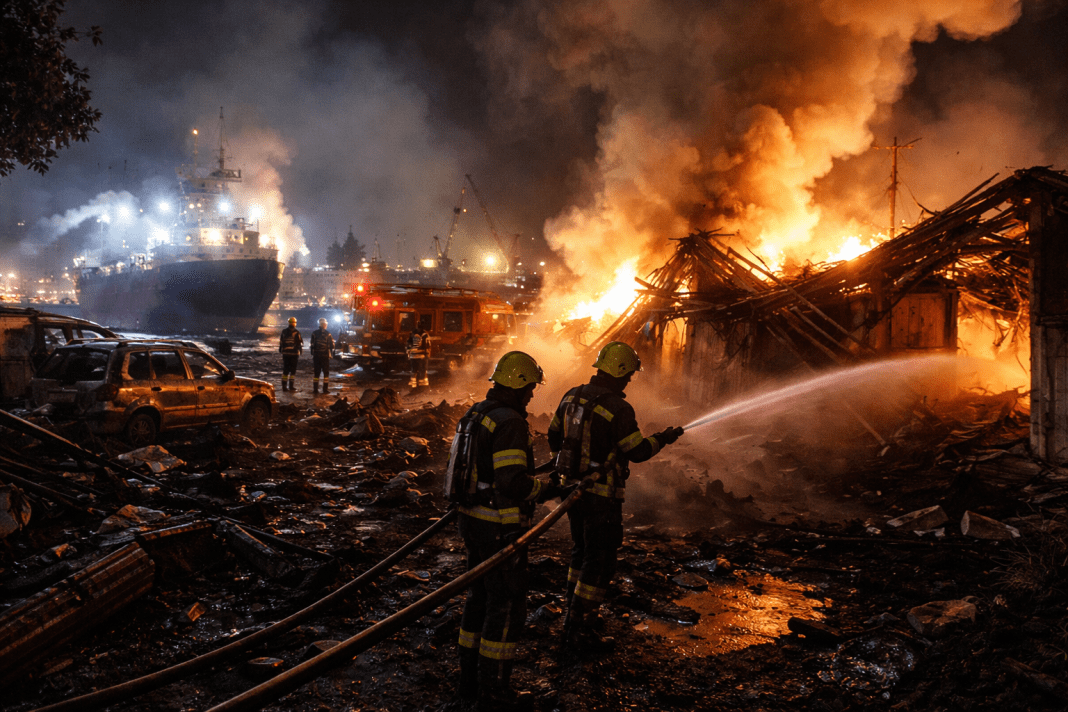


A deadly overnight drone attack struck Russia’s southern Rostov region, leaving three people dead and several others injured. The incident added to rising tensions as the war continues and diplomatic efforts show little progress.
Deadly Drone Attack Hits Russia’s Rostov Region
According to regional authorities, drones hit areas close to port facilities and residential neighborhoods. One of the main incidents involved a cargo ship, where a fire broke out after the attack. Emergency teams managed to put out the flames, but two crew members lost their lives. Three others suffered injuries and were taken for medical treatment.
In a nearby town close to the port area, another drone strike caused further damage. A civilian was killed when homes were hit during the attack. Two houses were burned down completely, and an apartment building that was still under construction suffered visible damage. Rescue teams were sent to the area to search for survivors and assess the destruction.
These attacks are part of a wider pattern. For many nights in recent weeks, drones have been launched deep into Russian territory. The Rostov region, which lies close to key transport and military routes, has increasingly become a target. Local officials said air defense systems were activated, but some drones still managed to reach their targets.
The strikes caused fear among residents, many of whom were asleep when the explosions happened. Emergency alerts were issued, and people were asked to stay indoors while authorities worked to secure the affected areas. Damage assessments are ongoing, and investigators are examining debris from the drones.
Europe Debates Using Frozen Russian Assets to Support Ukraine
The drone attack in Rostov happened at a delicate political moment in Europe, as leaders from several European countries met to discuss whether frozen Russian money should be used to support Ukraine’s war effort.
Since the conflict began, European nations have frozen about 210 billion euros in Russian assets. Most of this money is held inside European financial institutions. The proposal under discussion would use these frozen funds as the basis for loans to help Ukraine pay its bills and continue defending itself, while responding to attacks like the recent strikes in Rostov, over the next two years.
Supporters of the plan say the funding is urgently needed. They warn that without outside financial help, Ukraine could run out of money by the middle of next year. This could affect basic government services and weaken its ability to continue the war.
However, the proposal has created deep divisions among European countries. A major concern is legal risk. Some governments fear that if international courts later rule in Russia’s favor, the country holding the assets could be forced to pay large compensation claims.
Fueling the frontlines — Ukraine’s drone assaults cripple 20% of Russia’s oil capacity
One key European country hosts a major financial clearing house where much of the frozen Russian money is kept. Its leaders have said they do not want to bear the financial risk alone and are seeking strong guarantees from other European partners before approving the plan.
Although European rules allow decisions to pass with a majority vote, many leaders believe forcing the issue could damage trust and unity within the European Union. As a backup, officials considered raising money directly at the EU level, but this would need full agreement from all member states. Some have already ruled it out, making the option unlikely.
War Continues as Peace Talks Struggle to Advance
At the same time, efforts led by the United States to bring the war to an end have yet to produce clear results. Talks are ongoing, and officials from both sides are expected to continue discussions in the coming days. These meetings are part of a broader push to explore possible paths toward ending the conflict.
Despite these talks, major disagreements remain. One of the biggest issues is territory. Ukraine and its allies insist on strong security guarantees, while Russia maintains its claims over several regions. These opposing positions have made it difficult to reach common ground.
Russian leadership has repeatedly stated that it intends to achieve all its goals in the conflict. Western calls to prepare for a possible wider confrontation with Russia have been strongly criticized by Moscow, which has dismissed such warnings as exaggerated.
Meanwhile, the fighting continues on the ground and in the air. Drone attacks, missile strikes, and military operations are reported almost daily. Civilians on both sides remain caught in the middle, facing loss of life, damaged homes, and ongoing uncertainty.
Ukraine cripples Russian air defenses in Crimea after precision strikes destroy key radar systems
European leaders see the funding debate as a test of their credibility and resolve. The outcome could shape not only Ukraine’s ability to continue resisting but also Europe’s role in the conflict moving forward. As discussions continue behind closed doors, no final decision has yet been announced.
For now, the situation remains tense. The deadly drone attack in Rostov highlights how the war continues to spread beyond front lines, while political battles over money and responsibility unfold far from the battlefield.