


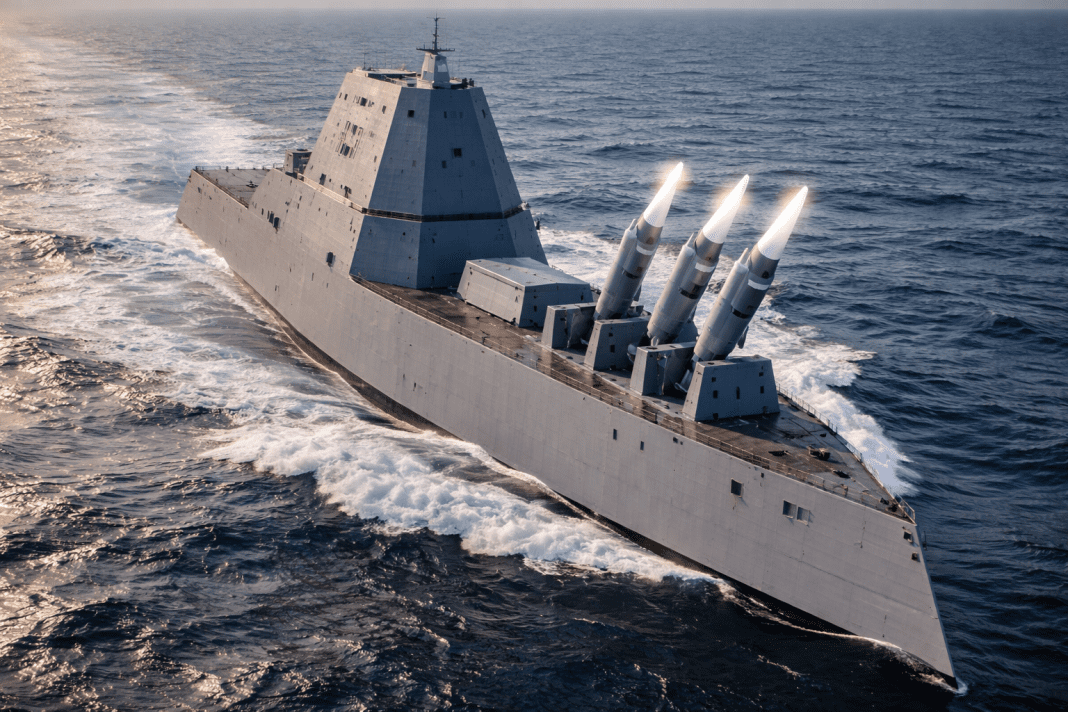


The U.S. Navy’s once-troubled Zumwalt-class destroyer is making a dramatic return to the seas, now redesigned as a hypersonic strike platform. After nearly three years in dry dock, the stealth destroyer recently completed major sea trials following a massive missile refit. The transformation marks a significant shift in the Navy’s strategy as competition with China heats up in the Pacific.
Zumwalt Refit Brings Hypersonic Missile Power to the Fleet
The Zumwalt-class destroyer has undergone a major modernization led by a prominent shipbuilder. The work involved extensive upgrades to the ship’s systems and careful testing at sea to ensure all components were fully operational.
As part of the overhaul, the Navy removed Zumwalt’s original large naval guns and replaced them with four massive missile tubes. These new tubes are built to carry the Conventional Prompt Strike (CPS) system, giving the ship the ability to launch hypersonic missiles over long distances.
US Navy increases P-8 Poseidon patrols near Venezuela as Washington seeks to curb cartel trafficking
The recent sea trials evaluated Zumwalt’s propulsion, navigation, and combat systems after the refit. The ship is expected to return to active service later this year, and similar hypersonic upgrades are planned for its sister ships, Michael Monsoor and Lyndon B. Johnson, enhancing the Navy’s long-range strike capabilities.
From Shore Bombardment to Long-Range Strike
When the USS Zumwalt was first commissioned in 2016, it was designed as a stealthy shore bombardment platform. Its mission was to approach enemy coastlines and use advanced naval guns to destroy shore defenses and inland targets.
However, the plan proved costly and risky. The specialized ammunition for its guns cost nearly $800,000 per round, making it uneconomical. At the same time, China’s advanced anti-ship missiles increasingly threatened ships operating close to its coast.
China’s Eye in the Sky? U.S. Accuses Satellite Firm of Fueling Houthi Attacks on Navy Warships
The recent refit has turned Zumwalt into a long-range strike asset. Equipped with CPS missiles capable of traveling over 2,700 kilometers, the ship can strike deep inside enemy territory while staying out of range of most shore-based weapons.
This makes Zumwalt a key part of the Navy’s layered strategy. Inside forces operate in the most dangerous zones with stealth submarines, advanced fighters, and special units. Middle forces, including Zumwalt, provide precision strikes just outside these zones, while outside forces like aircraft carriers and nuclear submarines serve as a strategic reserve.
Comparing Zumwalt to China’s Type 055
China is rapidly building large surface combatants like the Type 055 cruiser, which it calls a destroyer. These ships are heavily armed, with 112 missile launch cells, and serve as flagships for Chinese surface action groups. By comparison, the Zumwalt-class ships have just 12 missile tubes for the CPS system.
The Zumwalt’s hypersonic missiles have a longer range than China’s YJ-21 hypersonic missile, which can travel about 1,000 to 1,500 kilometers. This gives the U.S. the ability to strike deep into mainland China, while China’s long-range strikes rely more on land-based missiles. Still, in terms of numbers, China’s fleet advantage is significant. With eight Type 055 cruisers already deployed, and many other large ships in service, China outnumbers the three Zumwalt-class ships by a wide margin.
Dangerous Provocation: US Navy Submarine Triggers North Korea’s Outrage
The Zumwalt-class destroyers can operate flexibly—alone, with other surface groups, or as part of a carrier strike group. Their stealth and long-range strike capability add a qualitative edge for the U.S. Navy, particularly in the Taiwan Strait and nearby waters. However, they do not match China’s numerical superiority or offset its geographic advantage near home waters.
The return of the Zumwalt-class highlights a shift in U.S. naval strategy, from shore bombardment to deep strike capabilities. While the ships bring new power and precision to the fleet, they provide a focused, niche capability rather than broad parity with China’s expanding naval forces.