


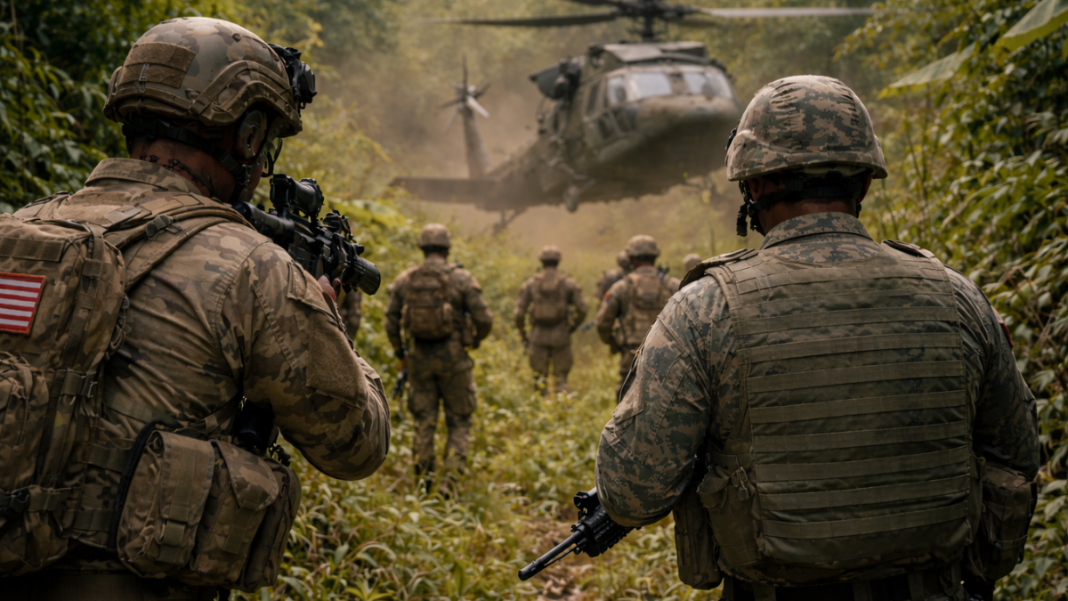


The United States has carried out its first land operation against drug cartels in Ecuador. The mission was done with the Ecuadorian military. The U.S. Southern Command confirmed the joint action. This shows a stronger focus on fighting organized crime and terrorist-linked drug groups.
For years, the U.S. mostly used air operations to stop drug trafficking. Specifically, planes targeted smuggling boats in the Eastern Pacific and Caribbean. However, this ground operation is a major change. U.S. troops are now on foreign soil to confront cartels directly. In doing so, they aim to disrupt drug pipelines.
Officials said the mission targeted terrorist organizations in Ecuador. These groups, in particular, run large-scale drug operations and violent crimes. As a result, they threaten local communities, regional security, and international trade routes.
Joint Operation Focuses on Criminal Networks
U.S. and Ecuadorian forces worked side by side in this historic mission. Ground troops from both nations conducted operations designed to dismantle cartel activities, seize illegal substances, and disrupt the logistical networks used to move drugs across borders.
The U.S. Southern Command emphasized that the operation was carefully planned, relying on local intelligence provided by Ecuadorian authorities. The cooperation between the two nations allowed forces to identify hidden cartel locations, track movements, and respond quickly to threats.
Political storm erupts after Musk accuses Mexico’s president Sheinbaum of cartel ties
According to officials, the mission represents a new approach in counter-narcotics strategy. Previously, U.S. military involvement in South America was mainly restricted to airstrikes, which, while effective at stopping some shipments, were not sufficient to dismantle the complex networks operating on land.
Additionally, the operation highlights the growing partnership between the United States and Ecuador. By combining resources, intelligence, and manpower, the two countries aim to enhance security, protect communities, and reduce the influence of violent cartels.
Background: U.S. Efforts and Airstrike Operations
For years, the U.S. military and allied agencies have focused on air and naval operations to combat drug trafficking. Specifically, aircraft frequently targeted smuggling boats carrying cocaine and other drugs from South America to Central America, the Caribbean, and beyond. However, while these efforts disrupted some shipments, many cartel operations continued to thrive on land, often hidden in remote areas or disguised within local communities.
In contrast, ground operations allow for a more direct approach. Troops can intercept shipments, apprehend criminals, and dismantle the infrastructure that supports trafficking. Moreover, by acting on land, U.S. forces can collaborate more effectively with local authorities, use intelligence gathered from the ground, and seize assets such as vehicles, laboratories, and storage facilities.
Afghanistan claims it thwarted Pakistani airstrike on Bagram as cross-border fighting escalates
Ecuador has increasingly become a focal point for such operations. Its geographical position makes it a transit hub for drug shipments heading toward North America and Europe. Recently, cartel-related violence in the country has risen, with criminal groups establishing secret routes and using local networks to move drugs undetected.
Regional Security and Strategic Importance
The United States expands its role in South America beyond traditional air and naval actions. By stepping onto Ecuadorian soil, U.S. forces show a stronger commitment to combating transnational crime.
Officials emphasize that troops conducted the operation carefully to minimize risks to civilians. Authorities report no casualties or arrests so far and say the mission targeted only specific criminal groups involved in drug trafficking and terrorism-linked activities.
US and Israel conduct strikes on Iran’s Konarak naval base as satellite images show major damage
Ecuadorian authorities welcomed the collaboration. They said joint military actions strengthen the country’s ability to secure its borders. They also help protect citizens from cartel violence. Furthermore, the operation sends a warning to organized crime networks. It shows that governments in the region are improving coordination and capacity to tackle these groups directly.
By combining U.S. military expertise with Ecuadorian local knowledge, the operation takes a big step in improving regional security. It also helps dismantle transnational criminal networks. Moreover, the mission marks a turning point in U.S. counter-narcotics strategy. It shows that future operations may include more direct ground action along with traditional air and naval missions.