


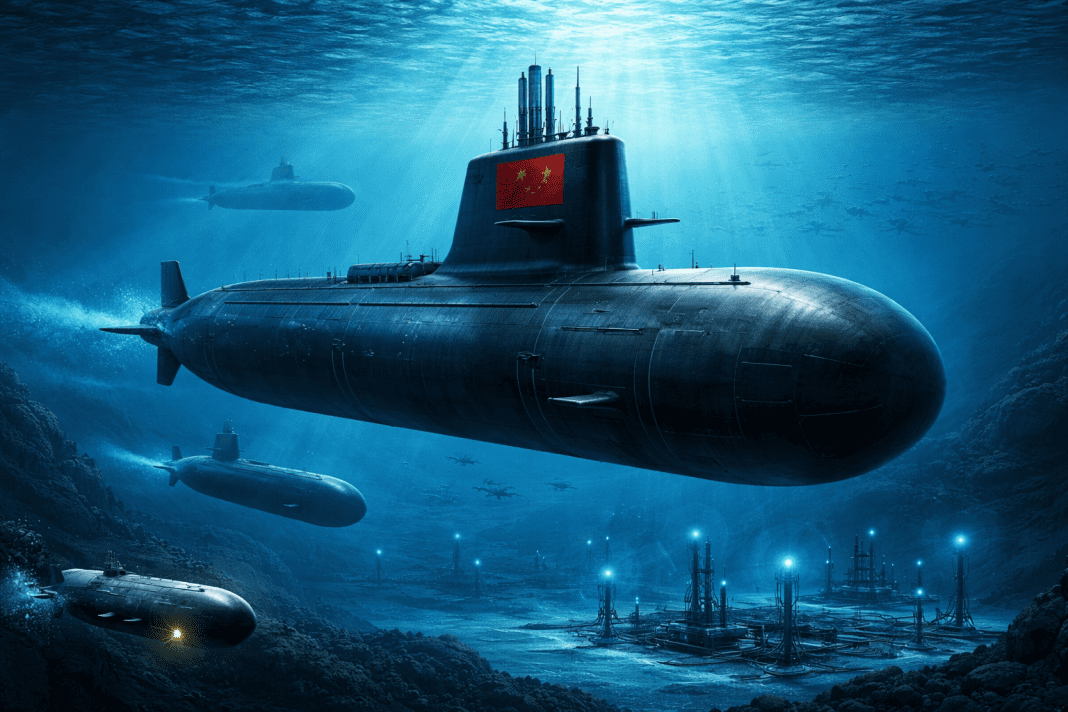


China’s growing focus on undersea warfare is drawing global attention as it steadily upgrades its submarine fleet and naval strength beneath the oceans. With a mix of advanced submarines, new weapons, and expanding surveillance networks, the country is working to close the long-standing gap with the United States in underwater military power.
These developments highlight a broader shift in naval strategy, where control of the deep sea is becoming just as important as dominance on the surface.
Rapid Expansion of China’s Submarine Fleet
China is rapidly expanding its submarine fleet, signaling a shift in the balance of power under the oceans. Although many details remain secret, it is clear that the country is focusing on building a larger and more advanced force.
Currently, China operates over 60 submarines, a number expected to rise to around 70 by 2027. This growth includes both nuclear-powered and conventional submarines, while older vessels are being retired. Nuclear submarines, which can stay underwater longer and operate more effectively, are a key part of this expansion.
China-made weapons face scrutiny after reported failures in Pakistan, Venezuela and Iran
By 2035, China’s fleet could reach about 80 submarines, with nearly half being nuclear-powered. This marks a significant shift toward more advanced capabilities. Meanwhile, the United States Navy may see a temporary drop in its submarine numbers, narrowing the gap. China has also boosted its shipbuilding capacity, allowing it to produce multiple advanced submarines at the same time.
Advanced Submarines and New Weapons
One of the most notable developments is China’s next-generation nuclear-powered submarine, often referred to as the Type 095. This submarine is larger and more advanced than earlier models, with improved speed, maneuverability, and stealth.
The design includes features like a modern rudder system and advanced propulsion, which help reduce noise and make it harder to detect underwater. Quietness is one of the most important qualities for submarines, as it allows them to operate without being noticed.
The Type 095 is also expected to carry powerful weapons. It has vertical launch systems that can fire multiple missiles from a hidden underwater position. These may include long-range cruise missiles capable of striking targets far away.
China uses disguised drone flights in South China Sea amid Taiwan tensions
China is also developing new types of missiles for its submarines. Among them is a hypersonic anti-ship missile that can travel at extremely high speeds. This missile can be launched from standard submarine tubes, making it more flexible in combat situations.
In addition to nuclear-powered submarines, China continues to build advanced diesel-electric submarines. Some of these use air-independent propulsion, which allows them to stay underwater longer without surfacing. These quieter submarines are especially useful in coastal and regional waters.
China is also working on a smaller nuclear-powered submarine designed for shorter missions. This type combines the endurance of nuclear power with the size and cost advantages of conventional submarines.
Expanding Undersea Surveillance and Operations
China is not only expanding its submarine fleet but also improving its ability to detect and track enemy vessels underwater. It is developing a wide network of seabed sensors, underwater drones, and surveillance systems to monitor ocean activity more effectively.
This system, often described as an “underwater wall,” includes fixed ocean-floor sensors, floating devices, and unmanned underwater vehicles. These tools collect data and track movement in key areas, and some have already been spotted in regional waters.
Unmanned underwater vehicles are playing a growing role. These drones can carry out missions such as surveillance, reconnaissance, and mine-laying. Some are designed to operate in groups, allowing them to cover larger areas efficiently.
China is also strengthening its anti-submarine warfare capabilities with advanced ships, better sonar systems, improved helicopters, and modern patrol aircraft. These upgrades help increase detection chances in important regions.
Rather than monitoring entire oceans, China is focusing on strategic zones like chokepoints and coastal areas. At the same time, it is preparing for wider operations, with submarines expected to travel farther into regions like the Indian Ocean.
Despite progress, challenges remain, especially in avoiding detection in heavily monitored waters.