


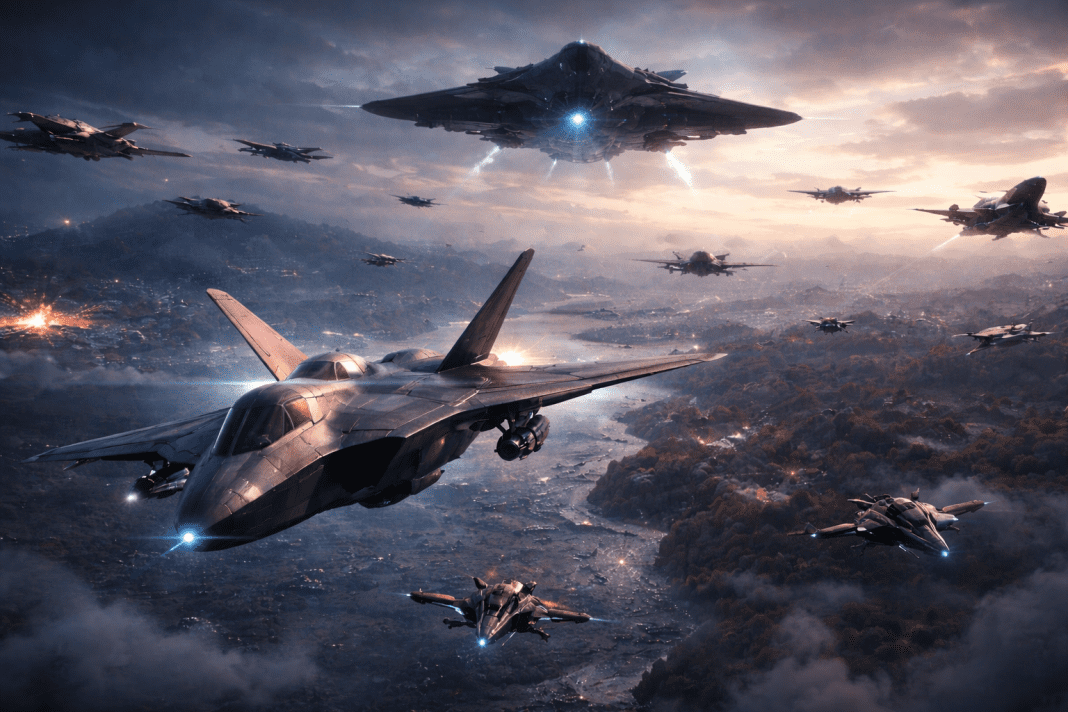


Modern air warfare is changing quickly, and military aviation is at the center of this transformation. Military forces are moving away from traditional dogfights and speed-focused tactics. Instead, they are focusing on “information dominance.” This means winning battles by using better data, faster communication, and smarter systems within modern military aviation.
Today’s advanced fighter jets already reflect this shift in military aviation. Aircraft like the F-35 are not just designed for speed or stealth. They are built to collect, process, and share large amounts of information in real time. This allows pilots to see a complete picture of the battlefield while staying hidden from most threats.
Over the next 25 years, this approach is expected to expand further across military aviation. Air combat will rely on connected systems where multiple aircraft work together as one coordinated force.
Transforming Air Combat in Modern Military Aviation
In the future, military aviation will follow a “system-of-systems” approach. This means different types of aircraft will operate together instead of acting independently.
The F-35 is no longer just a fighter — it’s becoming the commander of a robotic air war
There will be a mix of advanced and low-cost aircraft. High-end jets with cutting-edge technology will lead operations, while simpler and more affordable drones will support them in large numbers.
This strategy is often called a “high-low mix.” It combines the power of expensive, advanced machines with the flexibility of cheaper systems. Together, they can respond to both high-end threats and smaller, less predictable challenges in military aviation environments.
Instead of a few jets fighting alone, entire fleets will work together. These fleets will include crewed fighter jets, stealth bombers, and large groups of autonomous drones.
The most advanced aircraft will act like commanders in the sky. They will guide other aircraft, assign targets, and manage the flow of battle. These “orchestrators” will not need to engage every target themselves but will direct other assets to act more efficiently.
The Rise of Drone Swarms and Teamwork
One of the biggest changes in future air combat is the use of drone swarms, often called “loyal wingmen.” These drones will fly alongside crewed aircraft and carry out missions based on commands.
They can attack targets, gather intelligence, or act as decoys. In some situations, they may even absorb enemy fire, reducing risk for human pilots in military aviation missions.
Unlike older drones, these systems will not depend on constant remote control. They will use advanced artificial intelligence to make decisions during missions.
For example, if a pilot gives a simple command like “secure that area,” a group of drones can organize themselves automatically. Some may fly higher, others lower, while some act as distractions. This coordination can happen without detailed instructions.
This approach is known as Crewed-Uncrewed Teaming (MUM-T). It creates a connected battlefield where all systems share information instantly and operate together.
Different aircraft will also communicate through a shared digital language. This allows fighter jets, bombers, and drones to exchange data quickly, improving coordination and response time during military aviation operations.
Artificial Intelligence and Multi-Layered Operations
Artificial intelligence will play a key role in future military aviation. In older systems, pilots handled most tasks alone, but in modern aircraft, AI works as a smart assistant. It processes data from radar, infrared sensors, and electronic systems to give pilots a clear view of the battlefield, helping them focus on critical decisions.
AI will also control drones that operate without GPS or external signals. These drones use onboard sensors to navigate and respond in real time. In simulations, AI has already shown it can outperform experienced human pilots in certain situations, highlighting rapid technological progress.
Maintenance is also improving with AI. Systems can predict equipment failures before they happen and arrange repairs automatically, keeping aircraft mission-ready.
In electronic warfare, AI can quickly analyze unknown enemy signals, find weaknesses, and create countermeasures during combat.
Future operations will include “Mothership” aircraft that act as airborne command centers, controlling drone swarms from a safe distance. Air combat will follow a layered structure, with stealth bombers, fighter jets, and support aircraft working together.
Transport planes will also deploy drones mid-air, increasing flexibility and reducing operational risks, further strengthening the capabilities of modern military aviation.