


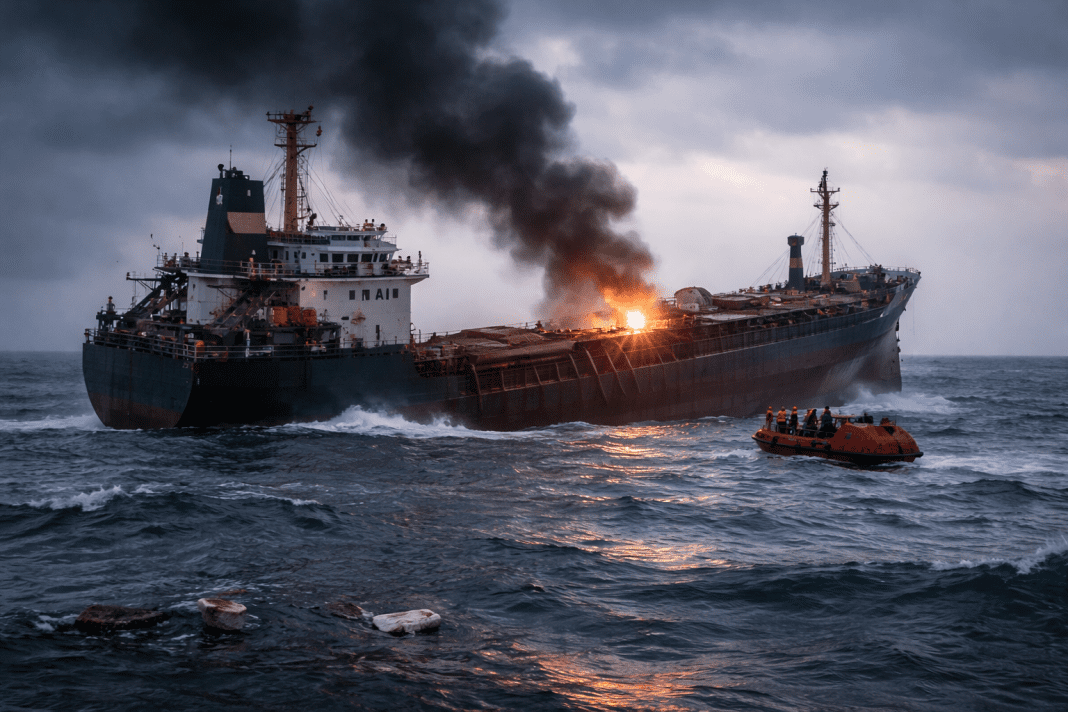


An Iranian-flagged cargo vessel suspected of transporting weapons from Iran to Russia has sunk in the Caspian Sea, drawing renewed attention to a shadowy maritime corridor long linked to covert arms transfers supporting Moscow’s war effort. Authorities in Turkmenistan confirmed the incident on Wednesday, saying the ship went down while returning from Russia along a route frequently cited by intelligence analysts as a key logistics channel for military supplies.
The vessel, identified as the Rona, was reportedly sailing back toward Russia when it encountered trouble and sent out a distress signal. Turkmenistan’s Ministry of Foreign Affairs said all 14 crew members on board were rescued safely. The crew consisted of Iranian and Indian nationals, and no casualties were reported.
While officials did not publicly confirm the nature of the cargo at the time of the sinking, the ship’s extensive travel history, port calls, and timing have intensified suspicions that it was part of a wider network used to move arms and military equipment between Iran and Russia.
A Vessel Linked to a Well-Known Arms Corridor
The Rona was a bulk carrier with a displacement of 2,453 tons, measuring approximately 114 meters in length and 13 meters in width. According to maritime tracking data, the ship had repeatedly traveled between Iranian and Russian ports over the past year, establishing a pattern consistent with vessels previously identified as part of Iran-Russia military supply routes.
Iran Sold Nearly $3 Billion in Missiles and Drones to Russia as Ukraine War Intensified
Between October 2024 and December 2025, the Rona reportedly docked around 20 times at Russian ports including Astrakhan, Makhachkala, and Azov. On the Iranian side, it regularly departed from the ports of Amirabad and Anzali, both of which have been flagged in past intelligence and media reports as hubs linked to clandestine shipments.
At the time of the sinking, the vessel’s declared destination was again Astrakhan, a strategic Russian port on the Caspian Sea that has emerged as a central node in Moscow’s logistics chain. The port connects directly to Russia’s internal waterways, allowing cargo to be moved onward with limited international oversight.
Security analysts have long described the Caspian Sea as an ideal environment for covert trade. Unlike major global shipping lanes, it is bordered only by a small number of states, limiting external monitoring. This has made it particularly attractive for shipments that benefit from low visibility and minimal interference.
Previous investigations by international media have documented how cargo ships on this route frequently disable or manipulate their transponders, creating gaps in tracking data. These “dark” periods often coincide with departures from Iranian ports or transits near key Russian facilities.
Ukraine’s Covert Operations Add to the Context
The sinking of the Rona comes against the backdrop of intensified Ukrainian efforts to disrupt Russia’s military supply chains far beyond the front lines. In recent months, Ukraine’s Special Operations Forces, often working in coordination with resistance movements, have expanded their reach into regions previously considered relatively insulated from the conflict.
South Africa begins naval drills with China Russia and Iran to strengthen maritime cooperation
Last month, Ukrainian special units, in cooperation with the resistance group Chornaya Iskra (Black Spark), carried out an operation in the Caspian Sea that reportedly struck two Russian vessels transporting weapons and military equipment. While details of that operation were not fully disclosed, it marked a notable escalation in Ukraine’s ability to target logistics deep inside Russia’s supply network.
Earlier, in August 2025, Ukrainian forces struck the Olya seaport in Russia’s Astrakhan region. That attack reportedly hit a ship carrying components for Shahed drones and ammunition originating from Iran. Olya is widely regarded as a crucial logistics hub for the transfer of Iranian military supplies into Russia, particularly those used in aerial attacks.
According to statements released at the time, Ukraine’s Armed Forces said the objective was to reduce Russia’s capacity to launch airstrikes by disrupting the flow of imported weapons and components. Those operations highlighted how ports and shipping routes far from active combat zones have become legitimate strategic targets.
Western intelligence assessments and investigative reporting have reinforced this picture. A report documented hundreds of cargo vessels suspected of ferrying arms between Iran and Russia, many of which exhibited irregular tracking behavior near Amirabad, Anzali, the Volga River, and Astrakhan. Analysts described the Caspian route as one where interdiction risks were minimal and oversight was weak.
Despite the growing scrutiny, experts have noted that Caspian trade has continued largely uninterrupted. The region’s geopolitical configuration, combined with limited enforcement mechanisms, has allowed such exchanges to proceed with little resistance.
Iran’s Khamenei reportedly plans to flee to Russia with close aides amid growing protests
A Sinking That Raises More Questions Than Answers
Authorities in Turkmenistan have not indicated whether an investigation into the Rona’s cargo will be conducted, nor have Russian or Iranian officials commented publicly on the incident. As with many events tied to covert logistics networks, the lack of official transparency leaves key questions unanswered.
What is clear is that the sinking of the Rona fits into a broader pattern of heightened pressure on Russia’s arms supply routes. Whether the incident was the result of mechanical failure, environmental conditions, or other factors has not been disclosed. Still, its timing—following a series of Ukrainian strikes targeting similar routes—will inevitably fuel speculation.
As the war in Ukraine continues to evolve, the focus is no longer confined to battlefields alone. Ports, shipping lanes, and supply corridors are increasingly becoming part of the conflict’s strategic landscape. The Caspian Sea, once considered peripheral, now appears firmly embedded in that reality.
For now, the loss of the Rona serves as another reminder that the logistics underpinning modern warfare are as vulnerable—and as consequential—as the weapons themselves.