


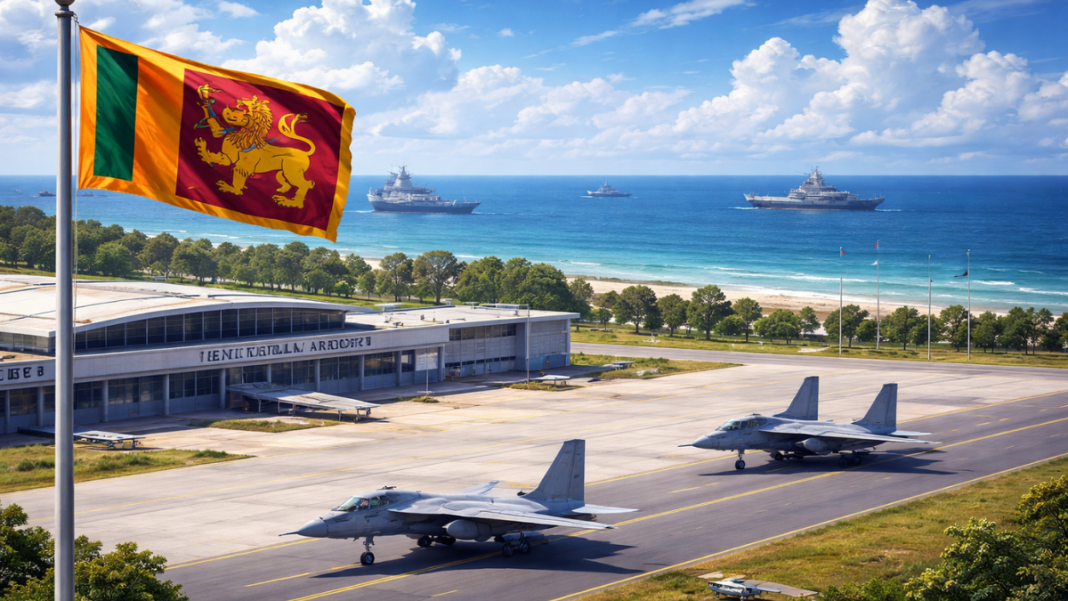


Sri Lanka has made a clear decision to remain neutral in an international conflict. The country recently turned down a request from the United States to temporarily station two missile-armed warplanes at a civilian airport in the south. The US had asked to move the planes from a base in Djibouti to Mattala International Airport for a short period from March 4 to March 8.
President Anura Kumara Dissanayake announced that the government would keep Sri Lanka neutral by refusing the request and ensuring no country could use its territory for military purposes. Officials confirmed that the country would not allow its airspace to support attacks against any nation. This decision is in line with Sri Lanka’s long-standing policy of neutrality in international affairs.
The request came at a time of rising tensions in the Indian Ocean. A deadly attack had hit an Iranian naval ship. Some reports said the US warplanes might be linked to military actions against Iran. However, there was no official confirmation. By refusing, Sri Lanka made it clear that it would not let its territory be used in any conflict.
Humanitarian Efforts Amid Conflict
While Sri Lanka refused military involvement, it acted quickly to help those affected by the recent naval attack. On March 4, a US submarine torpedoed the Iranian frigate IRIS Dena near the Iranian coast, killing at least 84 sailors.
Sri Lanka’s navy and air force immediately responded to the crisis. They rescued 32 sailors who were still alive from the sunken ship. The remains of the 84 crew members who died were recovered and safely returned to Iran.
The next day, Sri Lanka allowed another Iranian ship, the IRIS Bushehr, to enter its waters. This ship carried 219 crew members, who were provided shelter in Colombo. A third Iranian ship, the IRIS Lavan, sailed safely to the port of Kochi in India. Some sailors have already returned home.
Authorities emphasized that these actions were purely humanitarian. President Dissanayake said the focus was on saving lives, helping sailors in need, and not taking sides in the conflict.
Sri Lanka launches dramatic rescue as Iranian frigate IRIS Dena begins sinking in Indian Ocean
Balancing Relations Between Nations
Sri Lanka is also maintaining careful diplomatic balance between the United States and Iran. On the same day the US made its request, Iran sought permission for three of its warships to visit Colombo after returning from a naval exercise in India. Approving one side’s request could have been seen as favoring that country. Instead, President Dissanayake decided to refuse both military requests, keeping a neutral position.
Additionally, Sri Lanka abstained from voting on a UN Security Council resolution condemning Iran’s attacks. Officials said the resolution reflected only “half the truth” and did not show the full story. This move further emphasized the country’s commitment to fairness and neutrality in international matters.
Despite these refusals, Sri Lanka continues to maintain strong ties with both nations. The United States remains one of the country’s main export markets, while Iran is an important buyer of Sri Lankan tea. By rejecting military requests but assisting sailors in distress, Sri Lanka has shown a careful balance of diplomacy and humanitarian concern.
Through these actions, President Dissanayake and Sri Lanka have made it clear that the country prioritizes neutrality and humanitarian responsibility over military involvement. Its response highlights a careful approach to international relations while ensuring that the country’s territory is not used for foreign military purposes.