


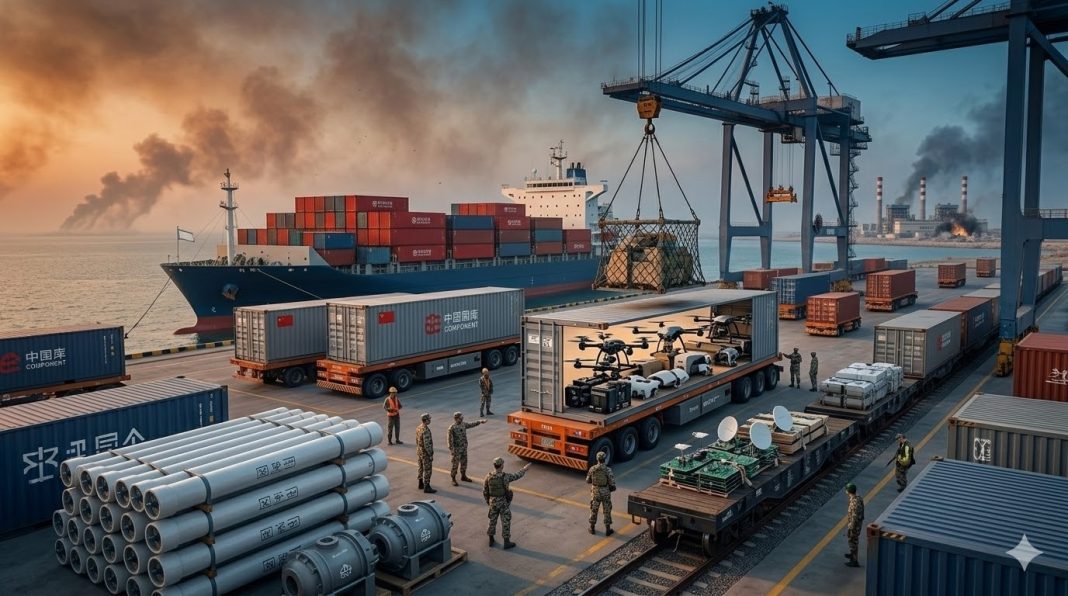


While the world watches Iranian drones strike desalination plants and American missiles hit infrastructure, the most consequential decisions in this nine-day war may not be happening on any battlefield at all. They’re happening in the quiet administrative offices of Chinese port authorities, where a simple choice—to delay or not to delay—carries the weight of thousands of lives.
The Ships That Beijing Chose Not to Stop
This week, two Iranian cargo vessels—the Shabdis and Barzin—departed Gaolan Port in Zhuhai, China, allegedly carrying sodium perchlorate, a critical component for solid rocket fuel. The ships are operated by the Islamic Republic of Iran Shipping Line (IRISL), an entity sanctioned by the United States, Britain, and the European Union specifically to prevent this type of transfer.
Beijing didn’t need to seize these ships. It didn’t need to impose new sanctions or make grand diplomatic gestures. All it needed to do was… nothing differently. Invoke a customs inspection. Discover a paperwork error. Implement a “routine administrative delay.”
China does this constantly for far less consequential cargo. But for these two ships, carrying material that will likely be converted into the very rockets now falling on Kuwait City and Manama, the bureaucratic machinery moved with unusual efficiency.
As Isaac Kardon of the Carnegie Endowment for International Peace noted: “China could have held these vessels at port, imposed an administrative delay, invented a customs hold—any number of bureaucratic tools, but didn’t. That’s a deliberate policy choice made during an active war in which Beijing publicly calls for restraint.”
Water wars begin: Iran strikes desalination plants as Gulf conflict enters deadly new phase
The War Behind the War
This reveals a fundamental truth about modern conflict that rarely makes headlines: wars are no longer won or lost solely on battlefields. They’re won in logistics hubs, financial networks, and supply chains that operate thousands of miles from any combat zone.
Consider the timeline: Iranian missile facilities have been degraded by U.S. and Israeli strikes. Iran’s domestic production capacity is damaged. Its need for rocket fuel precursor chemicals has intensified. And precisely when Tehran needs resupply most desperately, Chinese ports process IRISL vessels with remarkable speed.
This isn’t coincidence. It’s strategy masquerading as neutrality.
Since the beginning of 2026, multiple IRISL vessels have visited Gaolan Port and departed with cargo, later unloading at Iran’s Shahid Rajaee port in Bandar Abbas. The pattern is clear: China has become Iran’s de facto arsenal quartermaster, providing not weapons directly, but the industrial chemicals that make weapons possible.
The Genius of Plausible Deniability
What makes China’s role so strategically brilliant—and morally ambiguous—is its utter deniability. Sodium perchlorate has legitimate civilian uses. Chemical ports handle industrial materials daily. IRISL, despite sanctions, operates commercial vessels. On paper, everything is routine commerce.
Beijing can simultaneously:
- Publicly call for “restraint” and “diplomatic solutions”
- Criticize U.S. military intervention in the Gulf
- Present itself as a responsible mediator
- All while ensuring Iranian missiles have the fuel to fly
This is 21st-century great power competition distilled to its essence: achieving strategic objectives without accepting strategic responsibility. China arms Iran without selling arms. It fuels the war without firing a shot. It shapes outcomes while maintaining rhetorical neutrality.
The Strait of Hormuz Calculation
That both vessels are headed to ports in the Strait of Hormuz adds another layer of significance. This narrow waterway, just 21 miles wide at its narrowest point, channels roughly 21% of global petroleum consumption. It’s also now a war zone where Iranian missiles, potentially fueled by Chinese chemicals, target vessels and infrastructure.
If Iran decides to escalate by closing or mining the Strait, the global economic consequences would be catastrophic. Oil prices would spike. Supply chains would fracture. The world economy would face its most severe energy crisis in decades.
And the rockets that might make that scenario possible departed China this week with apparent official blessing.
What “Neutrality” Really Means
China’s actions expose the hollowness of declared neutrality in modern great power conflict. When a nation controls critical supply chains and chooses how to use that control, passivity becomes policy.
Beijing faces a straightforward choice:
- Delay these shipments and signal that fueling regional war carries costs
- Allow them to proceed and demonstrate that challenging American influence has Chinese support
China chose the latter. Not through dramatic declarations or military deployments, but through the mundane mechanics of port administration.
This is how wars are really fought in 2026. Not just with drones and missiles, but with customs forms and shipping manifests. Not just with soldiers and pilots, but with port administrators and logistics coordinators who determine what cargo moves when.
The Accountability Gap
Here’s what makes this particularly insidious: when an Iranian missile strikes a Kuwaiti airport or a Bahraini desalination plant, we see the impact. We count casualties. We assess damage. Attribution is clear.
But when Chinese port authorities expedite the departure of vessels carrying rocket fuel precursors? There’s no explosion. No casualties. No immediate damage. Just two ships departing on schedule, disappearing into the South China Sea, their cargo destined to become weapons that will kill people whose names we’ll never know.
The accountability gap is vast. Iran fires the missiles and bears international condemnation. China enables the missiles and maintains its image as a responsible stakeholder calling for peace.
The Larger Pattern
This isn’t isolated to the current conflict. It’s part of a broader Chinese strategy that has emerged over the past decade:
- Supporting Russia’s war in Ukraine with dual-use technology and economic lifelines
- Providing North Korea with sanctions relief through deliberately porous border enforcement
- Enabling Iranian sanctions evasion through financial mechanisms and trade routes
- All while presenting itself as a force for stability and multilateral cooperation
The genius is that each individual action can be explained away. Sodium perchlorate has civilian uses. Trade is normal. Sanctions aren’t universally accepted. But cumulatively, these actions constitute a deliberate policy of enabling authoritarian regimes to project military power while Beijing avoids direct involvement.
United States reviews missile defense after Iran reportedly destroys THAAD radar in Jordan
What This Means for the Gulf War
The departure of the Shabdis and Barzin matters enormously for the trajectory of this conflict. If Iranian missile stockpiles can be replenished as quickly as they’re depleted, the war’s duration extends indefinitely. If rocket fuel components flow freely from China, Iran’s strategic calculus doesn’t need to account for ammunition constraints.
American and Israeli strikes on Iranian missile facilities become less effective if the critical bottleneck—fuel components—can be resolved through Chinese ports. The military equation shifts fundamentally when one side has essentially unlimited resupply from the world’s manufacturing superpower.
The Question Beijing Won’t Answer
There’s a question that needs asking, even though China will never answer it directly: How many lives is a shipping schedule worth?
Every rocket that launches from Iranian territory toward civilian targets in the Gulf contains components that had to come from somewhere. Some were manufactured in Iran. Others were imported. The sodium perchlorate allegedly loaded at Gaolan Port will become solid rocket fuel. That fuel will propel missiles. Those missiles will impact targets.
Beijing’s port administrators know this. China’s foreign ministry knows this. President Xi Jinping knows this.
They chose to let the ships sail anyway.
That’s not neutrality. That’s a choice with consequences measured in human lives. And it’s a choice that reveals more about the true nature of this conflict than a thousand battlefield reports ever could.
The Gulf war isn’t just being fought in the skies over Kuwait or in the waters around Bahrain. It’s being fought in Chinese ports, where bureaucratic decisions about shipping schedules determine which side can sustain combat operations. It’s a war where the most impactful decisions are made not by generals, but by officials whose names we’ll never know, in offices we’ll never see, using tools as mundane as customs forms and port scheduling systems.
And that, perhaps, is the most unsettling revelation of all: in 21st-century warfare, the difference between victory and defeat may be determined not on battlefields, but in the banal administrative machinery of global commerce—where accountability is diffuse, consequences are distant, and plausible deniability reigns supreme.
The Shabdis and Barzin are just two ships. But they represent a form of warfare that’s invisible, deniable, and potentially more decisive than any missile strike: the warfare of supply chains, where enabling violence becomes indistinguishable from facilitating commerce, and where calling for peace while fueling war is just another day of great power competition.