


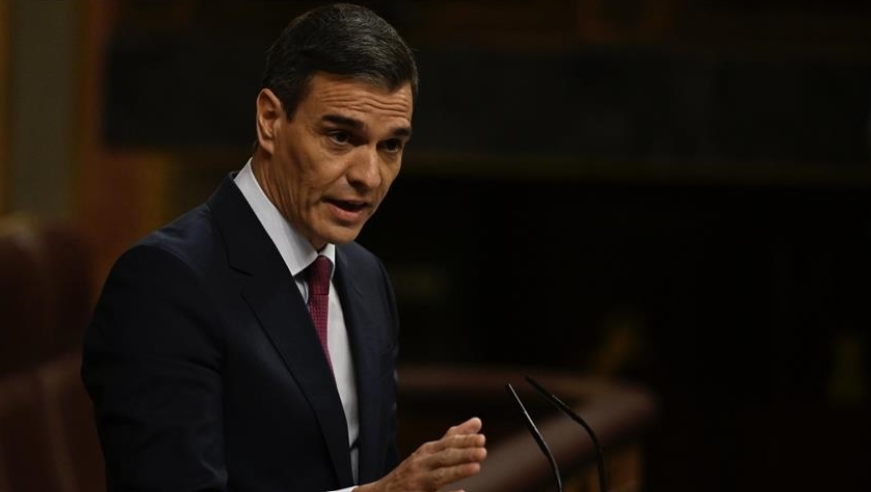


Spanish Prime Minister Pedro Sánchez has strongly criticized the government of Israel, accusing it of violating international law during a period of heightened tensions involving Iran. His remarks came during an official visit to Beijing, where he held talks with Chinese President Xi Jinping.
Speaking at a joint news conference, Sánchez did not hold back. He stated that international law is being “fundamentally violated” and directly pointed to Israel’s government as responsible. His comments reflect growing concern among some global leaders over the ongoing conflict dynamics in West Asia.
Spain’s Firm Stand on International Law Led by Pedro Sánchez
During the press briefing, Sánchez emphasized that Spain has been consistent in its stance since the beginning of the conflict. He described the war, which he said was “initiated unilaterally” by the United States and Israel, as both a “mistake” and an “illegality.”
He made it clear that Spain believes actions taken without broad international support or legal backing undermine global stability. According to Sánchez, respecting international law is not optional—it is essential for maintaining peace and cooperation between countries.
He also stressed that Spain has been “firm and vocal” in defending these principles. His government has repeatedly called for adherence to international rules, especially at a time when many nations are closely watching developments in the region.
The Spanish leader’s remarks highlight a broader debate among countries about how conflicts should be handled. While some nations support military responses, others, like Spain, are urging caution and strict respect for international legal frameworks.
Meeting in Beijing Adds Diplomatic Context
Sánchez’s comments came after his meeting with Xi Jinping in Beijing, adding an important diplomatic layer to the situation. The meeting itself focused on strengthening ties between Spain and China, but global tensions were clearly part of the discussion.
China has also been advocating for dialogue and stability in international conflicts. By raising the issue during his visit, Sánchez brought European concerns directly into conversations with one of the world’s most influential leaders.
UN peacekeepers injured in southern Lebanon after Israeli shelling hits Indonesian base
The setting of the statement is significant. Speaking from Beijing gave the remarks wider global attention and showed that the issue is not limited to one region. Instead, it is part of a larger international conversation about law, order, and the rules that govern relations between countries.
Sánchez noted that moments like these—when the international system is being challenged—are when countries must return to basic principles. He said that these principles form the foundation for future peace and prosperity.
Rising Concerns Over Global Order
The Spanish Prime Minister warned that the current situation reflects a deeper problem: the weakening of the international order. He said that when countries act outside agreed rules, it creates uncertainty and increases the risk of further conflict.
According to Sánchez, the world is at a point where established norms are being “openly called into question.” This makes it even more important, he argued, for nations to stand by international law and avoid actions that could escalate tensions.
His criticism of Israel comes at a time when the situation involving Iran has already raised fears of a wider regional conflict. Many countries are watching closely, as any escalation could have global consequences, including impacts on security and the economy.
Spain’s position, as outlined by Sánchez, focuses on accountability and adherence to shared rules. By calling out what he sees as violations, he aims to reinforce the importance of those rules in maintaining global stability.
The remarks also underline divisions in how different countries view the conflict. While some governments support strong military measures, others are urging restraint and legal compliance. This difference in approach is shaping international discussions and responses.
Sánchez’s statements in Beijing have added to the ongoing global debate, bringing attention to the role of international law in managing conflicts and maintaining order among nations.