


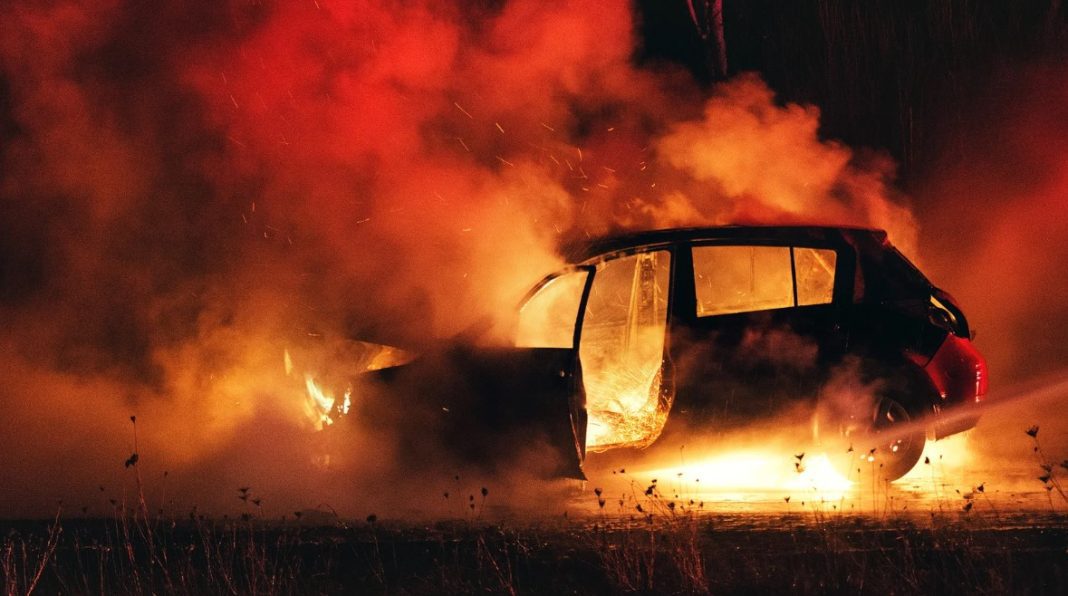


A car bomb explosion killed senior Russian military officer Lieutenant General Fanil Sarvarov in southern Moscow on Monday, Russian investigators said, adding that authorities are probing the attack as a murder and are examining possible Ukrainian involvement amid rising security concerns linked to the Ukraine war.
Car bomb explosion in southern Moscow
According to Russia’s Investigative Committee, the explosion took place at around 7am Moscow time in a car park on Yasenevaya Street, located in the southern part of the capital. Investigators said someone planted the device beneath a white vehicle while Sarvarov was inside it at the time of the blast.
Images released by Russian media showed the explosion badly damaged the car, tearing apart its metal body. Police, investigators, and forensic experts quickly arrived at the scene, and authorities cordoned off the area to collect evidence and protect public safety.
Svetlana Petrenko, a spokesperson for the Investigative Committee, confirmed Sarvarov’s death in a statement carried by Russia’s state news agency TASS. She said the perpetrators deliberately activated the device and described the blast as a targeted killing.
Investigators opened a criminal case under Article 105, Part 2, covering murder committed in a socially dangerous manner, and added charges under Article 222.1 for the illegal trafficking and use of explosives. These charges show that officials believe the attackers carefully planned the assault and used prohibited materials.
Authorities have not disclosed the type of explosive used or explained how the attackers triggered it, and they have not said whether investigators have identified any suspects. However, Petrenko said investigators are following several lines of inquiry and are treating the case with high priority.
Investigation and possible Ukrainian involvement
Russian investigators say one possible motive being examined in the killing of Lieutenant General Fanil Sarvarov is the involvement of Ukrainian intelligence services, though they have not presented any public evidence. Officials stressed that this is only one of several lines of inquiry as the investigation continues.
Since Russia launched its full-scale invasion of Ukraine in February 2022, Moscow has linked a series of attacks inside Russia and in Russian-controlled areas of Ukraine to Ukrainian forces or sympathizers. Several of these incidents have targeted senior military officers, public figures, and individuals accused by Kyiv of involvement in the war.
Ukraine explodes over secret talks to use Russia’s $300 billion frozen assets as peace bait
In some cases, Ukraine has openly claimed responsibility. In December 2024, Kyiv acknowledged carrying out an attack that killed Lieutenant General Igor Kirillov, head of Russia’s nuclear, biological, and chemical protection forces, using a bomb hidden on an electric scooter outside his apartment. A month earlier, Ukrainian sources said a car bomb killed Valery Trankovsky, a Russian naval captain accused of ordering missile strikes on civilian targets.
Other high-profile cases include the July 2023 shooting of Russian submarine commander Stanislav Rzhitsky while he was jogging in Krasnodar, and the April 2023 killing of military blogger Maxim Fomin, also known as Vladlen Tatarsky, after an explosive device hidden in a statuette detonated in a Saint Petersburg café. In August 2022, a car bomb killed Daria Dugina, the daughter of nationalist thinker Alexander Dugin.
While Russian authorities have not formally blamed Ukraine for Sarvarov’s death, the investigation reflects heightened tensions and the ongoing covert struggle linked to the conflict.
Who was Lieutenant General Fanil Sarvarov
Lieutenant General Fanil Sarvarov, born on March 11, 1969, in Gremyachinsk in Russia’s Perm region, built a long and influential military career over several decades. He rose through the ranks to become one of the senior figures in Russia’s armed forces and held the post of head of the general staff’s operational training directorate, where he oversaw the training and preparedness of military units.
Earlier in his career, Sarvarov took part in combat operations during the Ossetian-Ingush conflict and the Chechen wars of the 1990s, some of the most violent conflicts in post-Soviet Russia. He later played a role in planning and carrying out Russian military operations in Syria between 2015 and 2016, when Moscow supported President Bashar al-Assad’s government.
Ukraine hits Russian-linked oil tanker in Mediterranean, signaling dramatic expansion of war’s reach
In 2016, he was formally appointed to lead the operational training directorate, a position that increased his influence within the military command. State media and colleagues described him as an experienced officer with a strong background in combat and military planning.
His death is among the most senior assassinations to occur in Moscow in recent years. The killing has heightened security concerns and reflects the broader tensions linked to the war in Ukraine, which continue to have consequences far from the front lines.