


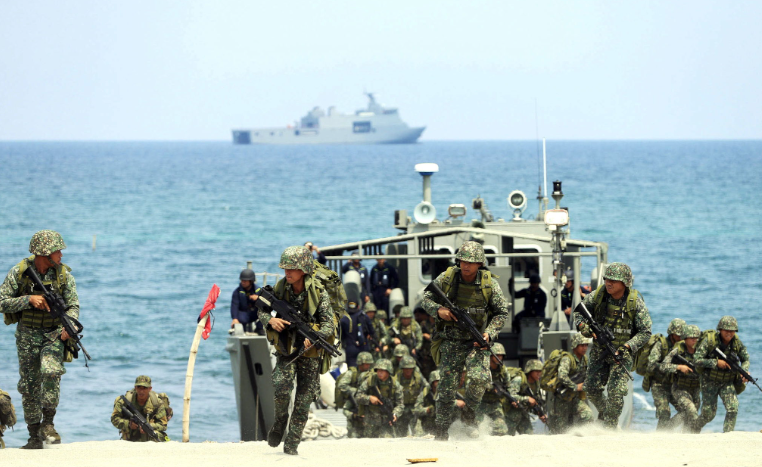


The Philippine Navy will send its most advanced warships to this year’s Balikatan exercises with the United States. This move highlights the major upgrades made to the navy’s fleet in recent years.
Balikatan means “shoulder to shoulder.” It is an annual joint exercise between the Philippines and the United States. The drills focus on sea cooperation, coastal defense, disaster response, and overall military readiness. The exercise is scheduled to run from April to May.
The deployment of these modern and heavily armed vessels shows the navy’s improved capabilities. It also highlights their role in defense, surveillance, and coordinated training with allied forces.
Modern Frigates Lead the Naval Lineup
At the core of the Philippine Navy’s role in the Balikatan exercises are its guided-missile frigates, which are built to counter threats from the sea, air, and underwater. In particular, two classes will take part: the Jose Rizal class and the newer, more powerful Malvar class.
No shots fired, but message sent: Philippine Navy shadows Chinese frigate near Zambales
The Jose Rizal-class frigates entered service between 2020 and 2021 and as a result marked a major upgrade for the navy. These 2,600-ton warships are equipped with modern radar and sensor systems, a 76-millimeter main gun for air and surface defense, C-Star anti-ship missiles, and torpedoes for anti-submarine operations. In addition, close-in weapons systems and heavy machine guns provide protection against nearby threats.
Meanwhile, the Malvar-class frigates, delivered and commissioned in 2025, are larger at around 3,200 tons and carry heavier firepower. They feature twice the number of anti-ship missiles compared to the Jose Rizal class, allowing them to engage more targets during operations.
Most notably, a key advancement on the Malvar class is the vertical launch system, which enables the firing of surface-to-air missiles to defend against aircraft and incoming missiles. Like their predecessors, these ships are also fitted with advanced sensors that support multi-role combat operations.
Landing Docks and Support Ships in Balikatan Action
In addition to combat ships, the Philippine Navy will also deploy large landing dock vessels to the Balikatan exercises. These ships are designed to carry troops, vehicles, and supplies and are often used for missions that support people on land.
Two landing docks will participate: BRP Tarlac and BRP Davao del Sur. These vessels are among the biggest ships in the Philippine Navy and play an important role beyond combat.
Landing docks are commonly used to transport soldiers and equipment during military operations. They also play a vital role in humanitarian assistance and disaster relief missions. Their large decks and storage areas allow them to carry food, water, medical supplies, and rescue equipment. These supplies can be delivered to areas affected by natural disasters.
During Balikatan, these ships are expected to support joint activities. These include moving forces, practicing amphibious operations, and coordinating logistics with partner forces. Their participation shows that the exercise is not only about combat training. It also focuses on preparing for emergencies and large-scale responses.
All ships taking part in the exercise are fitted with communication systems. These systems allow them to share information with other vessels and aircraft. This makes coordination smoother and helps different units work together as one force during drills.
Advanced Systems for Multi-Role Operations
All Philippine Navy ships joining this year’s Balikatan exercises are designed for multiple missions. They can shift from patrol and defense to rescue and support roles, allowing them to respond to different situations at sea.
The frigates are equipped with advanced sensors that monitor large ocean areas. These systems track ships, aircraft, and underwater activity, giving crews clear awareness and allowing information sharing with allied forces during joint drills.
Tensions flare in West Philippine Sea after Chinese frigate spotted near Zambales EEZ Waters
Their weapons are layered for protection at different ranges. Missiles handle distant threats, main guns cover mid-range targets, and smaller weapons defend against close dangers, helping the ships operate safely in complex conditions.
Landing dock ships focus on endurance and support rather than heavy combat. They can operate for long periods, transport troops and supplies, serve as floating bases, and play a key role in disaster response missions.