


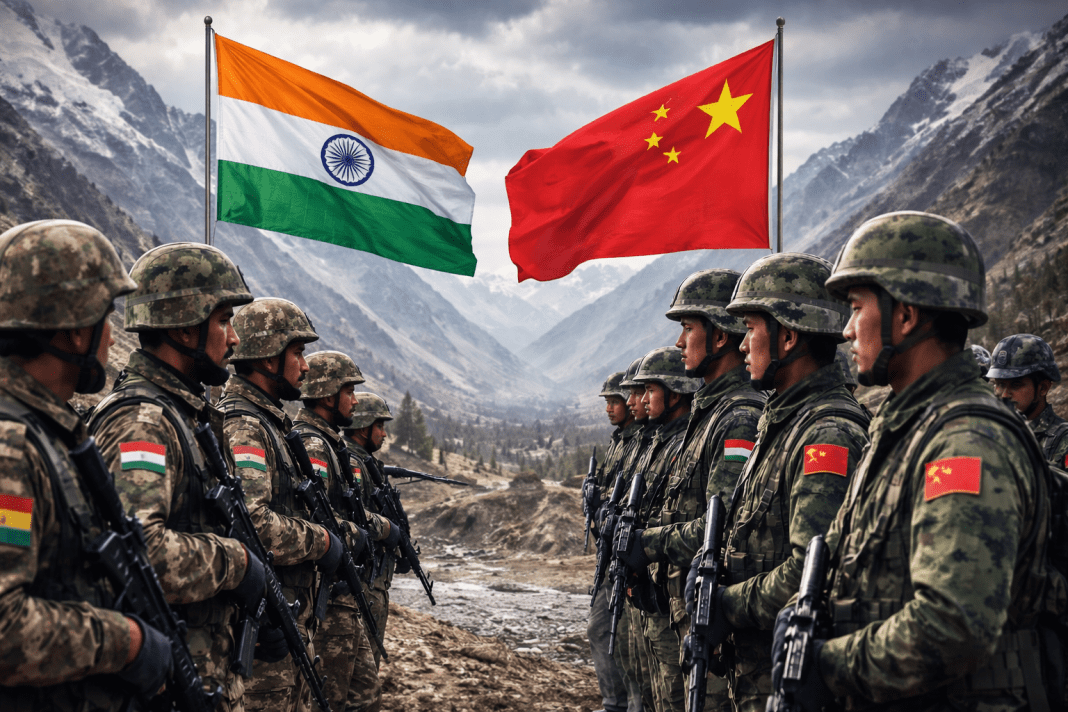


China’s long-standing Arunachal Pradesh claim has once again come into sharp focus after the US Department of Defense released its latest annual report on China’s military power. The report, submitted to the US Congress, offers a detailed look at Beijing’s strategy in South Asia and explains why India views China’s actions with growing concern.
China’s Arunachal Pradesh Claim and Rising Alarm for India After Pentagon Report
According to the Pentagon, China has formally expanded its list of so-called “core interests” to include Arunachal Pradesh. This is significant because Beijing considers issues defined as core interests non-negotiable and central to its national goals. China no longer treats the Arunachal Pradesh claim as a routine border dispute but ties it to its vision of national rejuvenation.
India has repeatedly rejected China’s Arunachal Pradesh claim, stating clearly that the state is an integral part of India. Arunachal Pradesh has an elected government, Indian administrative systems, and representation in Parliament. Despite this, China continues to refer to the region as “Zangnan,” or the southern part of Tibet.
Brahmaputra Dispute: 5 Major Risks of India’s and China’s Dam Rivalry
The Pentagon report explains that China’s territorial ambitions are expanding alongside its military power. By placing the Arunachal Pradesh claim alongside Taiwan and the South China Sea, the report suggests Beijing is adopting a more rigid and assertive approach to disputed territories.
This stance raises alarm in India, especially after the deadly 2020 Galwan Valley clash, where 20 Indian soldiers were killed. Although both sides have held talks since then, trust remains fragile. The continued emphasis on the Arunachal Pradesh claim keeps border tensions alive, even during periods of diplomatic engagement.
Border Talks and Arunachal Pradesh Claim Amid China’s Outreach to India
The Pentagon report states that China is trying to ease tensions with India along the Line of Actual Control, while continuing to insist on its Arunachal Pradesh claim. US assessments suggest Beijing hopes calmer borders will prevent India from strengthening its strategic partnership with the United States.
Washington views India as a key partner to balance China’s influence in the Indo-Pacific. The report indicates that China’s outreach is partly aimed at slowing this alignment, presenting itself as a stabilising force while maintaining contentious positions like the Arunachal Pradesh claim.
India-China relations see cautious reset as US tariffs tensions escalate
In October last year, India and China announced a patrolling agreement in eastern Ladakh, leading to disengagement at some forward positions and lowering immediate risks of clashes. Soon after, Prime Minister Narendra Modi and Chinese President Xi Jinping met at the BRICS summit in Russia, their first formal meeting since the Galwan incident.
Following this, monthly high-level talks began, focusing on border management and limited cooperation such as resuming direct flights and reopening visa services. However, the Pentagon report notes that mistrust remains.
India remains cautious, with unresolved areas like Depsang and Demchok still sensitive. China’s repeated insistence on the Arunachal Pradesh claim signals that its core position has not shifted, and the issue continues to be a major obstacle to normalisation between the two countries.
China-Pakistan Military Ties, Nuclear Expansion, and Strategic Pressure on India
While engaging India diplomatically, China is simultaneously deepening its defence partnership with Pakistan, according to the Pentagon report. This dual strategy is seen in India as a coordinated effort to apply pressure from multiple directions.
China is supplying Pakistan with advanced military platforms, including warships, fighter jets, and armed drones. By May 2025, Pakistan had received 20 J-10C multirole fighter jets from China out of a total order of 36. Chinese drones like Wing Loong and Caihong are also part of the military support. US defence assessments suggest China and Pakistan are coordinating “grey zone operations” against India—actions designed to intimidate without triggering open conflict. Intelligence sources describe Pakistan as China’s “pressure valve” against India.
This strategy is particularly concerning when combined with China’s territorial ambitions, including its Arunachal Pradesh claim. India faces strategic pressure along its northern borders and from its western neighbour, backed by Chinese military support.
Historic Breakthrough: India and China Forge Deal to End Border Standoff!
The Pentagon report also highlights China’s rapid nuclear expansion. Beijing is adding an estimated 100 nuclear warheads annually, with its stockpile reaching the low 600s by the end of 2024 and projected to hit around 1,000 by 2030. These forces are being deployed across land-based missiles, submarines, and bombers.
For India, the combination of China’s growing nuclear arsenal, military cooperation with Pakistan, and firm Arunachal Pradesh claim creates a complex security challenge. The Pentagon assessment underscores why Indian policymakers are closely monitoring China’s actions, as these developments together represent a serious strategic concern.