


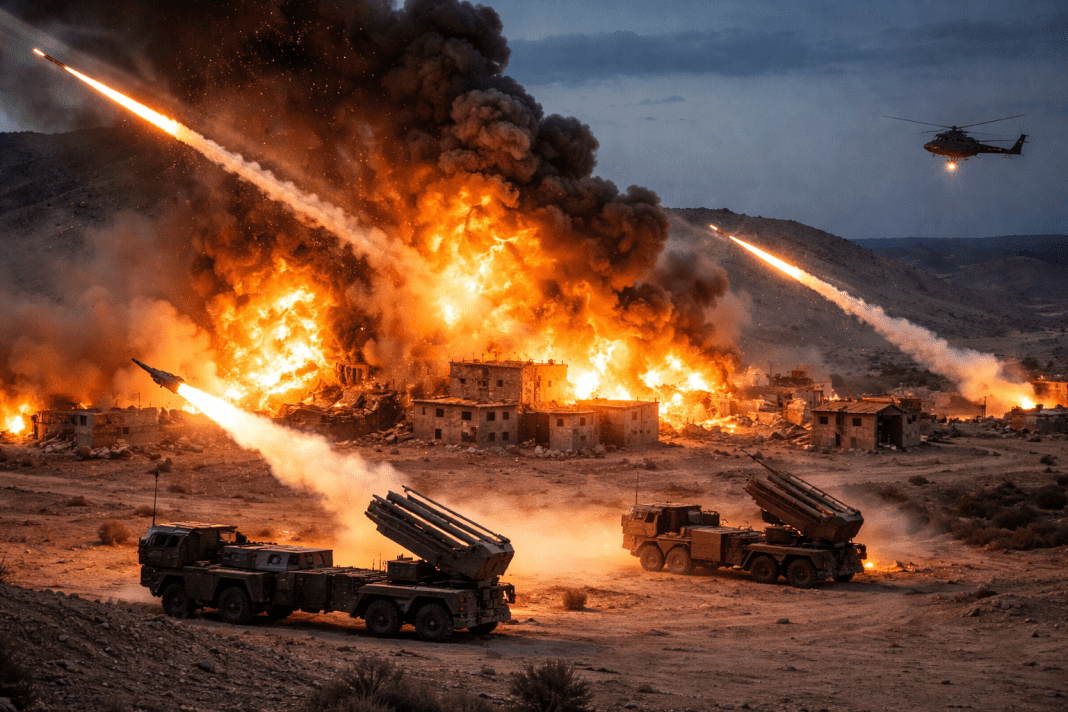


The United States military carried out powerful Retaliatory Strikes against Islamic State targets in central Syria on Friday after a deadly attack on American personnel, with U.S. officials saying the large-scale air and ground operation aimed to quickly weaken the extremist group’s ability to launch further attacks and underscored that U.S. forces remain on high alert despite reduced large-scale fighting in the region.
Deadly Attack Triggers US Retaliatory Strikes
The Retaliatory Strikes were ordered after an attack last weekend in the Syrian city of Palmyra. According to the U.S. military, an attacker targeted a convoy carrying American and Syrian forces. Two U.S. Army soldiers and a civilian interpreter were killed in the assault, while three other U.S. soldiers were injured.
The attacker was later shot dead at the scene. Syrian authorities later stated that the suspect was a member of the Syrian security forces who was believed to sympathize with Islamic State. This revelation raised serious concerns about extremist influence even within official structures.
US soldiers killed while fighting ISIS in Syria, Trump issues stern warning
Following the attack, U.S. officials made it clear that Retaliatory Strikes were imminent. Senior leaders described the response as necessary to protect U.S. forces and to hold Islamic State accountable for its actions. The message was firm and direct: attacks on American troops would be met with force.
The U.S. currently has about 1,000 troops stationed in Syria. These forces work alongside local and international partners to prevent Islamic State from regrouping. Despite major defeats in the past, the group continues to pose a threat through small-scale attacks, making Retaliatory Strikes a key tool in U.S. counterterrorism efforts.
How the Retaliatory Strikes Were Carried Out
U.S. Central Command confirmed that the Retaliatory Strikes hit more than 70 Islamic State targets across central Syria. These included militant hideouts, weapons depots, training areas, and logistical routes used by the group to move fighters and supplies.
The operation involved a wide range of military assets. Fighter jets carried out airstrikes on key locations, while attack helicopters provided close support. Ground-based rocket systems were also used to strike fortified positions. Officials said allied aircraft from a regional partner supported the Retaliatory Strikes, highlighting ongoing cooperation in the fight against terrorism.
Lafarge accused of paying Islamic State group to keep Syria plant running, faces trial in France
Defense officials described the mission as highly successful, saying the Retaliatory Strikes caused serious damage to Islamic State’s operational network. They stressed that the targets were carefully selected using intelligence gathered over time to minimize risks to civilians.
Although the Retaliatory Strikes were intense, U.S. leaders stated that the operation was not meant to start a wider conflict. Instead, it was framed as a decisive response focused solely on Islamic State. The strong language used by officials reflected the seriousness of the attack that prompted the action.
Syria’s Role and the Wider Security Situation
Syria has experienced more than a decade of conflict, leaving parts of the country unstable and vulnerable to extremist groups. Islamic State once controlled vast areas of Syria, but coordinated military campaigns pushed the group out of most territories. Still, the group remains active in isolated regions.
In recent months, U.S.-led coalition forces have carried out frequent operations against Islamic State suspects. These efforts often involve cooperation with Syrian security forces. After the latest Retaliatory Strikes, Syrian officials reiterated their commitment to ensuring that Islamic State has no safe haven within the country.
Syria’s current leadership emerged after years of civil war and includes former rebel groups that have clashed with Islamic State in the past. Despite complex political dynamics, fighting the extremist group remains a shared priority.
Last month, Syria reached an agreement with the U.S.-led coalition to expand coordination against Islamic State. This cooperation set the stage for rapid action, including the latest Retaliatory Strikes, following the deadly attack on U.S. personnel.
U.S.–Israel rift explodes as Trump slams Syria strikes, jeopardizing Abraham Accords expansion
For civilians living near the affected areas, the Retaliatory Strikes brought renewed attention to the ongoing security challenges. While officials did not report civilian casualties, residents in conflict zones often live with uncertainty as military operations continue.
The latest Retaliatory Strikes underline that Islamic State, though weakened, is still considered a serious threat. They also show that the U.S. remains prepared to act swiftly in Syria to protect its forces and disrupt extremist networks whenever necessary.