


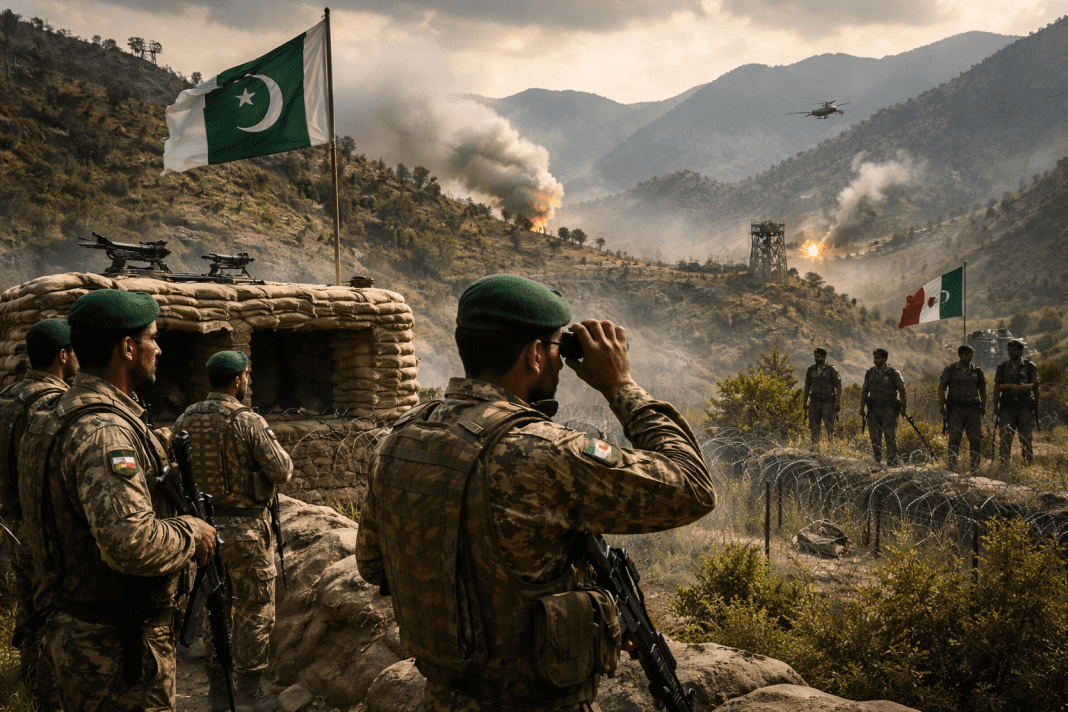


The government of Pakistan has formally accused India of supporting recent large-scale Taliban-linked militant attacks along its western border. The allegation was made during a high-level national security briefing held on Friday, February 27, 2026. Senior officials described the situation as a serious threat to regional stability.
Pakistan Claims “Irrefutable Evidence” After Major Taliban-Linked Border Attacks
Pakistani authorities said recent attacks were carried out by fighters linked to the Afghan Taliban near the Durand Line. The Durand Line is the disputed border between Pakistan and Afghanistan. Officials said the scale and coordination of the assaults were more advanced than previous incidents. They added that this suggested possible external support.
During a security briefing, Defence Minister Khawaja Asif said investigators had recovered what he described as “irrefutable evidence.” He claimed the evidence connected unnamed regional adversaries to the Taliban’s operations. Authorities also highlighted the use of advanced “laser units” in night combat. Officials said the equipment helped militants operate more effectively in darkness. They added that it raised suspicions of outside logistical or intelligence assistance.
Pakistan defence minister Khwaja Asif admits Afghanistan wars were about power, not jihad
Islamabad repeated its claim that hostile actors use Afghan territory to destabilize Pakistan. India rejected the allegations and called them “baseless propaganda.” Indian officials denied any involvement and said Pakistan was trying to shift attention away from its internal security challenges.
Operation Ghazab lil-Haq and Pakistan’s Expanded Military Response
The accusations emerged soon after Pakistan declared what it called an “open war” against Taliban fighters operating across the border. On the same day, Pakistani military leaders announced the launch of a major campaign named Operation Ghazab lil-Haq. Officials said the operation targeted Taliban strongholds in Afghan cities, including Kabul and Kandahar, focusing on command centers, supply routes, and locations allegedly used to plan cross-border attacks.
Military commanders stated the campaign began after repeated warnings to militant groups were ignored. Security officials said recent attacks inside Pakistan caused heavy casualties among both security personnel and civilians, prompting a stronger military response.
Following the announcement, Pakistani military leaders warned that any country assisting what they described as “terrorist elements” would face serious consequences. Although no nation was directly named, earlier accusations against India increased tensions in the region.
Taliban signals Afghans could stand with Iran if US launches strike
Security measures were quickly intensified along Pakistan’s borders. Authorities deployed additional patrols along both the Afghan frontier and the eastern border with India, while checkpoints were strengthened and surveillance operations expanded.
Pakistan’s National Security Council has remained in continuous session, with senior leaders reviewing intelligence updates. Residents in border areas reported increased troop movements and aerial monitoring as local administrations coordinated closely with federal security agencies.
International Reactions and Calls for Restraint
The escalating tensions quickly drew reactions from global powers and international organizations. Officials from Russia and China expressed concern about the growing confrontation and urged all sides to avoid further escalation.
Diplomatic representatives from both countries emphasized the risks posed by rising tensions in South Asia, a region that includes multiple nuclear-armed states. They called for dialogue and restraint, warning that misunderstandings or miscalculations could lead to a broader conflict.
The United Nations also issued a statement urging calm. UN officials encouraged Islamabad and New Delhi to use established diplomatic channels to address their concerns rather than allowing accusations to deepen hostility.
International observers noted that relations between Pakistan and India have historically been sensitive, particularly when security issues or cross-border militancy are involved. Analysts highlighted that allegations involving external sponsorship of armed groups can quickly increase mistrust between neighboring countries.
As tensions rose, diplomatic missions across the region increased monitoring efforts. Several foreign governments advised their embassies to closely follow developments, given the fast-changing security environment.
China voices strong backing for Pakistan after coordinated militant attacks in Balochistan
Meanwhile, Pakistani authorities continued to emphasize that their actions were defensive and aimed at protecting national sovereignty. Indian officials maintained their rejection of all accusations and reiterated their position that they do not support militant activities in neighboring countries.
By Friday evening, security measures remained elevated across Pakistan. Military patrols continued along both western and eastern borders, while government officials held ongoing consultations with defense and intelligence agencies.
The situation remained highly active, with official statements and counter-statements shaping a rapidly evolving regional security landscape.