
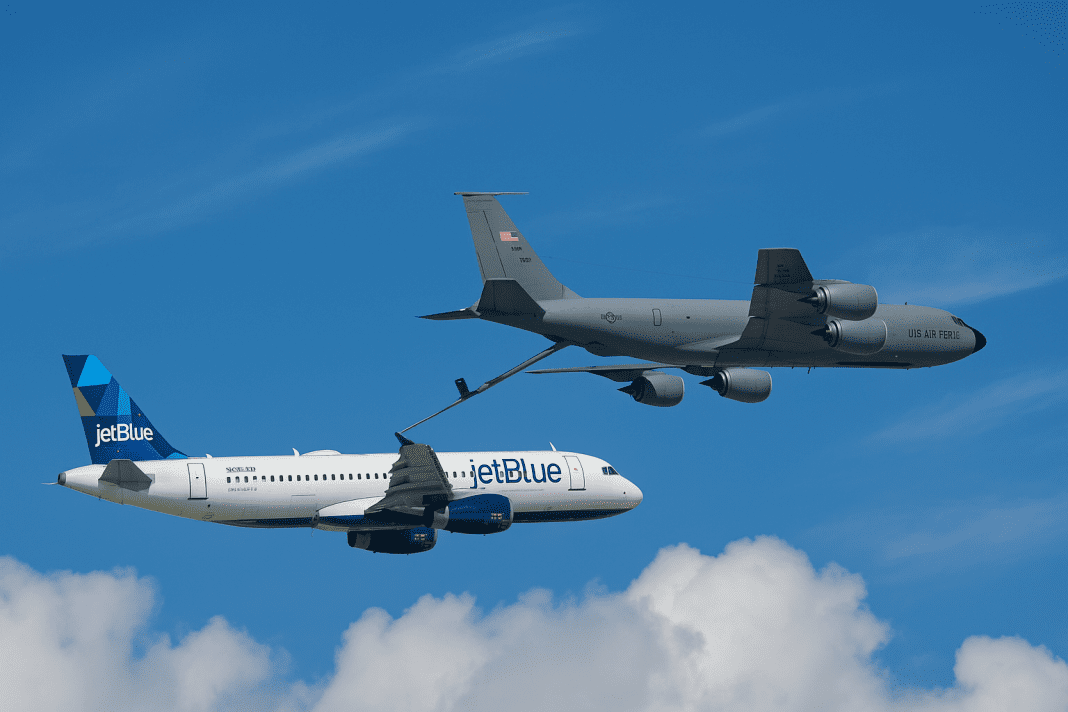

A serious aviation safety incident unfolded over the Caribbean on Friday evening when a JetBlue passenger aircraft narrowly avoided colliding with a United States military refueling plane while climbing out of Curaçao. The close call, confirmed through cockpit audio recordings and flight data, has raised fresh concerns over unidentified military traffic operating in civilian-controlled airspace near Venezuela.
The incident involved JetBlue Flight 1112, which had departed Curaçao for New York’s John F. Kennedy International Airport. Roughly 26 minutes after takeoff, while still under Curaçao air traffic control, the flight crew encountered a US military tanker flying directly across their planned flight path at the same altitude.
Publicly available air traffic control audio captures the pilots describing the situation as a near mid-air collision, forcing them to take immediate evasive action.
Pilots Halt Climb to Avoid Impact
According to the flight crew, the encounter occurred at approximately 5:04 p.m. local time. As the Airbus A320 was climbing, the pilots suddenly spotted the military aircraft passing at close range ahead of them.
To maintain safe separation, the JetBlue crew aborted their climb, leveling the aircraft instead of continuing upward. Flight tracking data later confirmed an abrupt pause in the aircraft’s ascent at the exact time the incident was reported.
In communications with air traffic controllers, one pilot stated that the crew had to act “defensively” to prevent a collision. The tone of the exchange underscored the urgency of the moment.
JetBlue Flight 1112 was operated using an Airbus A320-232, a narrow-body aircraft typically configured to carry around 150 passengers. The flight continued safely after the incident, and no injuries were reported.
Military Aircraft Not Visible on Radar
One of the most troubling aspects of the incident was the apparent absence of a working transponder on the military aircraft. The JetBlue pilots told controllers that the tanker was not visible on their onboard systems, a claim later supported by Curaçao’s air traffic control.
Controllers confirmed that the military aircraft did not appear on radar, severely limiting their ability to manage separation between aircraft in the busy airspace.
“This is unacceptable,” one of the pilots remarked during the recorded exchange, criticizing the risk posed to civilian flights.
Air traffic control acknowledged the seriousness of the incident, apologized to the JetBlue crew, and confirmed that the event would be officially logged. The pilots were instructed to submit a formal safety report.
Authorities Acknowledge Incident, Investigation Begins
The head of DC-ANSP, the organization responsible for air traffic control in Curaçao, confirmed awareness of the near-collision. While declining to comment in detail due to an ongoing investigation, the authority confirmed that the case is being reviewed.
JetBlue is expected to report the incident to the US Federal Aviation Administration (FAA), which may independently examine the circumstances, especially given the involvement of a US military aircraft.
Military tanker aircraft are designed to carry large fuel loads and refuel other aircraft mid-air, often supporting fighter jets and long-range military missions.
Aircraft Headed Toward Venezuelan Airspace
According to the JetBlue crew, the military tanker departed the area shortly after the incident, flying northeast toward Venezuelan airspace. The direction of travel has added to regional concerns, as the area has seen a sharp increase in military activity in recent months.
The United States has expanded its military presence in the Caribbean, deploying warships, surveillance aircraft, and combat jets as pressure mounts on Venezuela. Former President Donald Trump has repeatedly warned of possible military action, further heightening tensions.
Curaçao lies just tens of kilometers north of Venezuela, placing the island’s airspace near an increasingly active military zone.
Earlier Warnings About Unidentified Flights
The near-collision follows a formal warning issued on November 22 by Curaçao’s civil aviation authority. The advisory cautioned pilots about repeated reports of unidentified aircraft operating near Aruba, Curaçao, and Bonaire.
Pilots were told that multiple sightings of unknown aircraft in approach and departure zones had been confirmed by radar. As a result, crews were urged to exercise extreme caution and immediately report unusual aerial activity.
During the same period, the FAA also warned airlines about increased operational risks in Venezuelan airspace, which many international carriers now avoid entirely.
Aviation Experts Say Risks Are Rising
A local aircraft spotter in Curaçao who monitors regional military traffic said the incident was “unfortunate but predictable.”
“With so much military and unidentified air traffic in the region, these close calls are becoming almost inevitable,” the observer said. “Civilian aviation is increasingly sharing airspace with military operations, and that’s a dangerous situation.”
As investigations continue, the incident has renewed debate over airspace coordination, military transparency, and the growing risks faced by commercial aviation in geopolitically sensitive regions.
For now, aviation authorities are urging heightened vigilance as airlines continue operating near one of the Caribbean’s most strategically tense corridors.