


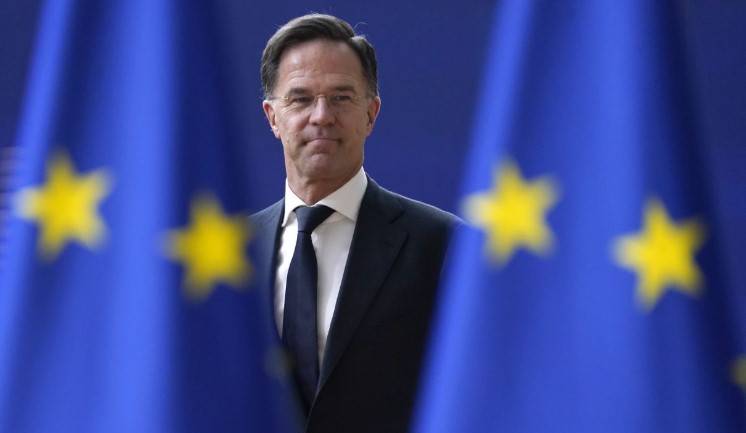


NATO is facing waves of confusion as its European leaders, led by Secretary-General Mark Rutte, confront both Russia’s ongoing war and the implications of the United States’ 2025 National Security Strategy. The tension comes amid bold rhetoric, strategic claims, and a stark divergence between European and American views on security.
Rutte and His Fiery NATO Address
In a dramatic speech at NATO headquarters, Rutte opened by reflecting on a piece of the Berlin Wall preserved as a historical reminder. He called it “a monument to the force of freedom, a reminder of the power of unity, and a lesson that we must stay strong, confident and steadfast.” While the sentiment is powerful, some experts note that Rutte overlooked the broader historical context. The fall of the Berlin Wall not only symbolized freedom but also presented Europe with an opportunity to stabilize its regions and ease tensions with the then-weakened Soviet Union.
Instead, NATO’s current strategy, as articulated by Rutte, frames Russia as an imminent threat despite the country suffering massive casualties in the ongoing conflict with Ukraine. Russia has reportedly lost over 1.1 million troops since the war began in February 2022, with an average of 1,200 soldiers killed or wounded each day in 2025. In this light, analysts argue that Rutte’s emphasis on Russia as a pressing threat seems exaggerated and divorced from current realities.
NATO Panic Mode: U.S. Demands 5% Military Spending or “Peace Is Dead”!
Rutte insisted that Europe must prepare for the scale of war endured by past generations. He linked Ukraine’s struggles directly to NATO’s security, portraying the Kremlin’s ambitions in Ukraine as a broader threat to all of Western and Central Europe. “Allied defence spending and production must rise rapidly. Our armed forces must have what they need to keep us safe, and Ukraine must have what it needs to defend itself – now,” he said. The NATO target to reach 5% of GDP in defence spending by 2035 reflects this push, but critics call it an insular and potentially wasteful strategy.
Conflicting Signals from Washington
Rutte’s rhetoric, however, does not align fully with the United States’ 2025 National Security Strategy (NSS), which has sparked confusion among European allies. The NSS is unusually critical of Europe, portraying the continent as weakened by low birth rates, declining national identities, political infighting, and economic uncertainty. The document questions whether certain European countries will remain reliable allies in the coming decades.
The NSS also criticizes European governments for their handling of the Ukraine war. It claims that some European states allow minority governments to suppress opposition and undermine democratic principles, which in turn prevents meaningful peace initiatives. The strategy suggests that the United States may prioritize its own geopolitical goals over European concerns, hinting at a “Trump Corollary” to the Monroe Doctrine that could focus U.S. attention on Latin America instead.
NATO Rift Deepens as US Demands 5% Defense Budgets — Can Europe Afford the Price?
This creates a sharp contrast with Rutte’s public statements. After his Berlin address, he told the BBC that Trump’s leadership is “good news for collective defence, for NATO and for Ukraine,” claiming that NATO is “stronger than it ever was” under the U.S. president. Yet, the NSS paints a very different picture, one where Europe is a struggling partner that may need close oversight to maintain alignment with U.S. priorities.
The Tension Between Reality and Rhetoric
The confusion at NATO stems from a combination of inflated threat perception and differing policy goals. Rutte portrays Russia as a dangerous, aggressive power, despite clear evidence of massive troop losses and economic strain. Meanwhile, the United States’ National Security Strategy views Europe as increasingly fragile, with some governments failing to uphold democratic principles or prepare adequately for long-term security challenges.
Spain’s Silent Rebellion: The Lone Holdout in NATO’s 5% Defence Revolution
The clash of narratives raises questions about NATO’s cohesion. While European leaders push for higher defence spending and direct support for Ukraine, the U.S. strategy seems to redefine the alliance’s priorities, focusing less on European conflicts and more on U.S. hemispheric influence. NATO’s messaging emphasizes collective defence, but underlying signals from Washington suggest potential limits to its engagement.
This tension between Europe’s perception of risk and the U.S. strategic approach highlights the delicate balance NATO must navigate. Leaders like Rutte advocate strong, visible support for Ukraine and increased military readiness, while U.S. policy documents hint at a more selective, interest-driven approach to alliances.