


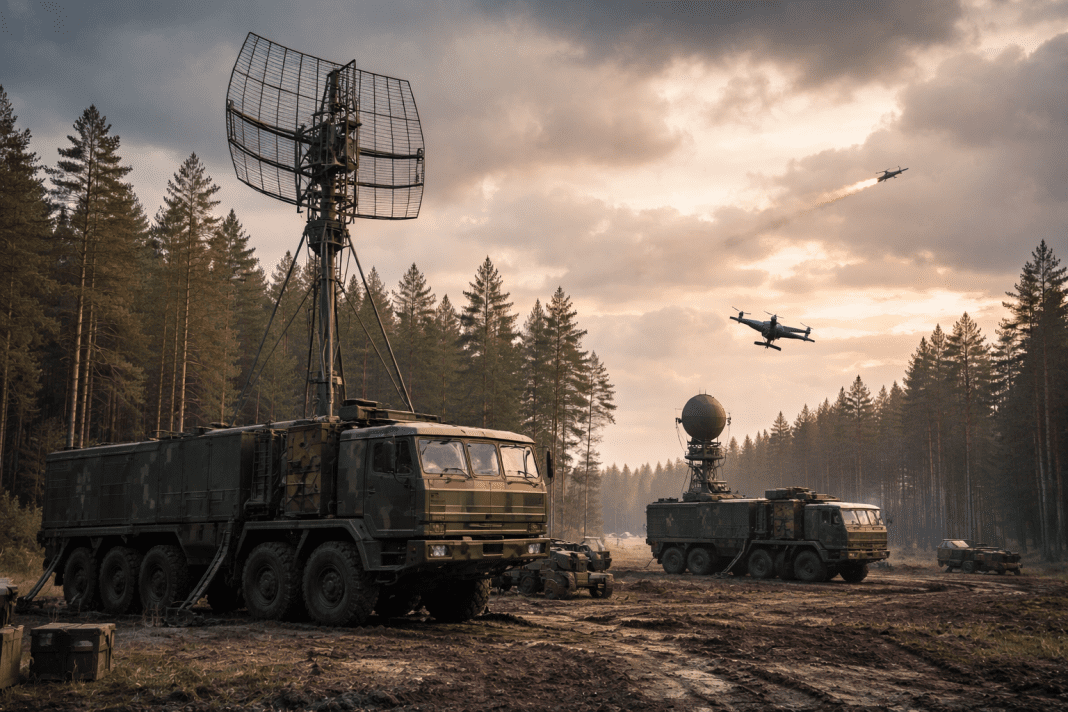


Recent reports based on open-source monitoring suggest changes in Russian radar deployment along the border with Finland. Some low-altitude radar systems appear less visible or no longer active at previously known positions. These systems are important for detecting low-flying aircraft and drones. The observed shifts come amid ongoing pressure on air-defense networks, with similar systems also reported as targeted in other regions during the ongoing conflict.
Reports Show Reduced Radar Presence Along Russia–Finland Border
Recent reports suggest that Russian radar coverage near the Finland border is becoming thinner in some areas. Observations from open-source monitoring indicate fewer active low-altitude radar systems positioned along key northern military sites. These systems are usually used to track low-flying aircraft and drones that can avoid normal radar detection.
Several previously active radar positions near the border are now reported as empty or less active. Satellite comparisons and mapping of older installations show missing equipment at locations once known for surveillance. These changes suggest a shift in deployment patterns, with reduced visible presence of low-altitude detection systems in areas.
Russia tip-off triggers probe into foreign nationals over suspected armed links near India border
Border regions near Finland are strategically important due to proximity to NATO territory. Radar systems in these areas normally provide early warning against airborne threats. Any reduction in coverage raises attention because it affects how quickly low-altitude objects can be detected and tracked across sensitive northern airspace zones overall security.
Low-Altitude Radar Systems Reported Missing or Relocated
The systems reported as missing or relocated include types designed to detect low-flying aircraft and drones. Equipment such as Kasta-2E2 and Podlyot-K1 is built for short and medium-range air surveillance. They help identify threats flying close to the ground where standard coverage is weaker in such operational environments.
Reports indicate several of these units are no longer visible at previously known positions along the border. Satellite imagery comparisons show gaps where equipment once existed. Some former sites now appear inactive, suggesting changes in how air surveillance assets are distributed across different northern monitoring zones over recent months.
Peace in Ukraine won’t end the threat, Finland warns as Russia eyes NATO borders
These radar systems are important because they provide early warning against small, fast, or low-altitude threats. Without them, detecting drones or missiles becomes more difficult. Their movement or loss may reduce coverage in certain areas, especially where continuous monitoring is needed for security and border awareness operations across northern regions.
At the same time, reports connected to ongoing military activity indicate that similar radar systems have been targeted in different regions. Damage or destruction of such equipment may affect overall availability. This has led to increased attention on how air defense resources are being managed across large territories recently observed.
Ukraine Strikes and Strain on Air Defense Network Reported
Reports connected to the ongoing conflict describe repeated strikes on air defense infrastructure, including systems used for detecting aerial threats. These attacks are said to target equipment that tracks drones and missiles. The aim appears focused on reducing the effectiveness of early warning networks in multiple monitored regions recently reported.
Some reports state that systems such as Kasta-2E2 and Podlyot variants have been damaged or destroyed in different locations. These incidents are linked to strikes carried out during ongoing military operations. The loss of such assets can create gaps in air surveillance across affected territories in recent military developments.
Ukraine’s new Shvidun drone hunter destroys nearly 100 targets in active combat
Satellite monitoring and open-source mapping are being used to track changes in radar placement. Analysts compare older images with newer ones to identify missing installations. This method helps show how air defense structures may have shifted or reduced in certain areas over time without official confirmation from available open sources.
Radar systems also play a key role in monitoring airspace activity and protecting military infrastructure. When units are damaged or relocated, remaining systems may need to cover larger zones. This can affect how quickly objects are detected, especially in areas requiring constant surveillance and rapid response capabilities in sensitive regions.