


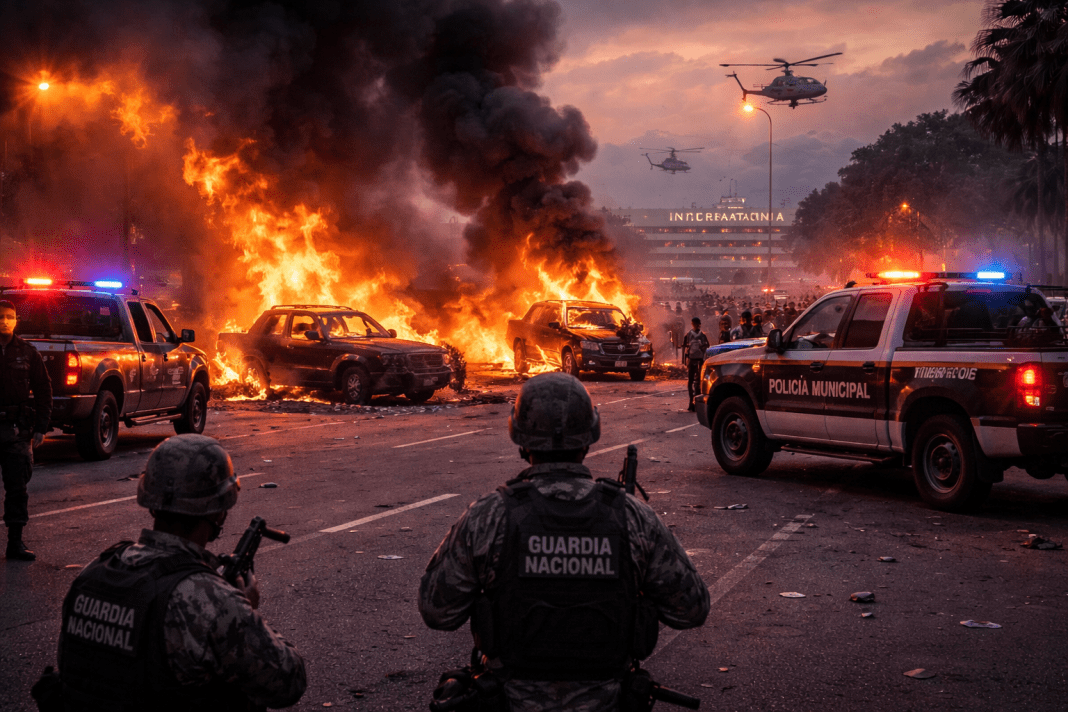


Mexico is facing fresh unrest after a military operation in Jalisco led to the reported death of Nemesio Rubén Oseguera Cervantes, also known as El Mencho. He was the head of the Jalisco New Generation Cartel (CJNG), one of the most powerful and violent cartels operating in Mexico.
Mexico on Edge After Death of CJNG Leader in Jalisco Operation
According to Mexico’s defense ministry, Oseguera Cervantes was seriously injured during a shootout with army forces in Jalisco. Officials said he died while being airlifted to Mexico City for medical treatment. The announcement was followed by rapid escalation on the ground, especially across western Mexico.
This development has placed Mexico security forces on high alert, particularly in urban and tourist-heavy areas. Authorities moved quickly to deploy additional troops and National Guard units to prevent wider spread of violence.
Violence Spreads Across Guadalajara and Puerto Vallarta
Soon after the news broke, armed clashes and roadblocks were reported in Guadalajara, Puerto Vallarta, Tapalpa, and nearby towns. Vehicles were set on fire and used to block highways. Gunfire was reported in several neighborhoods as security forces attempted to regain control.
Air travel was briefly disrupted. Guadalajara International Airport and Puerto Vallarta Airport reported operational impacts as authorities assessed security risks. Some airlines delayed or cancelled flights as a precaution. These disruptions underline how cartel-linked violence in Mexico can quickly affect civilian infrastructure.
Local officials confirmed multiple casualties linked to the security operation and the clashes that followed. In addition to suspects killed during the raid, reports said members of Mexico’s National Guard were killed in separate confrontations in Tapalpa and Zapopan. A jail guard was also killed during unrest at a detention facility in Puerto Vallarta. An official from the Jalisco state prosecutor’s office lost his life in Guadalajara.
At the same time, misinformation spread online. Viral videos claiming a plane was on fire at Guadalajara Airport were later dismissed by the Mexican Embassy in the United States, which stated that the images were generated using artificial intelligence. Authorities urged the public to rely on official updates during the crisis.
The United States issued a shelter-in-place advisory for its citizens in affected parts of Mexico. Canada issued a similar warning, advising Canadians to remain cautious and keep a low profile. These advisories highlight the cross-border impact of cartel violence in Mexico, especially in regions close to major travel routes.
DefTechTimes Perspective: Cartel Leadership Strikes and Regional Security
From a DefTechTimes perspective, the death of a cartel leader such as El Mencho is both a tactical win and a strategic challenge. Removing the head of the CJNG disrupts command structures. However, it can also trigger short-term instability as factions compete for control.
Jalisco holds major economic importance for Mexico. Guadalajara is a technology and business hub. Puerto Vallarta is a key tourism destination on Mexico’s Pacific coast. When violence hits these cities, the effects go beyond local crime. Supply chains, tourism revenue, aviation routes, and investor confidence are all affected.
The reported involvement of a US military-led intelligence task force focused on cartel networks reflects a broader shift. Drug trafficking is increasingly treated as a national security issue rather than only a criminal matter. Intelligence sharing, surveillance coordination, and joint operations between Mexico and the United States are becoming more structured.
Yet leadership decapitation strategies have mixed results. Past cases in Mexico show that removing one cartel leader can lead to fragmentation. Smaller groups may emerge, sometimes increasing localized violence. The key question now is whether Mexican authorities can stabilize Jalisco quickly and prevent CJNG factions from escalating further attacks.
For North America, stability in western Mexico is closely tied to border security, migration flows, and narcotics trafficking routes. Any prolonged unrest in Jalisco could reshape criminal logistics across the region.
In the short term, the priority for Mexico security forces is restoring order in Guadalajara, Puerto Vallarta, and surrounding municipalities. In the long term, the country faces the deeper challenge of dismantling financial networks, arms supply chains, and recruitment systems that sustain cartels.
The situation in Mexico remains fluid. What is certain is that the reported death of El Mencho marks a major turning point in the fight against the CJNG. Whether it weakens the cartel permanently or sparks a new phase of conflict will depend on how authorities manage the next critical weeks.