


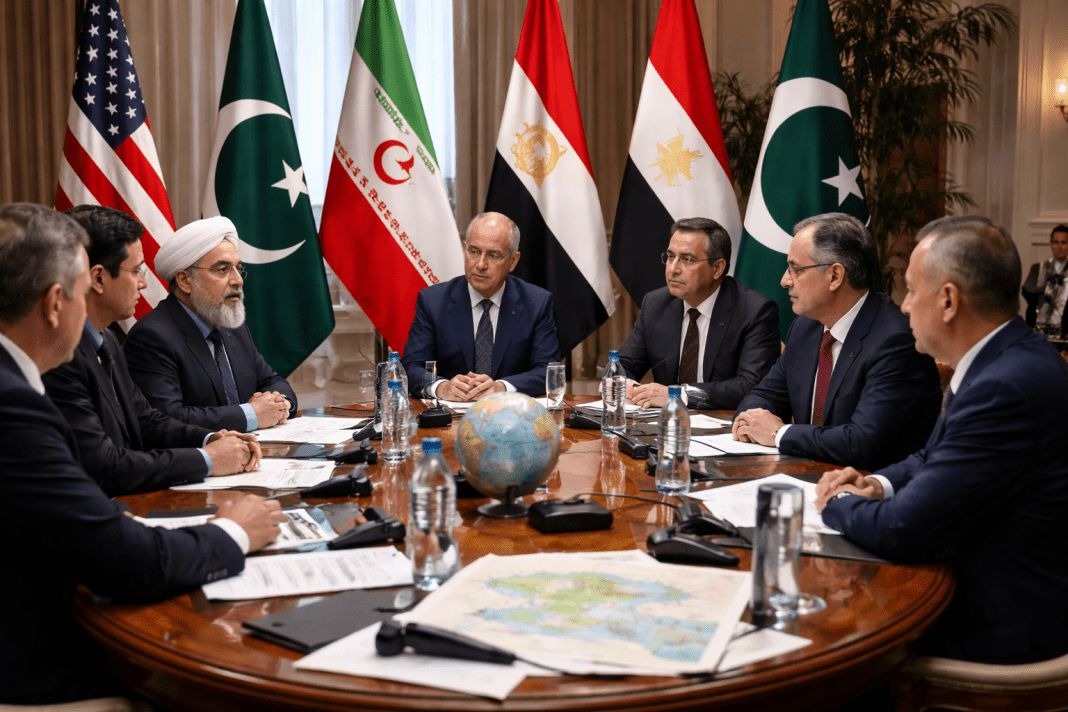


Efforts to ease tensions in the Middle East have intensified as discussions over a proposed 45-day ceasefire continue. Mediators are working to bring both sides toward a temporary pause in fighting, aiming to reduce violence and create space for further dialogue.
However, the situation remains highly unstable. Ongoing attacks, strong warnings, and recent military incidents have added to the uncertainty, making the outcome of these negotiations closely watched worldwide.
Regional Mediators Lead 45-Day Ceasefire Talks
Efforts are underway to pause the ongoing Middle East conflict through a proposed 45-day ceasefire. The plan is being discussed by the United States, Iran, and regional mediators, with the aim of creating a path toward a longer-lasting peace.
Talks are not happening directly but through intermediaries from Pakistan, Egypt, and Turkey. Messages are also being exchanged indirectly, showing how sensitive and complex the negotiations are.
Iran claims a second US F-35 stealth jet was shot down over its central region
If agreed upon, the ceasefire would require both sides to stop military actions for 45 days. This pause could help reduce violence and allow humanitarian aid to reach affected areas.
However, the chances of reaching even a partial deal soon are seen as low. Iranian officials have raised concerns, saying past ceasefires in places like Gaza and Lebanon often existed only on paper, with fighting continuing despite agreements.
Rising Tensions and Ongoing Attacks
While talks are happening behind the scenes, the situation on the ground remains tense and dangerous. On Monday, Iran launched new attacks across different parts of the Middle East. These actions were described as a warning and a response to growing pressure from the United States.
Several countries in the region, including Israel, Kuwait, and the United Arab Emirates, reported missile and drone strikes early in the day. These incidents show that despite ongoing discussions, active conflict continues to escalate.
Iran’s military command has issued strong warnings, stating that any attacks on civilian areas would lead to even more severe retaliation. This statement reflects the seriousness of the situation and the high risk of further escalation.
Experts warn that a quick end to the Iran war could leave the West at a disadvantage
At the same time, strong language and warnings have been coming from the United States. There have been threats related to reopening a key global shipping route, the Strait of Hormuz. This narrow waterway is extremely important for global oil transport, and any disruption can affect economies worldwide.
The situation has become even more tense due to threats targeting civilian infrastructure. There have been warnings about possible strikes on power plants and bridges. Such actions could have a major impact on daily life for civilians, making the conflict even more concerning.
Military Incidents Add to Uncertainty
Amid the rising tensions, there have also been reports of military incidents involving aircraft. One such incident involved a fighter jet going down inside Iranian territory. Images released later showed wreckage of multiple aircraft, though details remain limited.
An airman involved in the incident was reportedly rescued after taking shelter in a mountainous area. The rescue operation took place while forces from both sides were actively searching the region. This situation added another layer of urgency and complexity to the already tense environment.
Iran’s arsenal remains largely intact despite weeks of heavy strikes from the U.S. and Israel
Although images of damaged aircraft have circulated, there has been no clear confirmation from all sides about the full details of the incident. This lack of clarity adds to the uncertainty surrounding the conflict.
The announcement of the rescue was shared publicly and is expected to be followed by further updates. Such developments often increase attention on the conflict and can influence ongoing negotiations.
At the same time, religious observances like Easter were taking place, but even these moments did not slow down the exchange of warnings and threats. This shows how deeply the conflict is affecting daily life and global attention.