


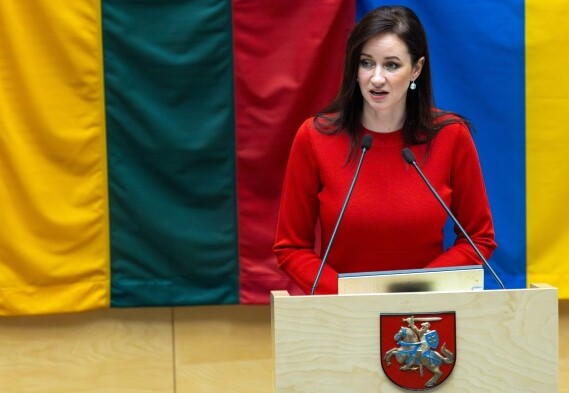


Lithuania’s Prime Minister, Inga Ruginienė, firmly warned on Thursday that Belarus’ recent behaviour — including repeated airspace intrusion incidents and the detention of Lithuanian trucks — could be so harmful that authorities may recognise it as terrorism. Her remarks came after a series of troubling events that have increased concerns about national security and public safety.
Escalating Airspace Intrusion Raises Tensions
The biggest worry at the moment is the ongoing airspace intrusion caused by balloons launched from Belarus. Although smugglers launch many of these balloons, Lithuanian officials say the balloons drift toward important and sensitive areas, including airports. These balloons, often used by cigarette smugglers, have caused several dangerous situations by entering Lithuanian skies without permission.
Prime Minister Ruginienė said it is unacceptable that “balloons are coming from its side and heading toward our strategic facilities and sites.” She added that the detention of Lithuanian cargo trucks by Belarus is also a serious concern, saying Belarus is effectively holding the trucks “hostage.” According to her, this behaviour threatens normal daily operations and puts drivers at risk.
Vilnius Airport — the country’s busiest international airport — had to halt operations three times on Wednesday evening and early Thursday due to the balloon threat. This is not a minor inconvenience, as even a single airspace intrusion can severely disrupt air traffic. Kaunas Airport has also been affected by similar incidents in recent months. These repeated shutdowns have caused delays, forced emergency checks, and raised many questions about how Belarus is allowing or possibly encouraging the problem.
Ruginienė confirmed that she has received support and assurances from the United States. She hopes to meet American officials soon to discuss how both countries can cooperate against this new kind of threat. She stressed that Lithuania does not stand alone and that international partners understand the seriousness of the situation.
Government Ramps Up Security After Airspace Intrusion Reports
Prime Minister Ruginienė said that multiple ministries, security agencies, and defence units are now working together to respond to the recent events. She explained that Lithuania’s armed forces are testing new technologies to detect and neutralise balloons before they cause more airspace intrusion incidents.
When asked by reporters why the military is not simply shooting down the balloons, she clarified that she had never used those words. Instead, she said the armed forces “will use all available means, including kinetic ones, after assessing all circumstances.” This means that the military could use physical force when necessary, but only after studying the risks involved.
Ruginienė made it clear that protecting public safety is her top priority, even if that means making difficult or unpopular decisions. She said, “I choose an uncomfortable situation, I choose uncomfortable questions and perhaps public irritation, but I will do everything to make people feel safe.” Her statement reflects the growing pressure to respond quickly and carefully to each airspace intrusion and related threat.
Lithuanian Railways ends oil shipments tied to sanctioned Russian energy firms
The prime minister said Europe has already begun asking Lithuania for details about its experience handling these balloon incidents. She said, “Everyone understands this is a new threat the world was not prepared for, and we will be the first.” Other countries want to learn how Lithuania is managing the danger, especially because modern hybrid threats are becoming more unpredictable.
Despite the urgency, Ruginienė warned that they cannot solve the situation instantly. She compared it to the long-lasting conflict in Ukraine, explaining that some problems take time to fully control. She said that while Lithuania is moving fast, each airspace intrusion requires careful analysis so that responses do not create more risks.
Why Lithuania Sees This as a ‘New Type of Threat’
Lithuanian officials say that balloons launched from Belarus have been floating across the border repeatedly, causing significant disruptions. These balloons have landed near sensitive sites and forced airport shutdowns several times. Because each event involves an airspace intrusion, aviation experts say the danger is real and cannot be ignored.
In addition to the balloon problems, Belarus is also detaining Lithuanian cargo trucks on its territory. Prime Minister Ruginienė described this as Belarus “holding our haulers’ trucks hostage.” She believes these actions, combined with the repeated airspace intrusion events, show a pattern of behaviour that could fit the definition of terrorism under international law.
Authorities in Lithuania say this situation is a hybrid attack, meaning it uses unconventional methods to pressure or destabilise another country. Hybrid attacks are not always violent in the traditional sense, but they can create chaos, fear, and major disruptions. In this case, a simple balloon becomes a threat when it causes an airport to shut down or when it enters restricted airspace without permission.
Lithuania outraged as Russian jets cross border — NATO responds within minutes
Prime Minister Ruginienė emphasised that the world has never faced this specific kind of danger before. Balloons drifting into a neighbouring country’s airspace may seem harmless at first, but when they cause multiple airspace intrusion incidents, they become a serious national security issue. Lithuanian officials say these balloons are intentionally released near the border and that Belarus is not stopping the activity.
As the incidents continue, Lithuania is working with its armed forces, civil aviation authorities, and international partners to prevent further airspace intrusion risks. The government is also monitoring how often the balloons appear and how they behave once they cross the border.