


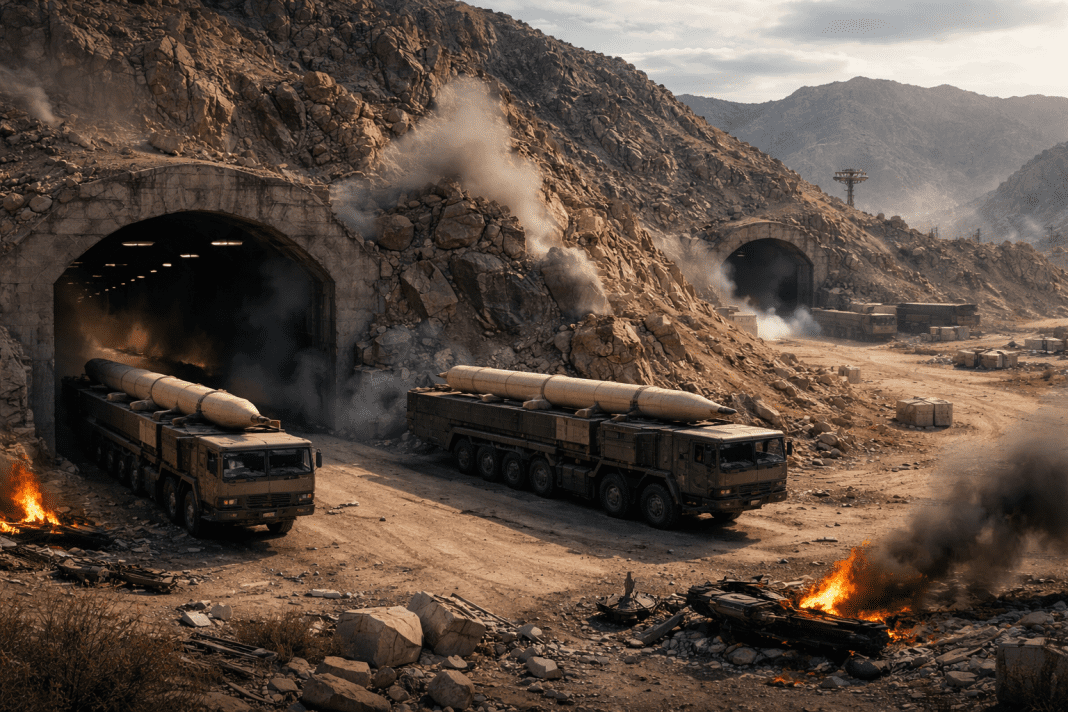


For years, Iran built underground “missile cities” inside mountains. The aim was to protect its missile arsenal from enemy airstrikes. Recent strikes linked to the confrontation involving the United States and Israel have put this strategy under pressure. Satellite images show damaged launchers and destroyed equipment near several base entrances. This has raised questions about how effective these bunkers are during active conflict.
Iran’s Underground Missile Cities
Iran began developing underground “missile cities” many years ago as part of its broader defense strategy. These facilities were built to store missiles, launcher trucks, and other military equipment deep inside tunnels carved into mountains. The goal was to keep weapons hidden and protected from enemy airstrikes.
The underground bases are believed to contain long corridors, storage areas, and spaces where missiles can be prepared for launch. In some cases, trucks carrying missiles can move through the tunnels and exit through protected openings when needed.
Tehran’s underground “missile cities” unleash surprise attacks, putting Israel on high alert
In early 2025, Iran released video footage showing what it described as one of its largest underground missile cities. The clip showed narrow corridors filled with military vehicles carrying missiles. However, the exact location of the base was not revealed.
Some sites also include underground missile silos dug into mountainsides. These shafts allow missiles to be launched without being moved outside. However, technical challenges and difficulties in reusing the silos have limited their use, leading to greater reliance on mobile truck-based launch systems.
Airstrikes Target Entrances and Surface Infrastructure
Most of Iran’s underground missile bases still have important structures above ground. These include tunnel entrances, support buildings, and roads used by missile trucks and supply vehicles. While the missiles themselves are stored deep underground, these surface features make it possible for satellites and surveillance aircraft to identify the locations of the bases.
During recent strikes, aircraft and drones have reportedly focused on these vulnerable points. Bombs have been dropped near tunnel entrances and nearby facilities. Satellite images taken after the attacks show destroyed launchers and damaged equipment close to several missile base entrances. Some launch vehicles appear to have been hit while outside the tunnels, possibly while preparing for launches.
US Navy conducts rare submarine torpedo strike against Iranian warship in international waters
Several sites across Iran have reportedly been targeted more than once. These include locations near major cities in the south, as well as bases in western and northwestern regions. Satellite photographs show visible damage around some of these facilities.
Military analysts say this strategy allows attacking forces to weaken missile operations without destroying the entire underground complex. Another reason is the limited number of specialized bombs designed to penetrate deep bunkers. By targeting entrances and launch equipment, strikes can slow missile deployments or trap equipment underground when attacks take place.
Iran Adjusts Missile Deployment Strategy
Recent reports indicate that missile and drone launches from Iran have decreased in recent days. Officials monitoring the conflict say this decline may be partly due to strikes on missile launch sites and related infrastructure. Another possibility is that Iran is conserving its missile supply instead of using it rapidly during the conflict.
Estimates of Iran’s missile arsenal vary widely. Some assessments suggest the country had around 2,500 ballistic missiles before the conflict began, while other estimates place the number closer to 6,000. The exact size of the remaining stockpile is not publicly known.
Doha explosions follow missile threat as Israel confirms incoming projectiles from Iran
There are also signs that Iran may have moved some missile launchers out of underground bases before the conflict intensified. Spreading equipment across different locations can reduce the risk of losing large numbers of missiles in a single strike. Mobile launchers mounted on trucks allow weapons to be relocated quickly, making them harder for enemy forces to track and destroy.
At the same time, underground “missile cities” remain an important part of Iran’s military infrastructure. Many of these bases have multiple tunnels and hidden chambers. While strikes have targeted infrastructure around them, these complex underground systems remain difficult to fully destroy.