


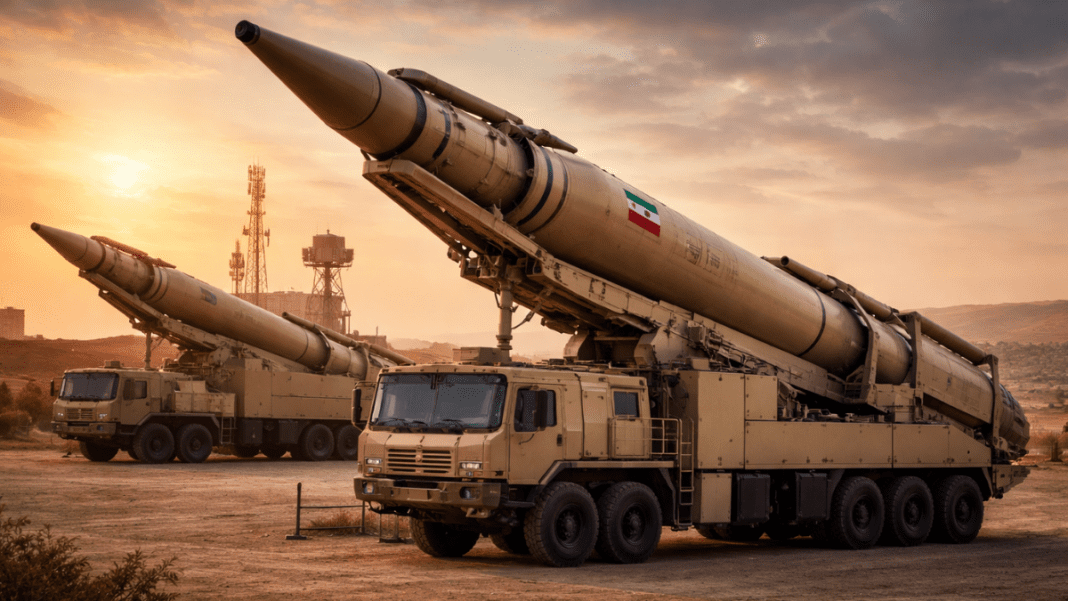


Tensions between Iran and the United States remain high. Security planners are closely watching Iran’s missile arsenal and overall missile capabilities. Iran cannot strike the US mainland. However, its ballistic and cruise missiles can threaten US forces across the Middle East. These systems could also pressure NATO allies like Germany and Italy through indirect regional deployments.
Iran’s missile arsenal and why it matters
Iran’s missile arsenal includes different families of weapons, each designed for a specific role. Ballistic missiles are the most discussed because they travel at very high speeds and are difficult to intercept once launched. Iran operates many short-range ballistic missiles that can strike targets a few hundred kilometers away, mainly aimed at nearby military bases, airfields, and key infrastructure.
One of the most important groups is the Fateh family. These solid-fuel missiles can be launched quickly from mobile vehicles, making them harder to detect and destroy before use. Some Fateh variants have enough range to hit major military bases and ports across the Gulf region.
Iran also fields longer-range missiles such as the Shahab series. These systems allow strikes across much of the Middle East. The Shahab-3, for example, can reach Israel and several US military facilities in the region. Another advanced missile, Sejjil, also uses solid fuel, allowing faster launch times compared to older liquid-fuel systems. Its long range puts many regional targets within reach in minutes.
Alongside ballistic missiles, Iran relies on cruise missiles for precision attacks. These weapons fly low and follow terrain, helping them avoid radar while accurately hitting specific targets. Iran also uses anti-ship cruise missiles, which pose risks to naval forces and commercial shipping, especially in narrow waterways like the Strait of Hormuz.
How Iran could threaten NATO allies like Germany and Italy
Germany and Italy are key NATO allies that support US military operations through bases, command centers, and logistics hubs across Europe and the Mediterranean. Iran cannot strike these countries directly from its own territory, but its missile arsenal and broader missile capabilities allow it to apply indirect pressure.
One approach is forward deployment. Iran maintains close ties with allied groups across the Middle East, where missiles or related technology from its missile arsenal could be positioned closer to Europe. From these locations, even medium-range missiles could threaten parts of southern Europe or facilities linked to NATO operations.
Iran protests continue under Khamenei as US military aircraft movements draw attention
Iran also relies on layered escalation rather than a single large attack. This strategy uses different types of weapons at the same time to strain air defenses. Ballistic missiles draw attention as fast, high-altitude threats, while cruise missiles fly low and approach from multiple directions. This combination makes interception more difficult.
Naval risks are another concern. Italy plays a central role in Mediterranean naval missions, and Iranian anti-ship missiles, drawn from its missile arsenal and used directly or through partners, could threaten vessels supporting NATO activities. Even the possibility of such attacks can disrupt operations and increase security and insurance costs.
These factors explain why European security planners closely monitor Iran’s missile developments, focusing on indirect threats as well as direct risks.
Operational risks to US forces and regional stability
US military forces are spread across the Middle East, with bases in Gulf countries and naval units operating at sea. Iran has shaped its missile arsenal to target these assets. Short- and medium-range ballistic missiles can reach bases in places such as Qatar, Kuwait, and the United Arab Emirates within minutes, leaving very little time for warning or defense.
Cruise missiles add to the challenge. Flying low and from unexpected directions, they can slip past radar coverage and strain even advanced air defense systems. When combined with ballistic missiles, they create a complex and difficult threat environment.
Middle East on edge as UAE draws red line and US warships move closer to Iran
At sea, Iran’s anti-ship missiles pose risks to naval forces operating near its coastline. Narrow waterways increase this danger, as ships have limited space to maneuver. These threats affect not only military planning but also commercial shipping and regional energy flows.
Iran also operates space launch vehicles. While not weapons, they use similar technology to long-range missiles and highlight Iran’s growing technical expertise. Together, these capabilities explain why Iran’s missile force is central to discussions about possible responses to US military action.