


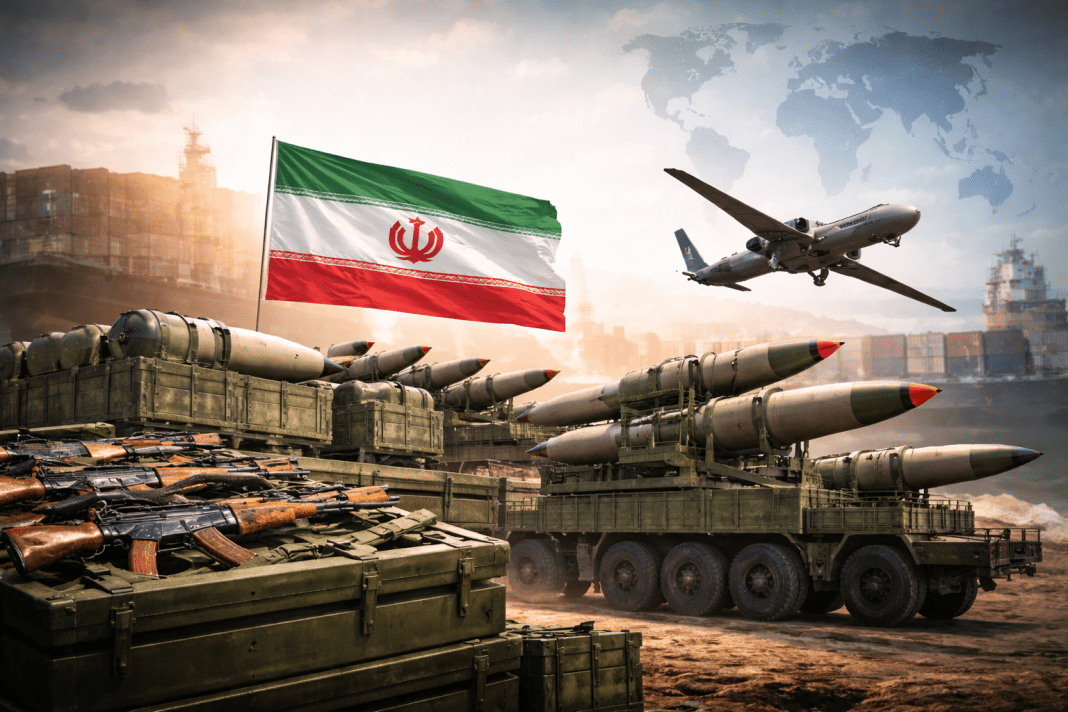


Iran may be a small player in global arms exports, accounting for just 0.4% between 2020 and 2024, but its drones, missiles, and military equipment have a big strategic impact. Despite sanctions and limited market access, Tehran uses these weapons to influence conflicts across the Middle East and beyond, supplying allies, partners, and even non-state groups.
From Moscow to Caracas: Major Powers Receive Iran’s Arms
Iran’s largest client for weapons in recent years has been Russia. Between 2020 and 2024, about 80% of Iran’s arms exports were sent to Moscow. This close relationship deepened after Russia’s invasion of Ukraine, as Iranian drones and other systems became critical to the Russian military supply chain.
These drones are not small gadgets—they are part of the weapons Russia uses in active conflict zones. Iranian technology helps Moscow maintain an edge where it counts, making Tehran’s relatively small exports strategically significant.
Beyond Russia, Iran has looked further afield. Venezuela, in South America, has emerged as the second-largest recipient of Iranian weapons, taking in around 11% of exports. While the numbers may seem modest, the partnership is important because it allows Iran to project power far from its home region. Tehran has even shared drone technology with Venezuelan firms, letting them assemble Iranian drones locally. Some of these drones are based on the Mohajer series, which have been in use since at least 2006.
The United States has been closely monitoring these exchanges. In December 2025, the U.S. Treasury imposed sanctions on ten individuals and organizations in Iran and Venezuela, targeting the transfer and production of drones. These steps aim to disrupt Iran’s influence in Latin America and its broader network of arms exports.
Fueling Proxy Wars: Non-State Actors and Regional Influence
Iran does not only deal with major powers. A unique part of its export strategy is supplying non-state actors. Around 7.1% of Iran’s arms exports have gone to Houthi forces in Yemen. Unlike most countries that export weapons, Iran openly supports groups that are not part of any recognized government.
Suspected Iranian arms cargo ship sinks in the Caspian, spotlighting a shadow war route to Russia
These transfers are part of a deliberate strategy to influence regional conflicts indirectly. By equipping allied groups with drones, missiles, and other military tools, Iran can shape battles without being directly involved. This approach has allowed Tehran to extend its influence in conflicts from Yemen to other parts of the Middle East, making it a key player even with a relatively small export footprint.
Within the region, Iran’s scale is modest compared to neighbors. Israel exported 3.1% of the world’s arms between 2020 and 2024, while Türkiye accounted for 1.7%. Other Gulf countries mainly import weapons rather than export them. Despite being smaller in scale, Iran’s exports are highly targeted, giving them a strategic punch beyond their volume.
Sanctions, Embargoes, and the Limits of Expansion
Iran’s arms exports have always been affected by international rules. The United Nations imposed an arms embargo on Iran starting in 2006 over concerns about nuclear and missile programs. Some restrictions were eased under the 2015 nuclear deal, but by late 2025, the embargo was fully re-imposed after a resolution to continue lifting sanctions failed.
These restrictions have not stopped Tehran from exporting weapons entirely, but they have set limits. Structural barriers like sanctions, technology controls, and market access issues mean Iran cannot expand freely. Despite this, the country recorded a dramatic 749% increase in arms exports compared with the 2015–2019 period. The rise reflects new partnerships formed after 2020, particularly with countries like Russia and Venezuela.
Russia steps into Middle East diplomacy as Putin holds talks with Netanyahu and Iran’s president
Even though volumes leveled off in 2024, the pattern shows that Iran is carefully choosing where to send its drones and missiles. Each shipment is meant to strengthen strategic ties or influence ongoing conflicts, rather than simply making a profit.
Iran’s export profile may be narrow, but it is telling. Its weapons are reaching major powers, distant allies, and regional proxies alike. By sending drones and missiles to Russia, Venezuela, and groups like the Houthis, Tehran is extending its reach far beyond its borders. Even in small numbers, these arms have a noticeable impact, shaping wars, conflicts, and global geopolitics in ways that go beyond the numbers.