


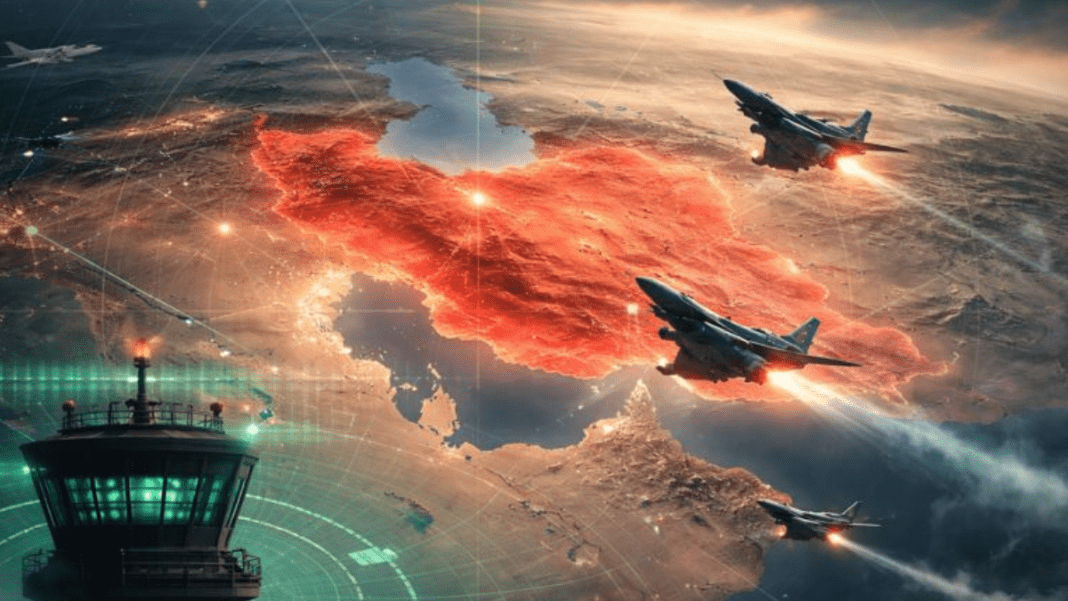


Iran briefly closed large parts of its airspace early Thursday, raising global concern as Western military officials said intelligence signals suggest US military action could be imminent. The move disrupted international flights, triggered emergency advisories from several countries, and added to growing tension across the Middle East. While no attack was confirmed, the fast-moving developments put the region on heightened alert.
Iran Closes Airspace as Regional Tensions Rise
In the early hours of Thursday, Iranian authorities issued a NOTAM, or Notice to Airmen, ordering a temporary shutdown of the country’s airspace. The restriction applies to most flights, with only a limited number of international routes allowed to operate with special government approval.
Flight tracking data showed that aircraft rapidly avoided Iranian and Iraqi airspace even before authorities formally issued the notice. Officials initially scheduled the closure to last a little over two hours, ending around 2:30 a.m. Israel time, but later extended it until about 5:00 a.m.
Suspected Iranian arms cargo ship sinks in the Caspian, spotlighting a shadow war route to Russia
The sudden decision immediately affected international travel. India’s largest airline, IndiGo, said the closure disrupted several of its international flights. A Russia bound Aeroflot flight heading to Tehran turned back mid-air and returned to Moscow. Other airlines rerouted flights to avoid the region, causing delays across multiple routes.
Authorities usually impose airspace closures during periods of military alert to reduce risks to civilian aircraft. In this case, the timing fueled speculation that Iran was responding to a possible escalation involving the United States.
Western Intelligence Signals and the US Response
Around the same time, a Western military official reported that intelligence indicators pointed toward a potential US attack on Iran. The official said the signals suggested action could be imminent but added an important caveat. According to the official, unpredictability is a known feature of the current US administration’s approach and is sometimes used as a strategic tool.
This meant that while warning signs were present, they did not automatically confirm that military action would follow. The official stressed that uncertainty itself can be part of pressure tactics.
Shortly before Iran issued the airspace notice, US President Donald Trump addressed reporters at the White House. He said he had been informed that killings in Iran were “stopping,” suggesting a possible pause in violence. When asked whether the United States was still considering military action, Trump replied, “We’re going to watch and see what the process is.”
The statement neither confirmed nor ruled out a strike, but it showed that Washington was closely monitoring the situation. At the same time, the US took precautionary steps by withdrawing some military personnel from Al Udeid Air Base in Qatar, one of its key installations in the region. Such withdrawals are commonly used to protect troops during periods of elevated risk.
Global Warnings and Regional Reactions
As tensions rose, several governments moved quickly to protect their citizens. Poland and Italy urged their nationals to leave Iran immediately. The British government temporarily closed its embassy in Tehran, and the United States issued similar advice to its own citizens less than a day earlier.
Officials typically take these steps only when they believe there is a serious risk of sudden instability. Embassy closures and evacuation advisories signaled growing concern about Iran’s internal security environment. Warnings from Tehran further heightened regional tensions.
Earlier on Wednesday, a senior Iranian official informed that Iran had informed neighboring countries it would respond strongly if the US launched an attack. Accordingly , Iran warned it would strike US military bases located in those countries in retaliation.
This message raised alarms across the Middle East, where several nations host US forces. Any conflict involving Iran and the United States could quickly spread beyond their borders, affecting multiple countries and military installations.
The airspace closure also had wider effects beyond Iran. Parts of Iraqi airspace saw reduced traffic as airlines chose safer routes. Such disruptions can ripple across global aviation networks, delaying flights between Europe, Asia, and the Gulf.
Crypto Wallet Exodus Penalized by OFAC for Advising Iran-Based Users on VPN Workarounds
Throughout the developments, officials emphasized that the situation was changing rapidly. Officials made no official confirmation of a US strike, but intelligence warnings, airspace restrictions, military movements, and diplomatic advisories underscored the growing tension.
The events highlighted how closely linked aviation safety, military decisions, and international diplomacy are during crises. Even short-term measures, such as closing airspace for a few hours, can signal deeper concerns and trigger global reactions when tensions are already high.