


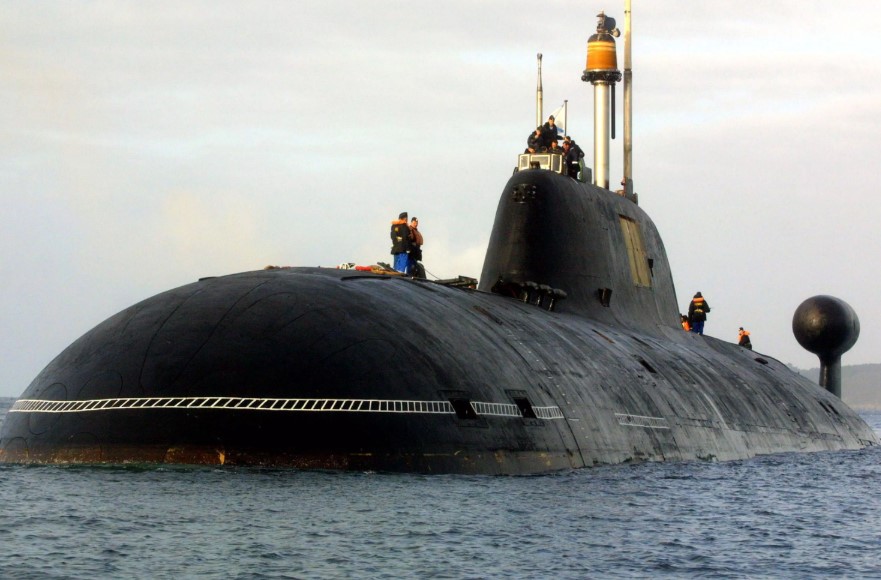


India has taken a significant step to boost its naval strength by finalizing a deal to lease a Russian nuclear-powered attack submarine. The agreement, reportedly worth $2 billion, involves India leasing the K-391 Bratsk, a 36-year-old Akula-class submarine, for a 10-year period starting in 2028. The deal, first signed in 2019, had remained largely unacknowledged until now. Russian authorities have confirmed the arrangement, while India has not yet released an official statement.
This submarine lease represents a major upgrade to India’s naval capabilities, especially with the possibility of mounting advanced missiles, including the Indo-Russian BrahMos and Russia’s hypersonic Zircon. Defense experts believe the K-391 Bratsk could significantly enhance India’s underwater strike power.
The K-391 Bratsk: Old Vessel, New Capabilities
The K-391 Bratsk is a Project 971 “Shchuka-B” class submarine, known in NATO circles as the Akula-class. The navy commissioned the submarine in 1989 but withdrew it from active service in 1998. Since then, repair teams have attempted multiple overhauls. They first sent the submarine to the Vilyuchinsk facility on Russia’s Kamchatka Peninsula. When the facility could not complete the necessary repairs, engineers moved the K-391 Bratsk to the Zvezdochka shipyard in Severodvinsk.
New India–Russia nuclear submarine pact sends shockwaves through U.S. and China as Putin visits Modi
Repair teams considered the work difficult, and by 2022, Russian reports described the repairs as “infeasible.” However, a new modernization program, Project 09718, revived the project. The program aims to adapt the submarine for India’s requirements. Engineers plan one of the most significant upgrades: installing vertical launch systems (VLS). These systems would allow the K-391 Bratsk to launch BrahMos cruise missiles, which India already deploys on ships and aircraft.
The Bratsk did not originally have VLS. It carried eight torpedo tubes for torpedoes and had limited missile capabilities. Integrating VLS will require engineers to redesign the submarine’s hull extensively, making the K-391 Bratsk the first of its class to carry such a system.
Hypersonic Zircon Potential on the K-391 Bratsk
Beyond the BrahMos, the K-391 Bratsk could potentially carry other Russian missiles such as the Kalibr cruise missile and the hypersonic 3M22 Zircon. The Zircon is known for its extremely high speed and is considered a major development in missile technology. It carries a relatively small warhead of 100–150 kilograms. While this is not enough for large-scale conventional damage, it aligns with the size needed for tactical nuclear weapons.
India’s discounted Russian oil imports come to an end with upcoming sanctions
India, being a nuclear-armed country, could enhance its underwater strike capability with such missiles. However, it remains unclear whether India currently has the technology to deploy tactical nuclear warheads from submarines.
This lease would mark India’s third nuclear-powered submarine from Russia. The country previously leased the K-152 Nerpa, another Project 971 vessel, which served as INS Chakra-2 until it was returned to Russia in 2021.
Strategic and Political Context
India’s ongoing defense cooperation with Russia falls under the scope of the US Countering America’s Adversaries Through Sanctions Act (CAATSA), which can impose penalties on countries conducting major arms deals with Russia. Despite this, the US has not imposed sanctions on India, even though it has purchased other Russian systems, including the S-400 air defense system. This indicates that India continues to engage with Russia for its military modernization without immediate international penalties.
In addition to submarines, India has plans to discuss acquiring advanced fighter jets and air-defense systems from Russia, including the Su-57 and S-500. This points to an expanding defense relationship between the two countries.
India moves to strengthen air defense by considering new S-500 systems from Russia
The delivery of the K-391 Bratsk is scheduled for 2028, reflecting the time needed for its extensive modernization. Once operational, it could give India a significant boost in underwater strike capabilities and allow it to operate advanced missile systems previously limited to newer Russian submarines.
This new India-Russia submarine deal has drawn attention worldwide because of the potential deployment of cutting-edge missiles like the BrahMos and hypersonic Zircon on the K-391 Bratsk. While India has not commented publicly, the deal signals a major enhancement of its naval power and continued strategic collaboration with Russia.