
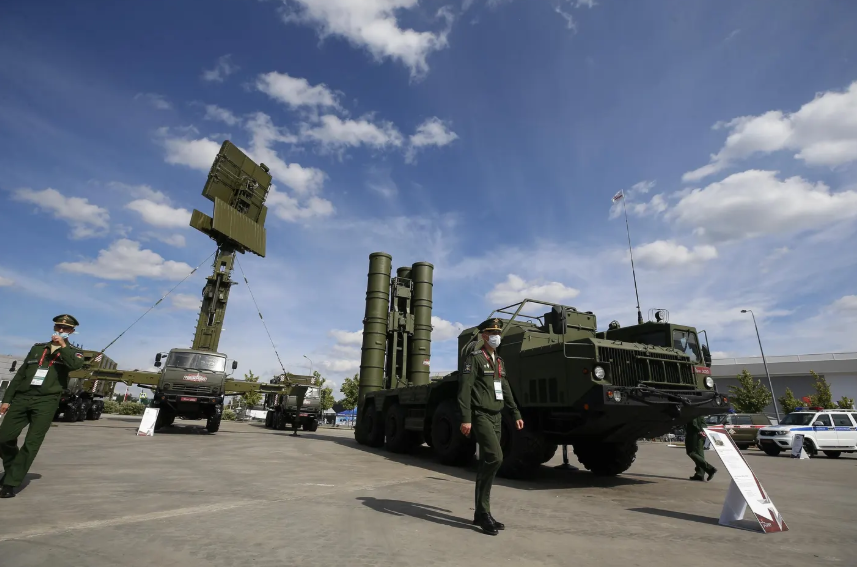

India has not yet placed a fresh order for new S-400 surface-to-air missiles, even as Russia has already begun using export-version missiles of the same family during its war in Ukraine. This situation has drawn attention because India remains the only country with active contracts for the S-400 system, while Russia is facing visible pressure on its own missile stockpiles.
The issue connects three major developments. First, Russia’s recent use of export-designated S-400 missiles against Ukraine. Second, India’s approval process to replenish missiles used during Operation Sindoor against Pakistan. Third, the wider questions around delivery delays and battlefield performance of the S-400 system.
Russia Uses Export S-400 Missiles in the Ukraine War
During a Russian strike on Ukraine on January 23, 2026, missile debris revealed an unusual detail. Analysts identified the remains as a 48N6E2 surface-to-air missile. The “E” in its name indicates it is an export version, not normally meant for use by Russia’s own forces.
Ukraine warns India against echoing Russia’s unproven Putin drone narrative
The 48N6E2 missile is part of the S-400 air defense system, designed to intercept aircraft, drones, and ballistic threats at long range. This variant can strike targets over 200 kilometers away and uses radar guidance to track them accurately.
The discovery drew attention because Russia has very few export customers for the S-400 system, with India currently being the only country holding active contracts. This has raised questions about whether export-designated missiles may have been diverted for use in Ukraine, suggesting pressure on Russia’s domestic missile stockpiles.
India’s S-400 Missile Use and Stock Depletion During Operation Sindoor
India acquired the S-400 air defense system from Russia under a major defense agreement signed around eight years ago. The system was meant to strengthen India’s ability to defend against aircraft, cruise missiles, and other aerial threats across long distances.
During Operation Sindoor in May 2025, India reportedly deployed several S-400 missiles amid tensions with Pakistan. The use of these interceptors reduced existing missile stockpiles, creating the need for replenishment. In response, India’s Defence Acquisition Council approved the purchase of 288 additional surface-to-air missiles for its S-400 units, with the deal valued at about 100 billion rupees, or roughly 1.1 billion US dollars.
New India–Russia nuclear submarine pact sends shockwaves through US and China as Putin visits Modi
Indian media reports say the proposed order includes two missile categories. Officials describe about 120 missiles as short-range and 168 as long-range. Although authorities have not officially confirmed the exact models, analysts believe the short-range missiles belong to the 9M96E family, which can engage targets up to 120 kilometers away using active radar guidance. The long-range missiles are likely from the 48N6E series, with advanced versions capable of engaging targets up to 250 kilometers away.
Despite this approval, India has not yet finalized or signed a new contract, even as Russia uses export-version missiles in combat.
Delays, Performance Questions, and Ongoing Deliveries
India is still waiting for the full delivery of all S-400 air defense systems ordered several years ago. India has already received some units, while others have yet to arrive. Production constraints and the ongoing Ukraine war have largely caused these delays by placing heavy pressure on Russia’s defense industry and manufacturing capacity.
At the same time, the S-400 system’s performance has faced closer scrutiny. During Operation Sindoor, assessments suggested the system did not meet earlier expectations in real combat conditions. In Ukraine, Russian air defense systems from the same family have also shown mixed results against newer threats, including drones and low-flying missiles, raising further questions about their effectiveness.
These issues have made the situation more complicated for both countries. India needs to replace missiles used during Operation Sindoor and build reserves for systems still awaiting delivery. Russia, meanwhile, appears to be under strain, reportedly using even export-designated missiles to support its own military operations.
This overlap has created a notable situation. India has approval to purchase additional S-400 missiles, yet no new order has been formally placed. At the same time, Russia is already using similar export-version missiles in a major conflict, highlighting supply pressures, delivery delays, and challenges in managing defense needs simultaneously.