


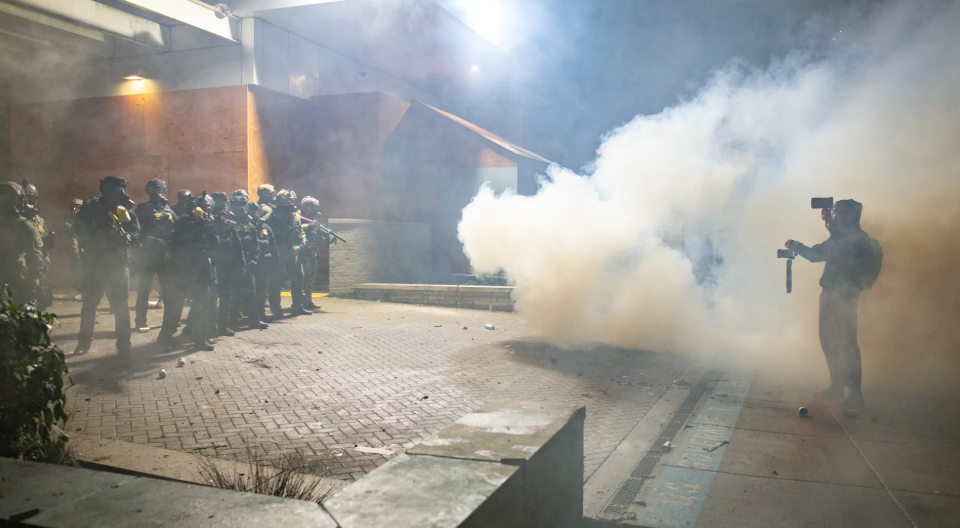


A U.S. judge has temporarily barred federal agents from using tear gas, rubber bullets, or other weapons at protests near ICE office in Portland, Oregon. The ban will last at least 14 days. Officers may only use force if it is legally justified. The judge also prohibited targeting people’s heads, necks, or torsos.
Portland Court Takes Action Over Excessive Force Reports
The ruling comes after several reports of federal officers using excessive force during otherwise peaceful protests. Federal officers shot an 84-year-old woman in the head with a chemical impact munition while she held a sign on a public street. She walked home covered in blood and later received medical treatment, including a concussion diagnosis.
Journalists covering the protests also reported that federal officers attacked them. One freelance video journalist said federal officers shot him in the groin, causing bruises despite his protective gear. On another occasion, the same officers sprayed mace on his face and damaged his camera equipment. A freelance photojournalist said a federal agent shoved him while he documented tear gas canisters being fired into dancing crowds. The agent damaged his camera and then shot him with pepper balls about 20 times.
Judge Simon emphasized the importance of protecting free speech and nonviolent protest. In court filings, he stated, “In a well-functioning constitutional democratic republic, free speech, courageous newsgathering, and nonviolent protest are all permitted, respected, and even celebrated. In an authoritarian regime, that is not the case. Our nation is now at a crossroads.”
The judge noted that independent courts have a responsibility to uphold the law and protect citizens’ rights, which formed the basis for the temporary restraining order.
Local Officials Condemn Federal Actions
Portland Mayor Keith Wilson strongly criticized federal officers for using chemical munitions against protesters. He highlighted that the majority of people at the demonstrations were peaceful and posed no threat to law enforcement. The mayor emphasized that such aggressive actions are unacceptable in a democratic society.
He specifically pointed out that federal agents should never use deadly force against the very citizens they are supposed to protect. Wilson’s comments underline growing frustration with federal intervention in local protests and the perception that it has escalated tensions rather than maintained order.
AOC backs nationwide anti-ICE shutdown while keeping congressional office open
In response to the incidents, the city of Portland is taking concrete steps to limit the use of chemical agents. Officials are moving forward with an ordinance that would impose fees on detention facilities that deploy tear gas, rubber bullets, or similar weapons during public demonstrations.
The proposed ordinance reflects Portland’s effort to protect residents and ensure safer conditions during protests. By holding facilities financially accountable, city leaders hope to discourage excessive use of force and promote a more peaceful approach to handling demonstrations near federal buildings.
Residents File Complaints Over Safety Concerns
Residents living near the ICE office have raised concerns about excessive federal actions. One resident reported being hit five times by rubber bullets, leaving bruises and welts. Others said they had to sleep wearing gas masks or in bathtubs to escape tear gas drifting into their homes. A property management company and residents of Gray’s Landing, located about 100 feet from the ICE office, have filed a lawsuit alleging the federal agents’ actions were excessive and unsafe.
ICE disclosure raises issues for OpenAI CEO Sam Altman as DHS reveals agency use of AI systems
Despite these complaints, the Department of Homeland Security (DHS), ICE, and U.S. Customs and Border Protection have not publicly responded to the court order. However, DHS Assistant Secretary for Public Affairs Tricia McLaughlin blamed local authorities and protesters for failing to maintain law and order. She noted that the frequency of protests near this particular ICE office is higher than at other locations, but said the agency is not at fault for the incidents.
This ruling underscores ongoing tension in Portland, where protests against immigration policies and federal actions have frequently drawn national attention. With the temporary ban in place, federal officers must refrain from using chemical agents or targeting protesters in sensitive ways, giving local residents and demonstrators a period of relative safety near the ICE office.