


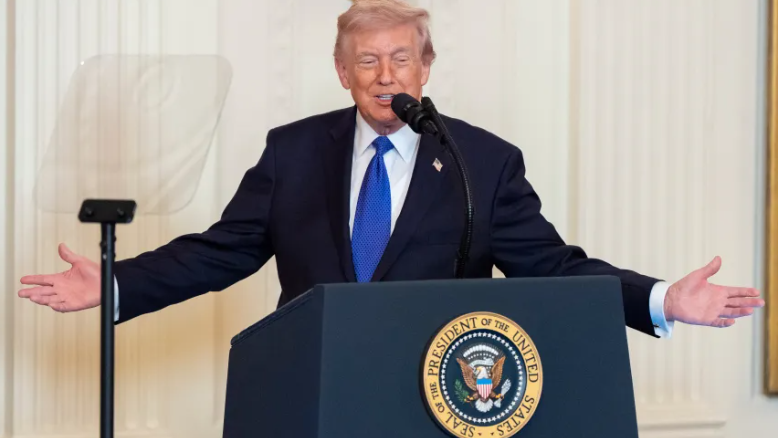


US President Donald Trump spoke about the Iran war and the US military campaign in Iran during a press conference in Doral, Florida. His message appeared confusing. He tried to reassure allies and global markets as tensions from the Iran war pushed oil prices above $100 a barrel. However, Trump did not clearly explain how long the war would continue. He also did not state the final goal of the campaign.
Trump Claims Victory but Signals the Iran War Will Continue
During a 35-minute press conference, US President Donald Trump repeatedly highlighted what he described as the success of American military operations in the Iran war. He said US forces had already caused serious damage to Iran’s military capabilities and achieved major results. “We could call it a tremendous success right now,” Trump said. “But we could also go further. And we’re going to go further.”
Earlier in the day, Trump suggested in a phone call with a CBS News reporter that the conflict might be nearly finished. He described the Iran war as “very complete, pretty much.” However, when journalists asked whether the fighting could end within days, he avoided a clear timeline. “No, but soon,” he said. “I think soon. Very soon.”
Iran IRGC says Strait of Hormuz passage open to states expelling US and Israeli envoys amid oil risk
The mixed signals created confusion among reporters and analysts. Some believed the United States might be preparing to scale back operations in the Iran war, but Trump later indicated the campaign would continue. He also said, “We have won in many ways, but we haven’t won enough,” suggesting the war is both successful and still unfinished.
Questions About the US Plan for Iran
Reporters repeatedly asked US President Donald Trump to explain the long-term plan for the Iran war. One journalist noted that Trump had described the war as nearly complete, while his defense secretary had recently said the campaign was only beginning. When asked to clarify, Trump responded, “I think you could say both.”
Trump then made another unexpected remark. He suggested the conflict could mark “the beginning of building a new country.” The comment surprised many observers because Trump and his advisers had earlier ruled out any plan for rebuilding or managing Iran after military operations related to the Iran war.
Trump downplays rising gas prices as US-Iran conflict disrupts oil markets globally
The idea of nation-building has been controversial in the United States for years. The debate became stronger after the Iraq War, when American forces stayed in Iraq long after the initial invasion to help rebuild the country.
Because of that history, Trump’s statement raised new questions about the administration’s plans. Analysts also noted that his description of US goals in the Iran war has changed several times during the conflict, sometimes suggesting the war could end soon and other times indicating it would continue.
Controversy Over Missile Strike Claim
Controversy emerged during the press conference when US President Donald Trump suggested that Iran may have secretly obtained a Tomahawk missile and used it in a deadly strike on a school in Minab. Trump said the attack killed more than 168 people, most of them children. His remarks quickly drew attention because the United States and its close allies primarily use Tomahawk missiles.
When reporters asked whether the United States could bear responsibility for the strike, Trump said that “Tomahawks are used by many countries” and suggested that Iran might have obtained some. The claim surprised many journalists and analysts because no widely known evidence shows that Iran possesses such missiles.
Reporters challenged the statement during the briefing. One journalist said Trump appeared to suggest that Iran had bombed its own school using a weapon that its military does not appear to have. The reporter also asked why Trump was the only official in his administration making that claim.
Trump later admitted that he did not have full details about the incident. He said someone had told him the matter was under investigation and that he did not yet know enough about it. The exchange highlighted uncertainty around the Iran war and raised fresh questions about the information the administration shared publicly.