
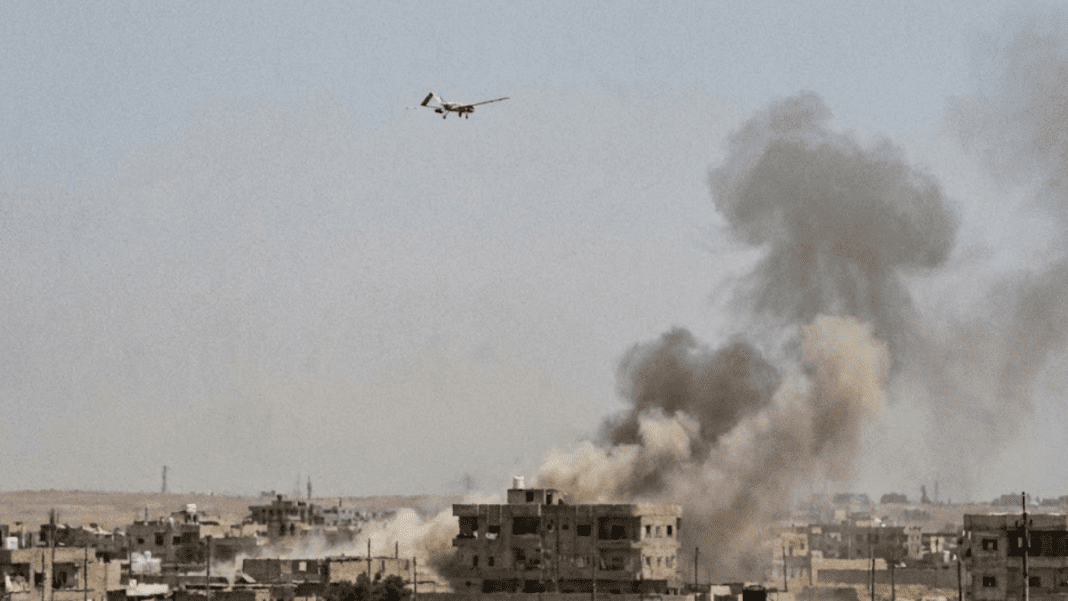

Dozens of people were killed in a drone attack on the town of Dilling in Sudan’s South Kordofan state. The Rapid Support Forces reportedly carried out the attack. It hit both civilian and military areas. These included a central market and an army base. Fear is rising in a region already suffering from violence, hunger, and displacement.
The strike came just one day after Sudan’s military said it had ended a long siege on Dilling. The siege lasted nearly two years. It cut residents off from food, medicine, and basic supplies. Instead of relief, the town now faces a new wave of violence.
Drone Strikes Hit Civilian Areas
Local media and medical workers reported that suicide drones struck multiple parts of the town almost at the same time. The attack targeted a military facility and also hit nearby civilian areas, including the central marketplace where people had gathered for daily activities.
Emergency responders confirmed that the attack killed dozens of people and injured many others. Hospitals and clinics, already facing severe shortages, quickly became overwhelmed. Health workers described a lack of basic medical supplies, including painkillers, antibiotics, and intravenous fluids, making it difficult to treat the wounded.
Sudan conflict sees drone attacks kill over 100 civilians in Kordofan, worsening humanitarian crisis
Residents described scenes of panic and confusion as explosions shook the town. Families fled their homes, and many searched desperately for missing relatives. The attack damaged several buildings, including facilities that provide water, electricity, and healthcare, further weakening the town’s ability to cope with the crisis.
This was not an isolated incident. Since the siege was lifted, repeated drone attacks have destroyed infrastructure in Dilling and caused civilian casualties. Military sources said the RSF appears to be trying to regain control of the area by disrupting supply routes and targeting key locations.
Dilling’s Strategic Importance
Dilling holds a critical position in South Kordofan, lying between Kadugli, the state capital, and El-Obeid, a major city in neighboring North Kordofan. Control of Dilling allows access to important roads used to transport food, fuel, and military supplies across the region.
For nearly two years, the RSF had surrounded the town, cutting it off from outside support. The Sudanese Armed Forces (SAF) recently announced they had reopened key routes and pushed RSF fighters back. However, the latest attacks suggest that control of the area remains contested.
Clashes are also continuing near the town of Habila in North Kordofan, where both sides are reportedly fighting for strategic ground. The SAF claims it continues to repel attacks, but the RSF’s use of drones signals a shift toward more remote and unpredictable warfare.
Japan moves to advance UAV program to support next-gen fighter jets amid safety push
The violence in South Kordofan is part of a wider civil war that began in April 2023 between the RSF and the SAF. Since then, fighting has spread across much of Sudan, including the capital, Khartoum, and the Darfur region. The conflict has killed thousands of people and shattered everyday life for millions more.
After losing control of Khartoum earlier this year, the RSF redirected its operations toward other regions, including Kordofan and the city of El-Fasher in North Darfur. El-Fasher had been the military’s last major stronghold in Darfur until it fell to the RSF in October. Reports from that area described mass killings, sexual violence, abductions, and widespread looting.
Growing Humanitarian Emergency
As fighting continues, humanitarian conditions in South Kordofan and surrounding areas are worsening. Local health networks and aid groups are calling for urgent humanitarian corridors to allow safe delivery of food, medicine, and medical equipment to civilians trapped in conflict zones.
In Dilling, shortages of food and medical supplies remain severe. Clinics are operating with limited staff and equipment, and many patients are unable to receive proper treatment. Hunger is widespread, and families are struggling to meet even their most basic needs.
Although Dilling has not been officially declared a famine zone, nearby Kadugli has been confirmed to be experiencing famine after more than a year and a half under siege. Aid organizations warn that similar conditions could spread if access to supplies remains blocked.
“Then it is war”: Musk explodes after Somali TikToker’s “About to Die” comment goes viral
worldwide
The conflict has forced massive displacement. More than 65,000 people have fled the Kordofan region since October alone, according to the latest United Nations data. Across Sudan, about 14 million people have been displaced, making this one of the largest humanitarian crises in the world.
Many people escaping violence have crossed into neighboring countries, especially Chad, which already hosts hundreds of thousands of Sudanese refugees. While they are safer from immediate fighting, many refugees face extreme hardship due to shortages of food, shelter, clean water, and healthcare. At the same time, funding for humanitarian aid has been decreasing, limiting the support available to those in need.