


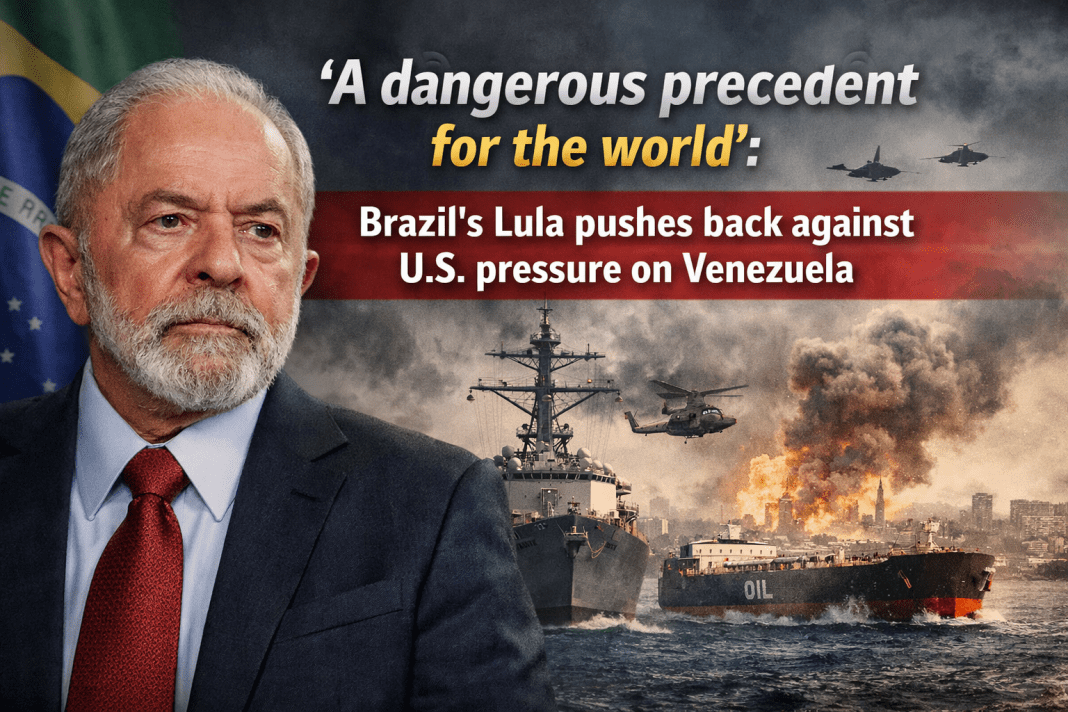


Brazilian President Luiz Inácio Lula da Silva has issued one of the strongest regional warnings yet against the prospect of U.S. military intervention in Venezuela, cautioning that any armed action would trigger a humanitarian catastrophe and destabilise South America. Speaking on Saturday amid rising tensions between Washington and Caracas, Lula framed the situation not merely as a bilateral dispute but as a broader geopolitical risk with global implications.
His remarks came days after U.S. President Donald Trump ordered a sweeping “blockade” of sanctioned oil tankers entering and leaving Venezuela, a move widely seen as an escalation in Washington’s pressure campaign against President Nicolás Maduro’s government. Venezuela’s oil sector remains the country’s economic lifeline, and the blockade directly targets its primary source of revenue. While the United States has portrayed the action as an enforcement of sanctions, regional leaders fear it could be a precursor to military confrontation.
Lula, addressing leaders at a Mercosur summit in Foz do Iguaçu, warned that intervention would establish a “dangerous precedent for the world.” His language underscored Brazil’s longstanding commitment to non-intervention and peaceful conflict resolution, principles that have shaped its foreign policy for decades. For Brasília, the spectre of external military action in Venezuela revives memories of Cold War-era interventions that left deep political and social scars across Latin America.
Lula Fires Back: “Trump Can’t Rule the World!” as 50% Tariff Threat Shakes Brazil-US Ties
U.S. Pressure on Venezuela and the Regional Response
The Trump administration’s decision to impose a blockade on sanctioned oil shipments marks a significant intensification of its strategy toward Venezuela. Washington has long accused Maduro’s government of democratic backsliding, corruption, and human rights abuses, using sanctions as a tool to force political change. However, critics argue that such measures have exacerbated Venezuela’s economic collapse, contributing to shortages of food, medicine, and fuel.
Latin America’s major economies have responded with visible unease. Lula and Mexican President Claudia Sheinbaum, whose countries represent the two largest economies in the region, jointly urged restraint earlier in the week as tensions escalated. Their intervention reflects a shared concern that punitive external actions, rather than weakening authoritarian governance, often worsen humanitarian conditions and entrench political stalemates.
At the Mercosur summit, Lula sharpened his criticism, warning that South America was once again being “haunted by the military presence of an extra-regional power.” His reference to the Falklands War more than four decades ago was deliberate. That conflict, between Argentina and Britain, remains a powerful symbol in the region of how external military involvement can redraw strategic realities and inflame nationalist sentiment.
The symbolism is particularly potent given Venezuela’s geographic proximity and existing instability. Any conflict would likely spill across borders, increasing refugee flows, disrupting trade routes, and straining fragile economies already grappling with inflation, debt, and social unrest. For Brazil, which shares a long and porous border with Venezuela, the risks are not abstract but immediate.
Mercosur and the Push for a Peaceful Path Forward
In a joint declaration following the summit, leaders from across Latin America reaffirmed their commitment to addressing Venezuela’s political crisis through peaceful and democratic means. The statement, endorsed by the presidents of Argentina, Paraguay, and Panama, as well as senior officials from Bolivia, Ecuador, and Peru, stressed the need to uphold democratic principles and human rights without resorting to force.
The declaration reflects an emerging regional consensus: while many governments remain critical of Maduro’s leadership, they reject military solutions imposed from outside the continent. Instead, they favour dialogue, mediation, and multilateral engagement as the only viable path toward long-term stability. This position also highlights Mercosur’s evolving role not just as an economic bloc, but as a political forum capable of articulating collective geopolitical positions.
Lula’s stance reinforces Brazil’s ambition to reassert itself as a diplomatic heavyweight in the Global South. By positioning Brazil as a mediator rather than a partisan actor, he seeks to balance criticism of Venezuela’s governance with resistance to coercive external measures. This approach aligns with Brasília’s broader foreign policy strategy of advocating multipolarity and resisting what it views as unilateral actions by major powers.
As global attention remains fixed on conflicts in Europe and the Middle East, Latin American leaders appear determined to prevent their region from becoming the next theatre of confrontation. Lula’s warning serves as both a caution to Washington and a rallying call for regional unity. Whether this diplomatic push can temper U.S. actions remains uncertain, but it underscores a clear message from South America: intervention risks igniting consequences far beyond Venezuela’s borders.