


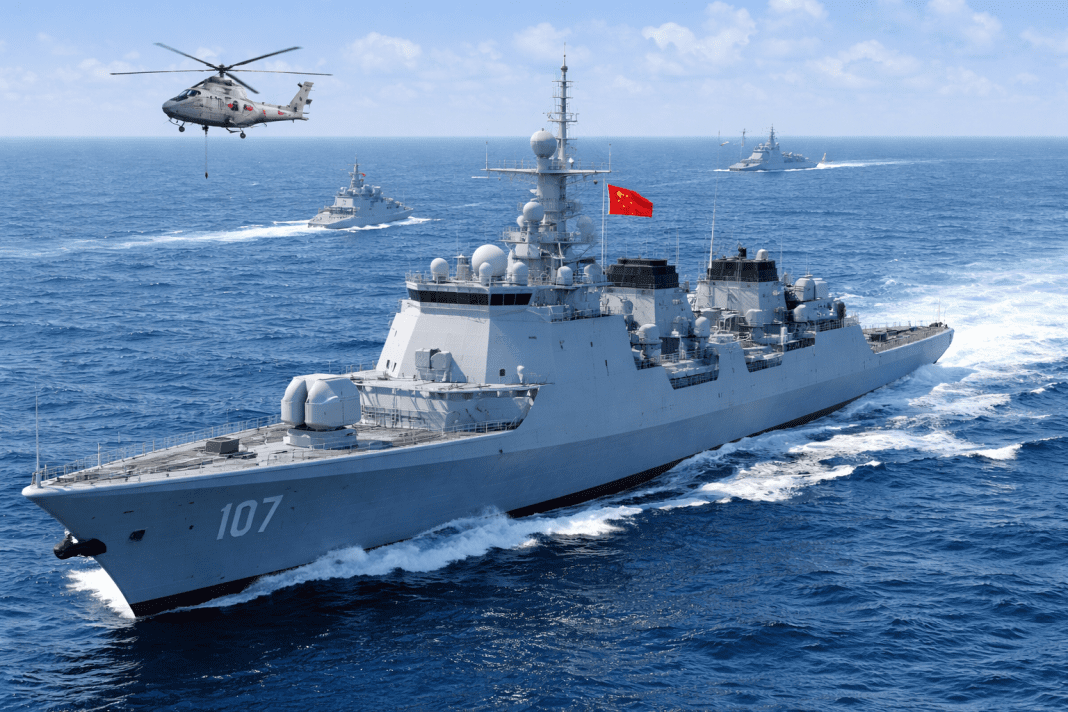


China has recently demonstrated the growing strength of its naval fleet. It showcased advanced anti-submarine capabilities in the contested waters of the South China Sea. The massive Type 055 destroyer, named Zunyi, took part in a rigorous training exercise. The drill highlighted its ability to detect, track, and respond to submarines. This signals a significant expansion of its combat roles.
The Zunyi is not just any ship. It weighs around 11,000 tons and is one of the largest and most powerful destroyers in the Chinese Navy. Its enormous size allows it to carry a wide array of high-tech equipment. This includes advanced sonar systems. The ship has both bow-mounted sonar at the front and towed sonar that trails behind. These systems give the Zunyi a far-reaching and highly accurate ability to detect underwater threats.
Type 055 Destroyer: Advanced Technology Meets Real-Life Training
During the exercise, the Zunyi was tasked with reconnaissance and early warning duties in a scenario simulating a confrontation with a submarine. The ship successfully identified submarine targets and shared real-time information with other ships in the group. This ability to operate as part of a networked fleet increases the speed and efficiency of response, allowing the entire task group to react quickly to potential threats.
From smartphones to EVs, G7 targets China dependence in critical minerals strategy
The Zunyi can also carry two anti-submarine helicopters. These helicopters extend the ship’s surveillance range even further and allow it to act faster when a submarine is detected. The South China Sea, known for its complex underwater conditions and frequent submarine activity, was chosen as the location for this drill to make the exercise more realistic and challenging.
The ship’s crew has spent over 200 days at sea in the past year, covering more than 50,000 nautical miles. Such extensive time at sea has allowed the crew to gain hands-on experience, refine combat tactics, and practice coordinating their advanced systems under real conditions.
From Air Defense to Underwater Dominance
While the Type 055 destroyers were originally designed mainly for air defense and surface combat, their anti-submarine capabilities are now becoming a central focus. The Zunyi’s advanced systems, combined with thorough training, detailed planning, and careful post-exercise evaluations, have strengthened its ability to operate against underwater threats.
China warns Europe not to admit Taiwanese politicians, citing diplomatic ‘red lines’
Reports from the exercises highlight how crew members are trained to understand every single system onboard in detail. By mastering these individual components and connecting them into a larger network, the ship can transform complex technology into actionable combat effectiveness. This level of preparation ensures that the Zunyi can contribute to a comprehensive battlefield awareness system for the fleet.
In the exercise, the destroyer not only identified submarine positions but also transmitted large amounts of data back to other ships in real time. This allowed for coordinated operations, giving commanders a clear picture of the battlefield. The combination of high-tech sonar, helicopters, and real-time information sharing demonstrates how the Type 055 destroyer can operate effectively in modern naval warfare scenarios.
Continuous Training Strengthens Fleet Readiness
The Zunyi has taken part in a variety of challenging operations over the past year. The ship has participated in aircraft carrier formation drills. It has also conducted long-distance patrols and realistic combat exercises. The Zunyi has been at the forefront of testing new operational tactics. Each deployment has allowed the crew to solve technical and tactical challenges. Lessons learned are transformed into practical skills for future missions.
While the world watches wars, China quietly rewrites the rules of global power
The exercises also highlight the importance of integrating multiple systems into a single operational network. By linking sonar data, helicopter surveillance, and real-time communication, the Zunyi creates broad situational awareness. This allows the fleet to respond quickly and accurately to potential threats. This integrated approach shows how modern naval forces rely on both technology and skilled personnel to stay effective at sea.
Through frequent drills and extensive sea time, the Zunyi has demonstrated the evolution of China’s naval capabilities. Its focus on anti-submarine warfare has grown stronger. Exercises in the South China Sea highlight the increasing sophistication of China’s fleet. They also show the Type 055 destroyer’s role has expanded beyond traditional air defense.