


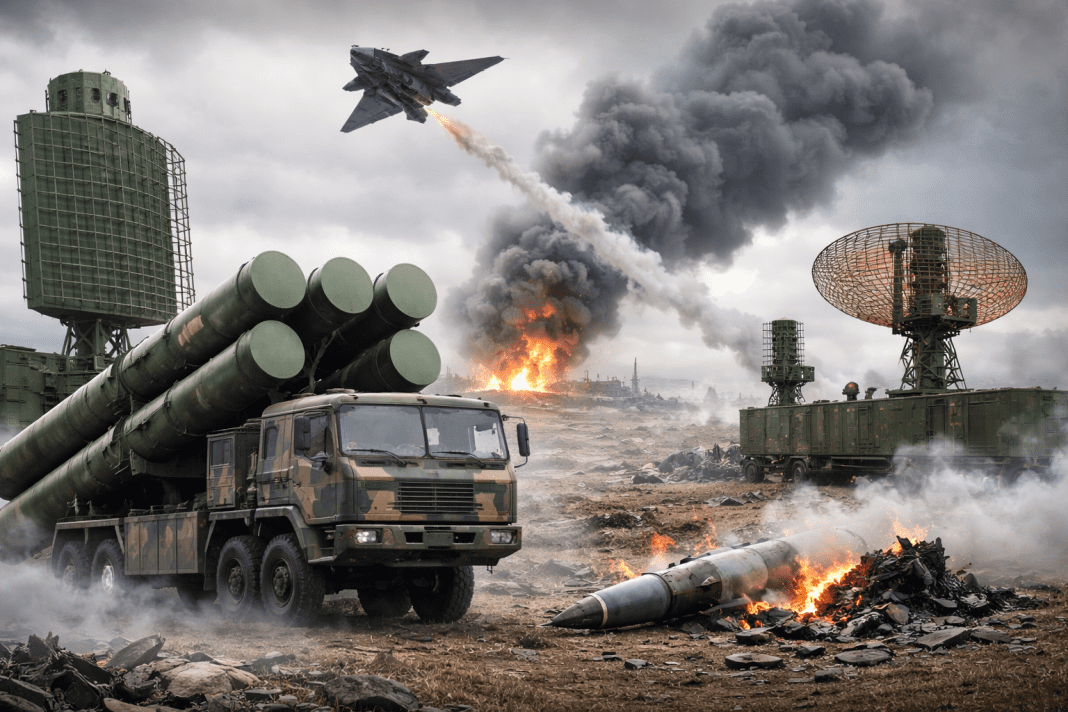


China-made weapons were long promoted as affordable alternatives to Western military systems, offering advanced capabilities at lower costs. Many countries invested heavily in these systems to strengthen defenses without the high price tag of American or European technology. However, recent real-world operations have raised serious doubts about the effectiveness of China-made weapons in actual combat.
Across multiple regions, air defenses failed to detect incoming threats, radar systems struggled against electronic interference, and missile batteries were unable to respond in time. These repeated incidents have sparked growing concerns over possible technical flaws in China-made weapons and their reliability on the battlefield.
Operation Sindoor exposes Pakistan’s China-made weapons defense network
In May 2025, India launched Operation Sindoor following a deadly terror attack that killed civilians. The operation targeted selected military bases and terror infrastructure in Pakistan without crossing the Line of Control. Lasting just 23 minutes, the strikes demonstrated precise coordination between missiles, surveillance systems, and electronic warfare tools. Supersonic cruise missiles flying at extremely low altitudes evaded detection, striking key targets with speed and accuracy.
Pakistan relies heavily on China-made weapons, including YLC-8E anti-stealth radars and HQ-9 surface-to-air missile batteries, marketed as capable of detecting advanced aircraft and resisting electronic jamming. Yet, during Operation Sindoor, these China-made weapons reportedly failed to respond effectively. Electronic warfare measures disrupted radar signals, allowing incoming missiles to hit targets undetected.
Attempts to counterattack with armed drones were also unsuccessful, as multiple drones were intercepted mid-air. Analysts examining the aftermath noted software delays, poor anti-jamming resilience, and weak coordination between radar and missile systems, highlighting critical shortcomings in these exported China-made weapons.
Venezuela raid reveals radar gaps and maintenance issues
Months later, a high-risk military operation in Caracas exposed further weaknesses in China-made weapons. During a covert extraction mission, foreign forces penetrated Venezuelan airspace and successfully retrieved high-value targets without triggering an effective response from the local defense network.
Venezuela had invested billions in layered air defense systems, including China-made weapons such as JY-27A anti-stealth radars and HQ-series missile systems. Despite the extensive network, reports revealed that radar units failed to register incoming aircraft. Electronic warfare measures disrupted radar frequencies, preventing proper tracking. Missile batteries remained idle as targeting systems could not engage intruders effectively.
Washington raises alarm over suspected 2020 nuclear explosion at China’s Lop Nur site
Investigations showed that many radar units were offline even before the operation due to maintenance shortages, limited spare parts, and insufficient technical support. Environmental challenges like corrosion, power fluctuations, and aging infrastructure further degraded sensitive electronics.
Recovered components revealed slow processing speeds in fire-control software, delaying system reactions. Analysts concluded that both technological design limitations and inadequate long-term support contributed to these failures, leaving China-made weapons vulnerable under real combat conditions.
Iranian strikes highlight electronic warfare vulnerabilities
More recently, airstrikes against Iranian military facilities have intensified scrutiny of China-made weapons. Iran had deployed HQ-9B platforms after earlier defenses struggled to counter stealth aircraft. These systems were promoted as capable of long-range interception with advanced radar guidance. However, during coordinated strikes involving stealth aircraft and low-flying cruise missiles, the defenses reportedly failed to intercept incoming threats.
Electronic jamming played a critical role in this failure. Wide-band interference disrupted radar tracking, creating coverage gaps that allowed stealth aircraft to approach closer than expected. Missiles exploiting blind spots caused by fixed radar positions further compromised defense effectiveness. Coordination issues between radars, command centers, and missile batteries slowed the network’s response compared to modern integrated air defense systems used elsewhere.
Pakistan dumps Chinese J-35 jet after U.S. pressure and India war setback
Recovered fragments revealed weaknesses in anti-jamming protection and inconsistencies in rocket components. Similar technical issues had previously appeared in Pakistan and Venezuela, where China-made weapons struggled with electronic warfare resistance and operational readiness. Across these incidents, a clear pattern emerges: radar and missile systems perform poorly under real combat conditions, and maintenance, training, and integration challenges exacerbate vulnerabilities.
China remains one of the world’s largest arms exporters, supplying affordable systems to countries seeking alternatives to Western technology. Yet these repeated failures in Pakistan, Venezuela, and Iran have highlighted a persistent gap between advertised capabilities and real-world performance. China-made weapons, once promoted as reliable and advanced, are increasingly exposed to scrutiny as electronic warfare, software flaws, and operational challenges reveal critical weaknesses in active combat scenarios.